
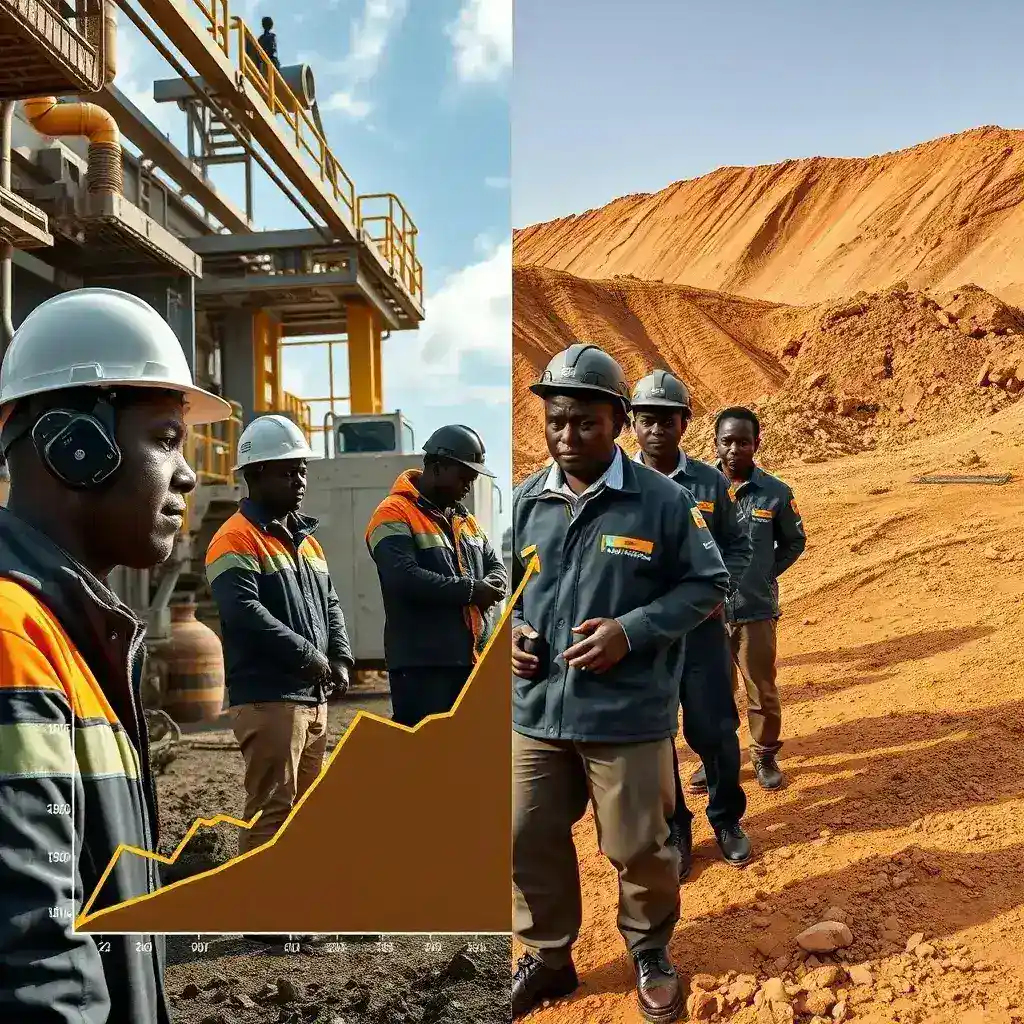
Ghana’s mining tax structure has reached a critical point, potentially driving away investors to competing West African nations, according to Ken Ashigbey, Chief Executive Officer of the Ghana Chamber of Mines. Speaking on Thursday, Mr. Ashigbey highlighted that Ghana is nearing the upper limits of acceptable profit-sharing between governments and mining investors as defined by the International Monetary Fund (IMF).
IMF’s Profit-Sharing Benchmark
The IMF employs a model that suggests a fair distribution of mining profits, after costs and other deductions, should fall between 40% and a maximum of 60% for the government. Mr. Ashigbey stated that Ghana is currently operating at this dangerous upper threshold.
This situation becomes particularly precarious for mines extracting lower-grade ore, which inherently incur higher production costs. Mr. Ashigbey cautioned that if gold prices decline, the government’s share could exceed 60%, rendering Ghana an unattractive destination for new and existing mining investments.
Investor Flight and Shifting Investments
“If you are an investor, and the government is going to take above 60, and you have an Ivory Coast, you have other countries that were going to take less, definitely you are going to find out that you’re going to get some of your investments moved out,” Mr. Ashigbey explained.
He revealed that this trend is not merely hypothetical, citing a specific instance where a mining firm, intending to reinvest funds from a South Sudan property sale into Ghana, redirected the capital to Côte d’Ivoire due to an unwelcoming fiscal regime, especially concerning royalty rates.
Impact of Royalty Changes
The recent adjustment in the royalty rate, increasing it from 5% to 12%, has significantly escalated operational expenses for mining companies in Ghana. This change directly adds to the cost of production, diminishing profitability and investor appeal.
Competition Intensifies in West Africa
Ghana’s historical advantages in attracting mining investment are now under threat as neighboring countries actively enhance their own investment climates. Côte d’Ivoire, for example, has openly stated its ambition to surpass Ghana as Africa’s leading gold producer within the next decade.
Mr. Ashigbey pointed to significant discoveries in Côte d’Ivoire, such as the find by Endeavour Mining, a major player that has reportedly shifted its focus from Ghana to its Ivorian operations. The growing mining activities in Guinea also present a challenge, indicating that Ghana can no longer assume automatic investor preference.
“The geology is not restricted to Ghana,” Mr. Ashigbey remarked. “Other countries are also beginning to become stable.” This underscores the need for Ghana to remain competitive on multiple fronts, not just geological potential.
Call for Fiscal Regime Reconsideration
Despite the recent legislative changes to the fiscal regime, Mr. Ashigbey urged the government to revisit and potentially revise certain aspects. Failing to make urgent adjustments risks eroding Ghana’s competitive edge in the global mining sector.
The sustainability of Ghana’s mining sector hinges on its ability to balance government revenue needs with the imperative of attracting and retaining foreign direct investment. As other nations vie for capital, Ghana faces a critical juncture where policy adjustments are necessary to maintain its position as a leading mining destination.










Leave a Reply