
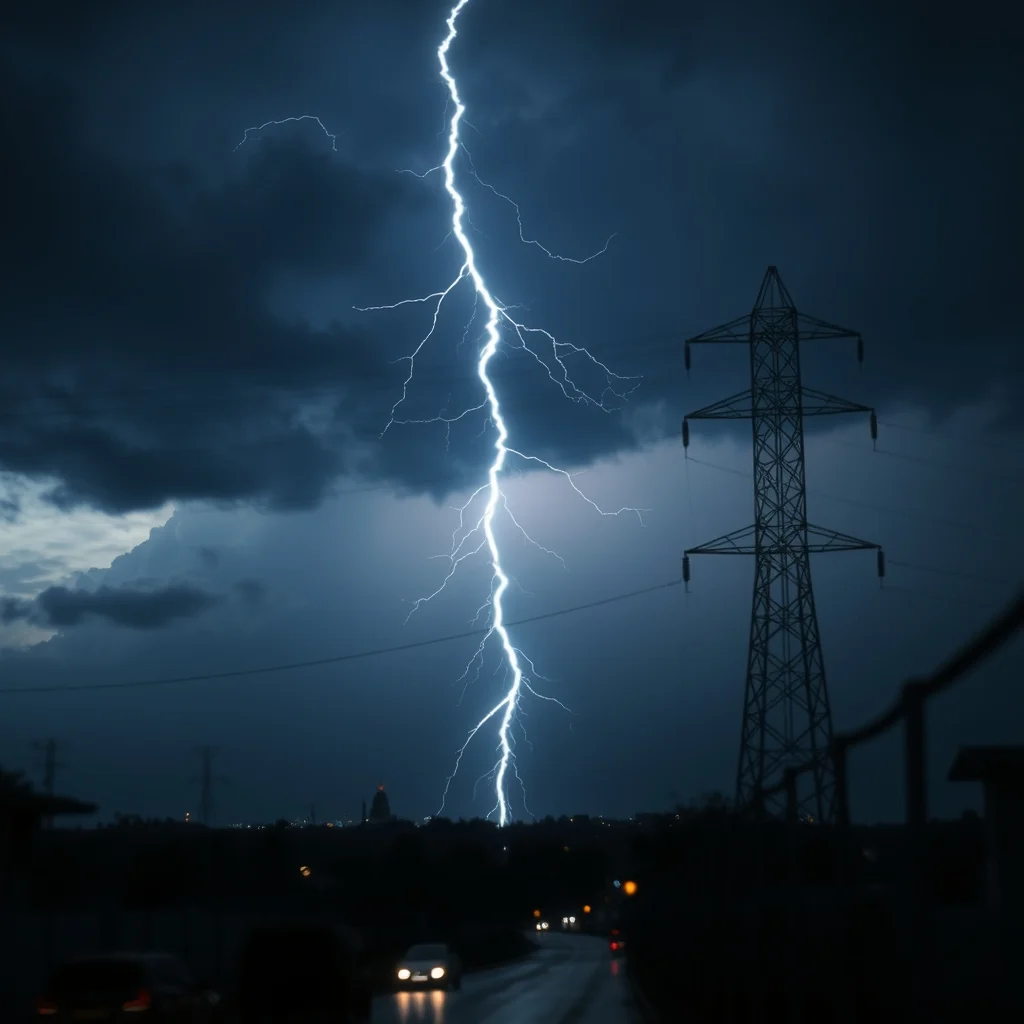
Accra, Ghana – Parts of Ghana are once again experiencing widespread electricity outages, commonly referred to as “light off,” attributed by authorities to natural causes such as rainfall, storms, and bushfires. This recurring issue, occurring during predictable seasonal events, raises critical questions about the resilience of the nation’s power infrastructure and its impact on economic competitiveness.
The Unacceptable Normalization of Outages
Electricity is no longer a luxury but the fundamental operating system for modern life, essential for hospitals, schools, factories, and the digital economy. For a nation striving for industrialization and a 24-hour economy, reliable power is a crucial economic competitiveness issue.
The recurring explanations for outages—rainfall, storms, bushfires, fallen trees, damaged poles, or technical faults—while factually possible, necessitate a deeper national conversation. The core issue is not whether these events can damage infrastructure, but whether a robust power system should repeatedly collapse under predictable, seasonal risks.
Ghana experiences rainfall and Harmattan conditions annually, and bushfires are a known seasonal hazard. Coastal corrosion, vegetation interference, flooding, lightning strikes, overloaded transformers, and pole deterioration are all recognized, measurable, and therefore manageable risks.
Defining and Achieving Grid Resilience
A truly resilient power system is not one that never experiences faults, which is an unrealistic expectation. Instead, resilience is defined by the system’s ability to anticipate disruption, absorb shocks, isolate faults rapidly, restore supply quickly, and learn from each incident.
Resilience means preventing a local fault from escalating into a community-wide outage, a feeder problem from becoming a regional disturbance, or a weather event from triggering an economic shock. By this standard, Ghana must critically assess whether its electricity network is planned, financed, operated, and regulated as essential national infrastructure or merely as a basic utility that reacts post-event.
While Ghana has made strides in generation capacity, transmission expansion, and customer connectivity, the resilience of its power system, particularly the distribution network, remains insufficient for a modern economy. The grid is often too reactive, manually operated, exposed to environmental risks, lacks real-time visibility, and is slow in fault isolation and restoration. Significant investments have been made in power generation, but not enough in creating an intelligent, self-monitoring, climate-resilient, and commercially accountable network.
Shifting Focus from Generation to Distribution
For years, national discussions have heavily centered on generation capacity, power purchase agreements, fuel supply, and tariffs. While these are vital, consumers experience electricity at the meter, transformer, and feeder—the “last mile.” A weak distribution network renders even ample generation capacity ineffective.
A country can possess sufficient generation and strong transmission assets yet still suffer from unreliable service if the distribution network is not modernized. Reliability is achieved through the integration of engineering, technology, finance, regulation, and operational discipline.
Ghana must transition from asking, “Do we have enough power?” to a more pertinent question: “Can the power system deliver electricity safely, reliably, efficiently, and continuously under stress?”
Environmental Triggers Expose Systemic Weaknesses
Storms reveal the true condition of a grid, highlighting weak poles, inadequate vegetation management, overloaded transformers, vulnerable conductors, poor protection coordination, inadequate substation drainage, slow restoration systems, limited redundancy, and insufficient field logistics. Bushfires expose poor right-of-way management and lack of surveillance.
Rainfall can expose poorly insulated equipment, vulnerable underground cables, weak earthing, inadequate asset records, and insufficient preventive maintenance. In a resilient system, these risks are mapped and mitigated proactively. In a weak system, they become post-outage explanations.
Ghana must cease normalizing preventable outages as mere acts of nature. While weather may trigger a fault, systemic weakness dictates the scale of disruption. A storm might damage one component, but poor planning allows that single failure to impact thousands. Lack of surveillance and control measures can turn a fire threat into a prolonged blackout.
The Overwhelming Case for Technology Investment
Underinvestment, rather than nature, is often the root cause of prolonged outages. The case for technological investment is therefore compelling. Ghana needs technology not for prestige, but because manual grid management is inadequate for a complex, growing, and climate-exposed electricity system.
First, the full deployment of modern Supervisory Control and Data Acquisition (SCADA), Distribution Management Systems (DMS), and Outage Management Systems (OMS) across transmission and distribution networks is crucial. Real-time visibility of substations, feeders, transformers, and customer outage clusters is fundamental for effective fault management and restoration.
Second, accelerating distribution automation with intelligent reclosers, sectionalizers, fault passage indicators, and automated switches will enable rapid isolation of faulty sections and quick restoration of healthy ones. This contrasts sharply with manual fault finding, which can leave large communities in darkness for extended periods.
Third, investing in Advanced Metering Infrastructure (AMI) and intelligent prepaid meters will not only improve revenue collection but also provide vital data for outage alerts, voltage quality monitoring, and feeder performance intelligence, transforming meters into network sensors.
Fourth, building a geospatially mapped electricity network is essential. A digital asset register detailing every component, its location, age, and condition is critical for efficient operations and restoration. Incomplete or outdated asset records frequently cause significant delays.
Fifth, adopting predictive maintenance using thermal imaging, drone inspections, AI, and sensor data can anticipate failures before they occur, proving more cost-effective than emergency repairs and economic disruption.
Sixth, vegetation and right-of-way management must be treated as a core reliability program. A disciplined clearance regime, supported by modern technology and community engagement, is vital to prevent common storm-related outages.
Seventh, selective undergrounding of critical lines in high-density business districts, government centers, and strategic corridors can significantly enhance resilience, though it is an expensive solution not suitable for universal application.
Eighth, implementing microgrids and distributed energy resources for critical infrastructure like hospitals, water systems, and data centers provides essential backup during grid instability, acting as an insurance policy for the economy.
Ninth, establishing climate-resilience standards for infrastructure design, considering current and future climate risks such as wind loading, flooding, and lightning, is imperative. Ghana cannot design for yesterday’s weather while experiencing tomorrow’s storms.
Tenth, robust emergency response logistics, including strategically located spare equipment, rapid-response teams, and mobile substations, are necessary to minimize restoration times to hours, not days.
The Cost of Inaction and the Path Forward
While the investment in grid resilience is substantial, the cost of inaction is far greater. Every outage incurs economic losses through reduced productivity, damaged appliances, disrupted services, and weakened investor confidence. Unreliable power acts as a hidden tax, increasing production costs and undermining industrial policy.
Investment must be disciplined, guided by an integrated grid-modernization roadmap with clear priorities, transparent procurement, and performance benchmarks. A national power-system resilience audit is the crucial first step to identify vulnerabilities and prioritize investments.
A ring-fenced resilience investment program, potentially using blended financing models including climate finance and green bonds, should be established. Performance-based regulation, linking utility rewards to measurable reliability improvements, is essential.
Furthermore, accountability in outage communication, providing customers with timely and accurate information, is vital for building trust. Institutional coordination among various government agencies and effective community involvement are also key components of a resilient system.
The financial sustainability of utilities is intrinsically linked to grid resilience. Persistent revenue under-recovery and high losses hinder investment capacity. Conversely, improved reliability can enhance revenue collection, creating a virtuous cycle.
Ghana must build a modern electricity system on four pillars: physical hardening, digital intelligence, financial sustainability, and regulatory accountability. These pillars must advance in tandem. The time has come for Ghana to deliberately invest in a smarter, stronger, and more resilient power system, moving beyond the “light off” narrative to one of reliable and continuous power delivery.







Leave a Reply