
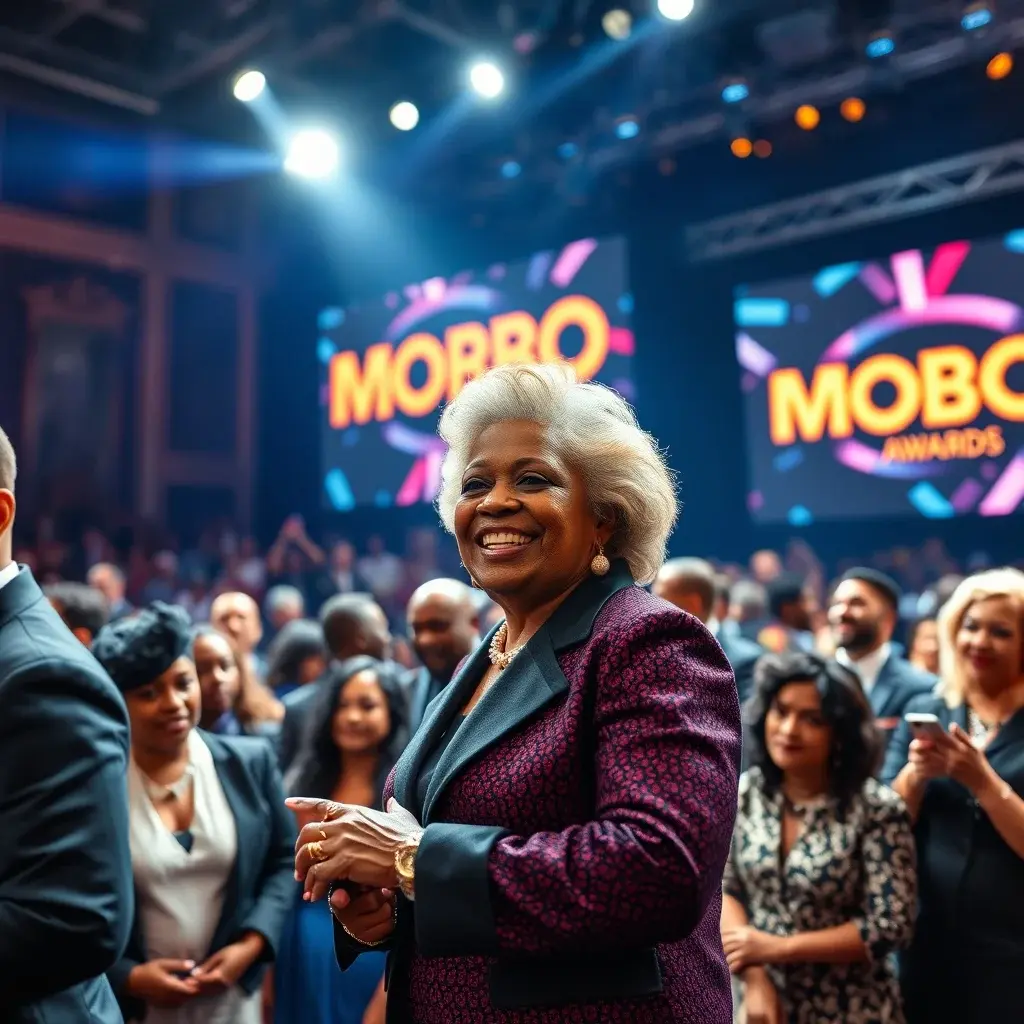
Kanya King CBE, the visionary founder of the MOBO Awards, has died at the age of 57 after a battle with colon cancer. King passed away on Wednesday, leaving behind a profound legacy of championing black musicians and fundamentally reshaping Britain’s cultural landscape. Her death was announced by the MOBO Organisation, prompting widespread tributes from artists, industry figures, and public officials who lauded her as a pioneer who “changed the face of culture and music.”
A Trailblazer for Black Music
King’s journey began with a fierce determination to create a platform for artists of black origin, whose contributions were largely overlooked by mainstream awards ceremonies. In 1996, she self-funded the inaugural MOBO (Music of Black Origin) Awards, a bold move that defied industry expectations and established a vital space for recognition and celebration.
From its humble beginnings, the MOBO Awards grew into a globally renowned event, consistently spotlighting emerging talent and pushing the boundaries of the music industry. The awards have been instrumental in launching the careers of countless artists and providing a crucial stage for genres like UK garage, grime, R&B, and Afrobeats.
Overcoming Adversity
King’s path was far from easy. As a teenage mother who left school early, she faced significant obstacles entering the male-dominated music industry. She recalled facing skepticism and being told to focus on less ambitious roles.
“I remember being told, ‘You’ve got a chip on your shoulder, why are you talking about race all the time?'” King shared in a 2021 interview with Music Week. Despite these challenges, her persistence and unwavering belief in her vision led to the MOBO Awards becoming a prominent fixture, eventually standing alongside established events like the Brit Awards.
Her upbringing in a crowded council flat in Kilburn fueled her passion for change and entrepreneurial spirit. King often spoke about feeling underestimated after becoming a mother at 16, a sentiment that ignited her ambition to prove her capabilities.
The Genesis of MOBO Magic
King’s stated aim for the MOBOs was to bridge what she described as the “real music divide,” where hip-hop and R&B were largely ignored by existing award shows. The early days were marked by significant rejection, with King famously running the organization from her bedroom.
“Rejection became normalised,” she told Music Week. “People didn’t want to take my calls.” However, through sheer tenacity, she secured support from key figures in the black music industry, enabling the first ceremony to take place in London. The event gained immediate attention, notably with the attendance of Tony and Cherie Blair, and featured early accolades for legends like Lionel Richie and Tina Turner.
The MOBOs quickly became a star-studded affair, hosting both British stars like Stormzy and Amy Winehouse, and international icons such as Beyoncé, Usher, and Rihanna. The awards were intentionally inclusive, celebrating “music of black origin” rather than focusing on artists’ race, as King explained in a 2001 BBC interview: “We’ve always said it’s about the music… an event that celebrates music of black origin doesn’t seek to separate artists according to skin colour.”
Navigating Controversy and Hiatus
As the MOBOs gained mainstream traction, they also faced scrutiny. Negative press, including a false implication of violence at an after-party in 2002, led to sponsors withdrawing, forcing King to remortgage her home to keep the awards afloat. The ceremony also faced criticism for awarding white artists, a debate that resurfaced when Sam Smith won multiple awards in 2014.
The MOBO Awards moved locations annually from 2009 onwards. Following a gap year in 2017, which extended to 2020, the absence of the awards was noted by critics during a significant period for British grime artists. King later clarified the hiatus was a strategic pause to reassess the MOBOs’ relevance, concluding that their mission remained vital.
Expanding Influence and Final Years
The MOBO Awards returned with a revamped focus, supporting emerging talent not only in music but also in film, television, and other arts. King, who received a CBE in 2018 for her cultural contributions, also launched Mobolise to address the “scary underrepresentation of black talent” across various industries.
Her influence extended to advisory roles on bodies like the Creative Industries Council and the UK Music Diversity Task Force. In 2020, she penned an open letter to the Culture Secretary reflecting on her experiences with systemic racism and demanding action.
In December 2024, King announced her stage four bowel cancer diagnosis on Instagram, coinciding with receiving a lifetime achievement award. She expressed a determination to find meaning through adversity and hoped her story could save lives. Her last public appearance was at the 2024 MOBO Awards in Manchester, where Pharrell Williams paid tribute to her resilience and passion for her work.
A Lasting Cultural Impact
Tributes poured in following the announcement of her death. TV host Alesha Dixon described King as an “incredible woman” whose impact was “immeasurable.” Sir Idris Elba called her a source of inspiration whose dedication was “unmatched.” JLS star Oritsé Williams recognized her as a “pioneer” who “created belief” in black culture and potential, stating, “Your impact will be felt for generations to come.” London Mayor Sadiq Khan and Culture Secretary Lisa Nandy echoed sentiments of her being a “true pioneer” who “changed British music for the better.”
King’s family released a statement describing her courageous battle with illness and her refusal “to be diminished.” They highlighted her role in giving “an entire generation of black British artists the right to be seen, to be celebrated, and to be heard on their own terms.” They concluded, “Kanya leaves behind 30 years of music of joy, of resistance, of proof – proof that one woman, with vision, nerve, and love, can move an entire culture.”
The enduring legacy of Kanya King and the MOBO Awards continues to shape the cultural conversation, highlighting the ongoing need for platforms that champion diversity and representation in the arts. As the industry reflects on her monumental contributions, attention turns to how her pioneering spirit will influence future initiatives aimed at fostering inclusivity and celebrating talent from all backgrounds.




Leave a Reply