
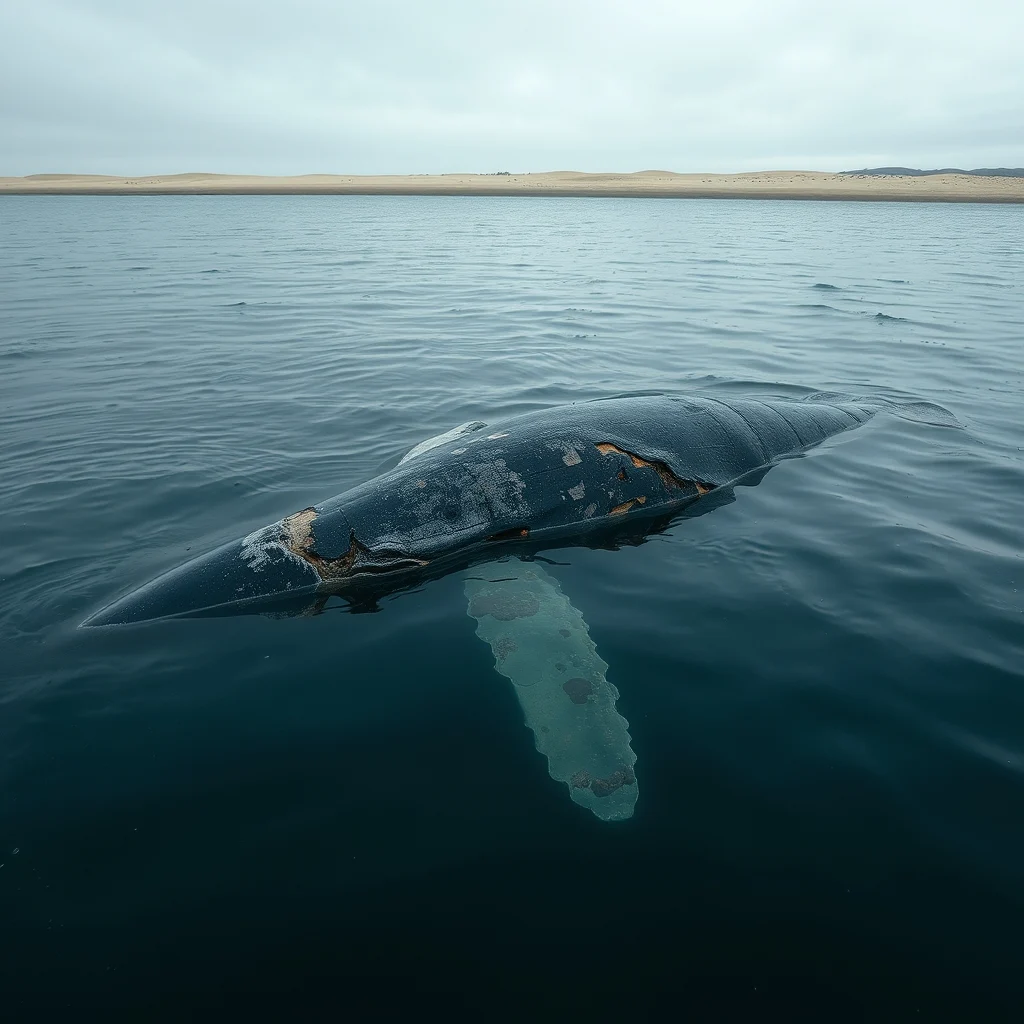
A humpback whale, previously the subject of a privately funded rescue operation in Germany, has been found dead near the Danish island of Anholt. The whale, nicknamed “Timmy” or “Hope,” was first discovered stranded on a sandbank off the German Baltic coast in late March and was eventually transported to the North Sea in early May.
Background of the Rescue Operation
The whale’s ordeal began on March 23 when it became stranded on Timmendorfer Beach in Lübeck Bay. Initial attempts by German authorities to rescue the animal were unsuccessful, leading them to abandon the effort. This prompted two German entrepreneurs to fund a private operation aimed at saving the whale.
The private rescue involved fitting the whale with a tracking device and carefully coaxing it onto a specially designed water-filled barge named Fortuna B. This barge then transported the weakened animal into the North Sea, a move hailed by some as a success and an example of private initiative. Till Backhaus, the environment minister for the state of Mecklenburg-Vorpommern, publicly praised the operation.
Criticism and Skepticism
However, the rescue operation was not without its critics. Wildlife organizations expressed significant skepticism regarding the whale’s chances of survival and the ethical implications of the intervention. The German Oceanographic Museum warned that the whale’s weakened state made it susceptible to drowning, even after its release.
Organizations like Whale and Dolphin Conservation voiced particular concern, stating that the whale had a “no long-term chance of survival.” They pointed to potential skin damage caused by prolonged exposure to the less saline waters of the German Baltic Sea coast, suggesting this would hinder its ability to recover and thrive.
Discovery and Official Response
The discovery of a whale carcass off the Danish island of Anholt on Thursday raised immediate questions about its identity. Authorities in Denmark are working to confirm if it is indeed the same humpback whale that underwent the extensive rescue in Germany. The Danish Environmental Protection Agency stated that conditions on Saturday would allow for verification and the retrieval of the whale’s tracking device.
While the Danish agency has not confirmed the identity, they have issued a public safety warning. Citizens are advised not to approach the carcass due to potential disease transmission risks to humans. There is also a noted risk of explosion from internal gases produced during decomposition, a common phenomenon in deceased marine mammals.
Implications and Future Considerations
The Danish Environmental Protection Agency has indicated that there are no immediate plans to remove the whale carcass or perform a necropsy, as it is not currently considered a hazard in its location. This case highlights the complex challenges and ethical debates surrounding marine animal rescues. It raises questions about the effectiveness of large-scale interventions for stranded cetaceans and the potential for causing further distress to already vulnerable animals.
The outcome of this rescue will likely fuel further discussion among conservationists, scientists, and the public about when and how to intervene in such situations. The successful identification of the whale and the data from its tracking device could provide valuable insights into the post-rescue movements and ultimate fate of stranded marine mammals, informing future conservation strategies and rescue protocols.










Leave a Reply