
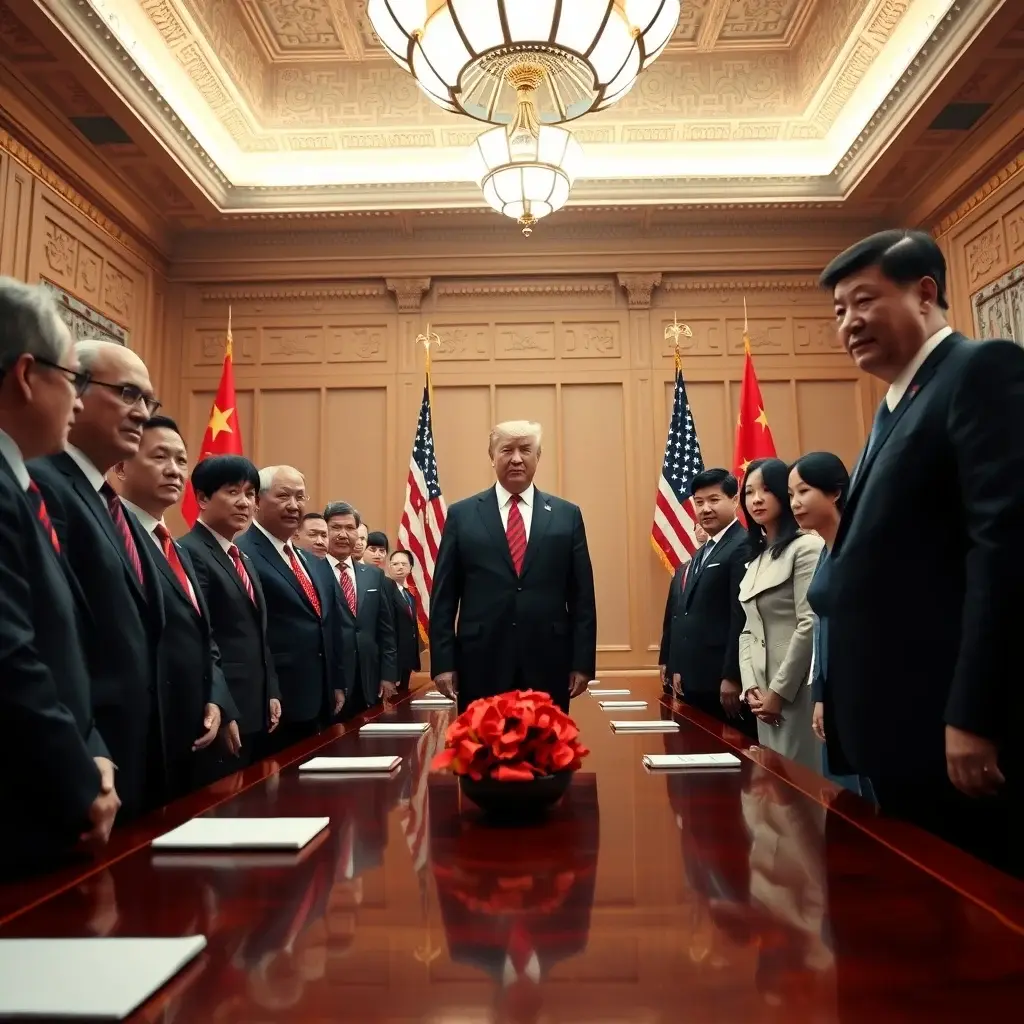
President Donald Trump is embarking on a crucial state visit to China this week, accompanied by a delegation of 17 top American business leaders, including titans of the tech and finance industries such as Tim Cook of Apple and Elon Musk of Tesla. The trip, beginning [Insert Date] in Beijing, aims to navigate escalating economic and technological tensions between the two global powers.
A High-Profile Delegation
The roster of executives joining President Trump underscores the significant role the business community plays in shaping US-China relations. Beyond Cook and Musk, the delegation includes Larry Fink, CEO of BlackRock; representatives from Meta, Visa, JP Morgan, Boeing, and Cargill, among others. This high-profile assembly signals a strategic effort to leverage corporate influence in delicate trade negotiations.
The White House, through an official familiar with the plans, confirmed the composition of the business delegation. The presence of such prominent figures suggests a focus on key sectors like technology, finance, and manufacturing, areas central to the ongoing trade discussions.
Navigating Economic Animosity
This visit occurs against a backdrop of intensifying trade friction and technological rivalry between the United States and China. Both nations have imposed tariffs and are engaged in a battle for dominance in critical technologies, including artificial intelligence, semiconductors, and 5G networks.
President Trump’s meeting with Chinese President Xi Jinping is anticipated to address these complex issues. The inclusion of CEOs from companies heavily invested in or reliant on the Chinese market highlights the administration’s intent to foster dialogue and potentially secure favorable trade conditions.
Industry Stakes in China
For companies like Apple and Tesla, China represents a massive market and a critical part of their global supply chains. Tim Cook’s presence is particularly noteworthy, given Apple’s significant manufacturing operations in China and the growing competition it faces from local brands.
Similarly, Elon Musk’s Tesla relies heavily on China for both production and sales. The electric vehicle market in China is booming, and Tesla’s Gigafactory in Shanghai is a cornerstone of its global strategy. Executives from financial institutions like JP Morgan and BlackRock are also keen to understand and influence the evolving landscape of financial services in China.
Industry analysts suggest that the business leaders are seeking clarity on trade policies, intellectual property protection, and market access. Their participation offers a direct channel for feedback and negotiation, potentially influencing the outcomes of the diplomatic talks.
Data and Expert Insights
According to the U.S. Chamber of Commerce, China remains one of the largest markets for American goods and services. However, recent reports from the U.S. Department of Commerce indicate a widening trade deficit, fueling protectionist sentiments in Washington.
“The direct engagement of CEOs with President Trump and President Xi can be a powerful tool,” stated Dr. Evelyn Reed, a senior fellow at the Peterson Institute for International Economics. “It provides a real-time pulse on business concerns and can help temper overly aggressive policies on both sides, though success is far from guaranteed.”
Implications for Business and Consumers
The outcomes of this visit could have far-reaching implications. For American businesses, favorable trade agreements or reduced market barriers could boost profitability and encourage further investment. Conversely, continued or escalated trade disputes could lead to higher costs for consumers and disrupt global supply chains.
The tech sector, in particular, faces a delicate balancing act. While access to the Chinese market is vital, concerns over data security, intellectual property, and geopolitical risks are growing. The decisions made during this trip could shape the future of international technology collaboration and competition.
What to Watch Next
Market watchers will be closely observing any joint statements or trade deals announced following the summit. Key indicators will include potential changes in tariffs, commitments to market access for foreign firms, and agreements on technology transfer. The long-term impact on global trade flows and technological innovation will unfold in the months and years to come.










Leave a Reply