
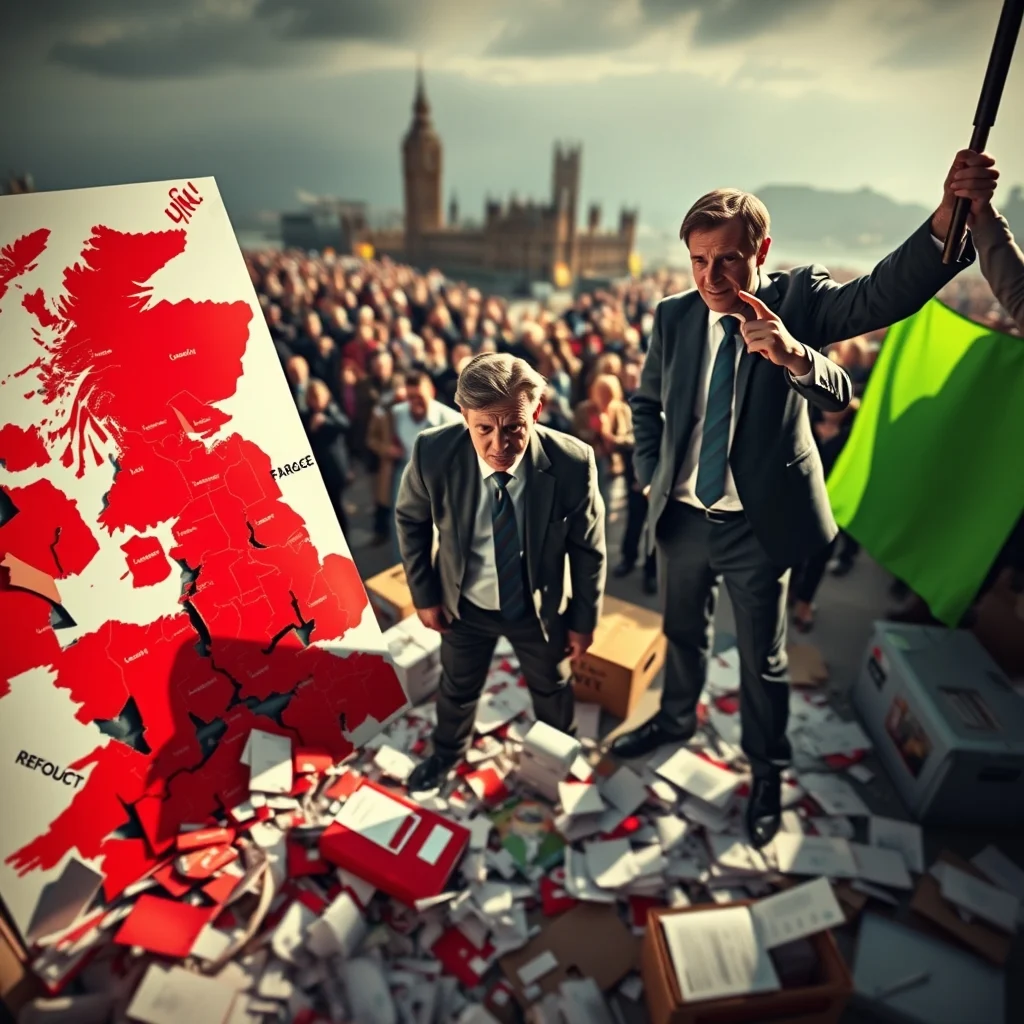
Prime Minister Keir Starmer confronted a critical juncture in his leadership on Friday as early UK local election results indicated a profound shift in the nation’s political landscape. Labour, his party, experienced significant setbacks across its traditional strongholds, while the resurgent Reform UK and the ascendant Green Party disrupted the long-standing dominance of the UK’s two major parties. Starmer, characterizing the outcomes as “very tough,” rejected calls for his resignation, despite the electoral drubbing occurring just two years after his party’s landslide victory in 2024, a decline attributed to economic stagnation and controversial leadership decisions.
A Seismic Shift In Traditional Strongholds
The magnitude of the defeat was particularly evident in England’s industrial north. Reform UK, under the leadership of Nigel Farage, secured hundreds of local council seats, effectively displacing Labour in former strongholds such as Hartlepool. Farage declared the results a “truly historic shift in British politics,” stating that Labour was being “wiped out by Reform in many of their traditional areas.”
This fragmentation of the vote also impacted the left. The Green Party celebrated a significant night, notably with Zoë Garbett becoming the first directly-elected Green mayor in Hackney, a traditional Labour stronghold. Green leader Zack Polanski proclaimed the end of the status quo, asserting, “Two-party politics isn’t dying. It’s dead, and it’s buried.”
Devolution And The End Of Dominance
Labour’s vote collapse was not confined to England. In Wales, the party faced the possibility of not securing first place in a nationwide election for the first time in over a century. Projections indicated Labour could be surpassed by Plaid Cymru, the pro-independence party aiming to lead a coalition government, and Reform UK.
In Scotland, the Scottish National Party (SNP) appeared set to maintain its dominance in the Holyrood parliament, although the extent of any majority remained uncertain. Collectively, these results from approximately 5,000 local contests and devolved legislatures suggest a national turn towards insurgent parties. Polanski summarized the evolving political scene, suggesting, “It’s very clear that the new politics is the Green Party versus Reform.”
Internal Dissent And Leadership Challenges
The electoral “shellacking” has emboldened critics within the Labour Party. Backbench MPs are reportedly exploring options for a leadership contest. Jonathan Brash, a Labour lawmaker from the significantly affected Hartlepool district, was direct in his assessment: “I don’t think Keir Starmer should survive these results. We have to be bolder, and we have to go further. And quite frankly, we need new leadership in order to achieve that.”
Speculation about potential successors has already focused on prominent figures such as Health Secretary Wes Streeting, former Deputy Prime Minister Angela Rayner, and Greater Manchester Mayor Andy Burnham. Professor Ben Ansell of the University of Oxford highlighted the escalating pressures, observing, “Keir Starmer is playing existential problems buckaroo at the moment, as he stacks them on the back of his electoral donkey. Everything is happening at once.”
Economic Anxiety And Ethical Scandals
The Prime Minister’s public standing has been further challenged by numerous policy U-turns and a perceived failure to alleviate the cost-of-living crisis. Additionally, the appointment of Peter Mandelson as ambassador to Washington, despite his past associations with Jeffrey Epstein, has drawn widespread criticism.
Starmer conceded that voters were dissatisfied with “the pace of change” but maintained his position. “The results are tough, they are very tough, and there’s no sugarcoating it,” Starmer stated. He dismissed resignation calls, asserting, “Tough days like this don’t weaken my resolve to deliver the change that I promised.” He further vowed not to “walk away from those challenges and plunge the country into chaos.”
Markets React To Political Instability
The financial sector, which had shown jitters regarding potential leadership instability, exhibited signs of cautious stabilization. Yields on benchmark 10-year UK government bonds, known as gilts, decreased by 4 basis points to 4.904% by Friday afternoon, reacting to Starmer’s commitment to remaining in office.
The Conservative Party, led by Kemi Badenoch, also continued to see vote reductions following their 2024 defeat, though Badenoch noted “signs of renewal everywhere that we are standing.” Investment analysts, including those at Deutsche Bank, commented that while the results were poor, they did not constitute the immediate “catalyst for a change” that some market observers had anticipated.
The “Stagflation Trap” and Shifting Africa Ties
For observers in Ghana and across Africa, Starmer’s political uncertainty signals a potential shift in the UK’s foreign engagement strategy. Foreign Secretary David Lammy has advocated for a “new approach” centered on equal partnerships, yet the government’s domestic “Stagflation Trap,” with inflation nearing 3.6%, is impacting the African diaspora. Remittance flows are strained as families in the UK grapple with energy debt and rising food costs. Furthermore, the rise of Reform UK has pressured Labour to adopt stricter border policies, including the planned “Visa Brake” for several nationalities in March 2026 and increased English language requirements for settlement.
As Starmer navigates his leadership challenges, his government’s pledge to transition from “donor to investor” in Africa faces significant hurdles, particularly with aid budgets already reduced to 0.3% of GNI.
A Premature Pilot Change Warned Against
Amidst mounting pressure, Starmer’s allies have initiated a defensive strategy. Deputy Prime Minister David Lammy urged the party to prioritize stability during the crisis, cautioning against internal challenges by stating, “You don’t change the pilot during the flight.”
While the complete election results are expected by Saturday afternoon, the electorate’s message appears to be one of widespread dissatisfaction with the political establishment. By moving beyond the traditional Labour-Conservative binary, British voters have indicated that the post-war political consensus is under strain, leaving Starmer to manage a divided party and a nation seeking direction.










Leave a Reply