
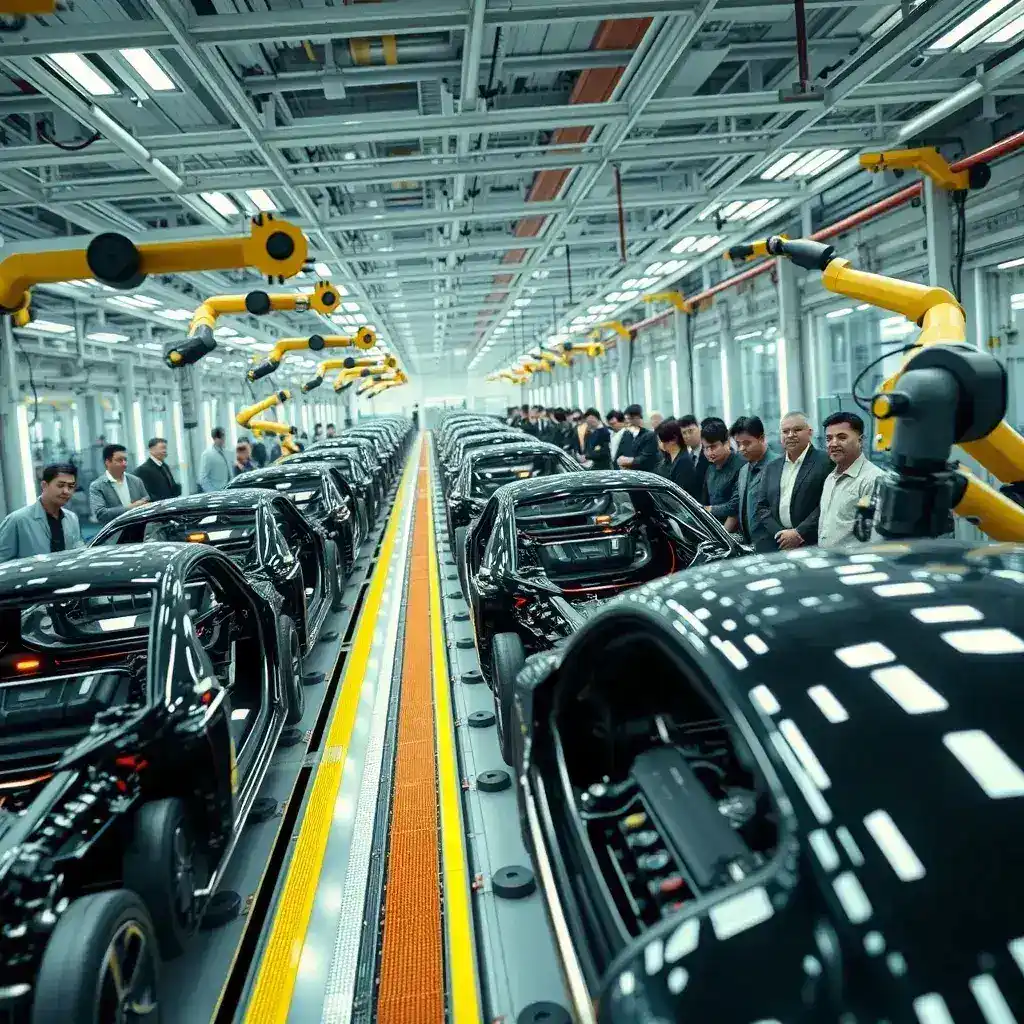
Global carmakers face a significant challenge as Chinese brands rapidly gain ground in electric vehicles (EVs), batteries, design, and software, according to observations at Auto China 2026 in Beijing and Hefei. This shift sees long-dominant US, European, and Japanese manufacturers struggling to compete with the innovation and speed demonstrated by their Chinese counterparts, who are setting new industry standards.
A New Era of Automotive Competition
The landscape of the automotive industry is undergoing a seismic shift, with Chinese manufacturers emerging as formidable global players. This transformation is not solely about electric vehicles; it encompasses a broader technological revolution in mobility. Auto industry leaders are increasingly vocal about the intensity of this competition. Honda’s chief executive, Toshihiro Mibe, expressed concern after visiting a highly automated Chinese factory, stating, “We have no chance against this.” Similarly, Ford’s CEO, Jim Farley, has warned that Western automakers are “in a fight for our lives” as Chinese rivals expand their global reach.
Beyond EVs: China’s Tech Integration
China’s ascendancy is built on a foundation of state support and rapid technological advancement. The country’s dominance extends beyond vehicle manufacturing to critical components within the EV supply chain, including batteries and manufacturing machinery. A report by Rhodium Group indicates China’s export strength across hundreds of product categories, many linked to EV technology. The International Energy Agency estimates that producing a small electric SUV in China is approximately 30% cheaper than in more advanced economies, largely due to lower battery costs and optimized supply chains. This advantage has been cultivated through substantial state investment, with Rhodium estimating tens of billions of dollars channeled into EV and battery manufacturing in recent years.
This robust ecosystem has fostered intense competition within China, driving rapid innovation. Tech giants such as Xiaomi, Huawei, and Alibaba have entered the automotive sector, bringing their expertise in consumer technology to car design and functionality. “They’re not racing the West anymore,” notes Shanghai-based auto analyst Bill Russo. “They’re racing each other.” This internal competition accelerates development, particularly in software, which is becoming increasingly integral to vehicle performance, from driver assistance systems to in-car entertainment.
“Smartphones on Wheels” and Advanced Manufacturing
Chinese automakers are redefining the car as an extension of the digital ecosystem. Xiaomi, for instance, launched its first EV in 2024 and is already a top seller, focusing on seamlessly integrating cars with phones, apps, and smart-home devices. Their factory outside Beijing showcases remarkable efficiency, with a new car rolling off the production line every 76 seconds. Nio’s Hefei plant demonstrates near-full automation, while BYD has developed ultra-fast charging technology that can add 400 km of range in about five minutes, rivaling the time it takes to refuel a gasoline car. XPeng’s CEO, He Xiaopeng, is looking even further ahead, prioritizing the development of humanoid robots and flying cars alongside EVs, predicting that “In the next decade, any car company will also be a robotics company.”
Foreign Brands Grapple with Shifting Market Dynamics
Foreign carmakers, who once relied on joint ventures for market access, are now finding themselves outmaneuvered. Their share of China’s car market has plummeted from 64% in 2020 to 32% this year, according to consultancy Automobility. This decline has impacted the earnings of major players like General Motors and German manufacturers, who previously depended heavily on Chinese profits. Even luxury brands are feeling the pressure; Huawei’s Maextro S800 luxury sedan has surpassed imports like the Porsche Panamera and BMW 7 Series in China. While Tesla exports vehicles manufactured in Shanghai, and BMW sells Chinese-made Minis globally, many foreign brands struggle to compete within the Chinese market itself.
The traditional relationship between foreign automakers and Chinese partners is evolving. Stellantis has entered a significant deal with Dongfeng to produce and sell Peugeot and Jeep models, while also planning to bring Dongfeng’s electric brand, Voyah, to Europe and exploring the production of Chinese-designed vehicles in France. Volkswagen is investing $700 million for access to XPeng’s software and autonomous driving technology, acknowledging its inability to develop such systems quickly enough domestically. Toyota, Hyundai, Ford, and Nissan are also expanding their R&D operations in China or investigating the production of Chinese-designed vehicles abroad, leveraging local expertise.
Global Expansion and Future Implications
The intense competition and overcapacity within China’s domestic market are driving Chinese manufacturers to expand internationally. Brands like BYD, Chery, and SAIC are targeting Europe and emerging markets despite significant tariffs. Chery’s Jaecoo 7, for example, quickly became a top-selling model in the UK. However, tariffs exceeding 100% have effectively blocked Chinese brands from the US market. Experts caution that the shift of vehicle production, battery technology, and software development to China could impact manufacturing hubs in Southeast Asia and Europe, potentially affecting jobs and local economies. As consultant James Pearson notes, “If you lock them out of one market, they will just find another.” Bill Russo asserts that the industry’s center of gravity has already shifted, and companies willing to collaborate with China are best positioned for the future, while those resisting its rise risk being left behind.
Looking ahead, the automotive industry will likely see continued rapid innovation driven by Chinese companies, particularly in software integration, autonomous driving, and new mobility solutions like robotics and flying cars. The ability of established global automakers to adapt, collaborate, and integrate these new technologies will be critical to their long-term competitiveness. The ongoing geopolitical landscape and trade policies will also play a significant role in shaping the global distribution of automotive manufacturing and market access.








Leave a Reply