
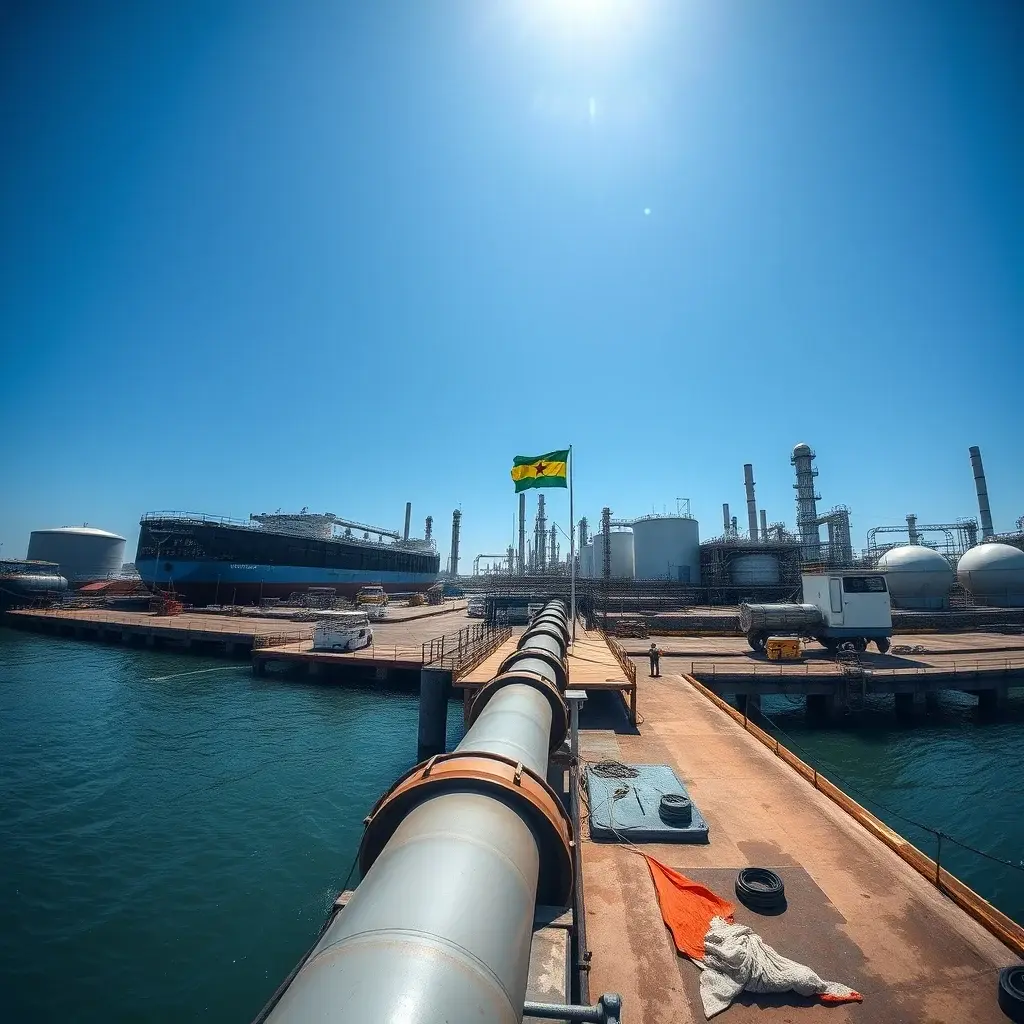
Tema, Ghana – Minister for Energy and Green Transition, John Abdulai Jinapor, declared the successful delivery of Jubilee crude oil to the Sentuo Oil Refinery for local processing a pivotal moment for Ghana’s energy sector. This event, which occurred recently in Tema, signifies a strategic shift towards maximizing value addition from the nation’s petroleum resources, enhancing energy security, and accelerating industrial growth.
Shifting the Paradigm: Local Refining Over Exports
For decades, Ghana has exported its crude oil only to import refined petroleum products, a model the Minister described as unsustainable. This new initiative directly addresses that imbalance, allowing locally produced crude to be refined within Ghana. The move reflects a deliberate government policy to ensure that the economic benefits derived from natural resources are retained domestically.
“Today’s achievement goes beyond a commercial transaction. It represents a deliberate national policy decision to deepen local value addition, strengthen energy security, promote industrialisation, and retain a greater share of the benefits derived from Ghana’s petroleum resources within our economy,” Minister Jinapor stated during the Sentuo Oil Refinery’s first-ever Jubilee Crude Oil Berthing Ceremony.
Addressing Past Challenges and Future Capacity
The Minister highlighted the long-standing operational challenges faced by Ghana’s sole state-owned refinery, which had significantly limited the country’s capacity to process its own crude oil for nearly eight years. “True economic transformation requires that we process, refine and add value to our resources locally,” he emphasized.
Sentuo Oil Refinery’s first phase, completed in 2024, boasts a processing capacity of 40,000 barrels of crude oil per day. Plans are already underway for a second phase, which is expected to add another 60,000 barrels per day. Upon completion of both phases, the refinery will have a total capacity of 100,000 barrels daily, substantially boosting Ghana’s refining capabilities.
“The Sentuo Oil Refinery has emerged as one of the most significant private sector investments in Ghana’s downstream industry. Once the second phase is completed, the refinery’s total capacity will reach 100,000 barrels per day, significantly enhancing Ghana’s refining capability,” Jinapor noted.
Economic Impact: Job Creation and Reduced Import Dependence
The expansion of local refining capacity is expected to create significant employment opportunities. Minister Jinapor pointed to the hundreds of workers already employed at Sentuo Oil Refinery as evidence of this direct economic benefit. “If this refinery did not exist, many of these young men and women would still be searching for jobs or competing for limited opportunities elsewhere. This is why investments of this nature are critical to Ghana’s economic future,” he remarked.
Furthermore, increased domestic refining is anticipated to drastically reduce Ghana’s reliance on imported refined petroleum products. The Minister expressed optimism that, with both Sentuo and the revitalized Tema Oil Refinery operating at full capacity, Ghana could transition from being a major importer to a potential net exporter of refined petroleum products.
“If Sentuo and Tema Oil Refinery operate at their full capacities, Ghana’s reliance on imported refined petroleum products will reduce considerably. Ultimately, we have the potential to become an exporter of refined products rather than a major importer,” he stated.
Geopolitical Resilience and National Prosperity
The push for enhanced local refining capacity gains further urgency in light of recent geopolitical tensions, particularly in the Middle East. These global conflicts underscore the vulnerability of nations heavily dependent on imported fuels, exposing them to supply disruptions and price volatility. Strengthening domestic refining capabilities is seen as a crucial step in building Ghana’s resilience against such external shocks and ensuring greater stability in its energy supply chain.
Minister Jinapor reiterated the government’s commitment, tracing the policy’s roots to the administration of President John Dramani Mahama, which prioritized local participation and value addition in the petroleum sector. The ultimate goal is to ensure that Ghana’s natural resources directly contribute to industrial development, job creation, and overall national prosperity.
“We are on course to reset the economy and build a stronger and more resilient energy sector. Our objective is to ensure that Ghana derives maximum value from its natural resources while creating opportunities for businesses and citizens,” he added.
Looking Ahead: A New Era for Ghana’s Petroleum Industry
The successful berthing of Jubilee crude oil at Sentuo Oil Refinery is poised to usher in a new era for Ghana’s petroleum industry. Industry stakeholders are anticipating a surge in local refining activities, a bolstered energy security, and stronger economic linkages between the energy sector and the broader Ghanaian economy. The focus will now shift to the efficient operation and timely completion of Sentuo’s expansion, alongside efforts to maximize the output and reliability of the Tema Oil Refinery, potentially positioning Ghana as a regional energy hub.









Leave a Reply