
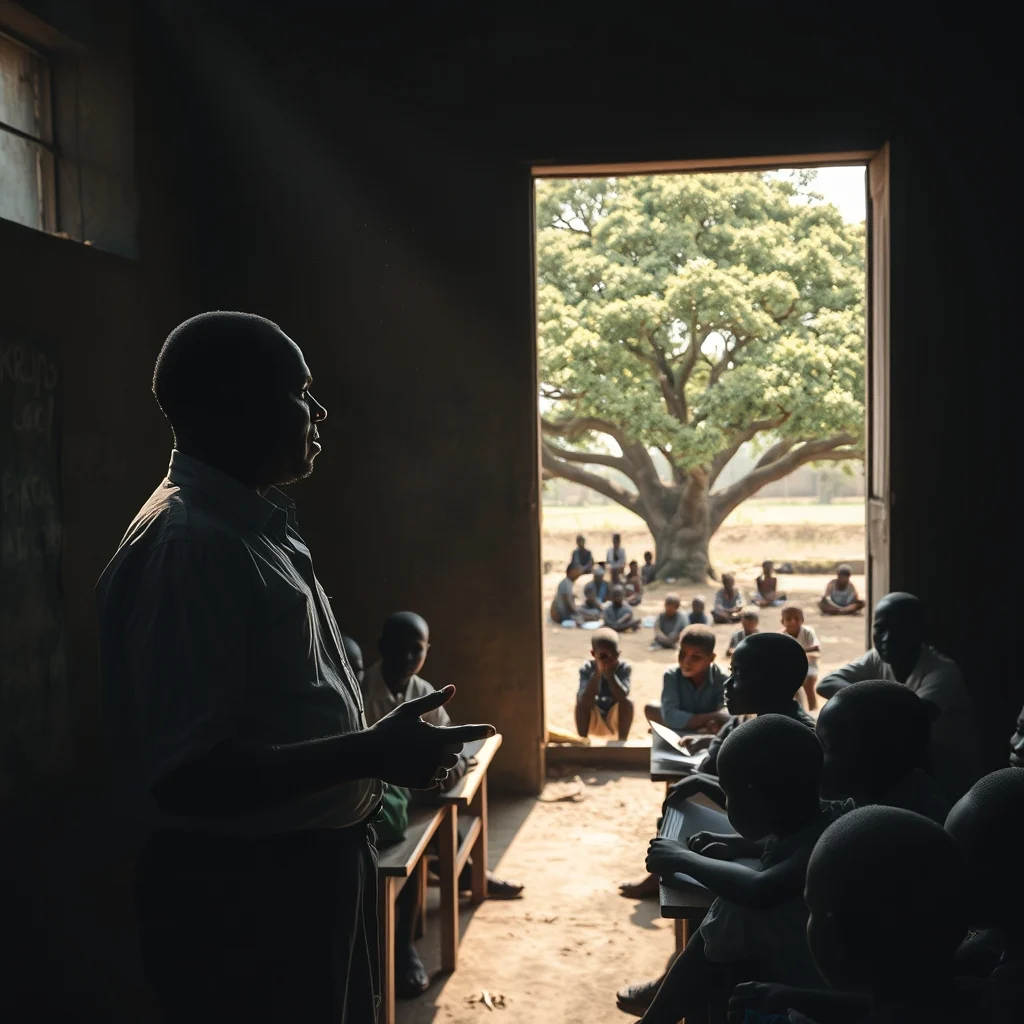
Samuel Donkor, the sole government-trained teacher at Kakpeni District Assembly School in Ghana’s Northern Region, is single-handedly managing 12 classes, from Kindergarten to Junior High School (JHS). This dire situation has persisted for over three years, with Donkor fulfilling the roles of both teacher and headteacher for the school’s 448 students in the Kpandai District.
Kakpeni D/A Primary and Junior High School faces a severe teacher deficit, forcing Samuel Donkor to juggle an overwhelming workload. He teaches core subjects like English, Mathematics, Science, and Ghanaian Language to students across all grade levels. To manage, multiple classes are merged, with Kindergarten, Basic One, Two, and Three sharing one room, and Basic Four and Five combined. Basic Six students learn alone, despite differing syllabi, highlighting the compromises made in the learning environment.
The educational compromises are palpable. Donkor described the challenge of teaching one group while others are left unattended or engage in non-academic activities. “By the time I reach the last class, the first class has forgotten what I taught them,” he told Graphic Online, underscoring the cyclical nature of knowledge loss. When Donkor leaves the community for official duties, all teaching activities cease, leaving students with no instruction.
Beyond the critical shortage of teaching staff, the school grapples with severe infrastructure deficiencies. Some JHS students are forced to study outdoors under trees due to a lack of classrooms, exposing them to adverse weather conditions and constant disruptions. Essential resources such as furniture and teaching materials are also in critically short supply.
The challenges extend beyond the classroom walls for Donkor. His official duties often require him to cross a river by canoe to reach Kpandai, a journey that can be perilous, especially during the rainy season, and is often undertaken without life jackets. He recounted a harrowing experience where a canoe he was on capsized, though fortunately, no lives were lost.
The immense pressure has taken a toll on Donkor’s personal life, with him stating, “As we speak, most of my time is spent in the school and community, with little attention to my family and personal life.” Despite these Herculean efforts, residents have affectionately nicknamed him the “One Man Contractor” in recognition of his dedication.
Students express frustration and a sense of being deprived. Pupils from Basic Two and Three reported missing crucial lessons in reading and numeracy. “There are more days without lessons than days we are taught,” one student lamented, particularly concerned about the JHS students preparing for the 2026 Basic Education Certificate Examination (BECE).
Parents and community members share these concerns, emphasizing that their children deserve the same quality of education as those in other areas. “Our children are no less important. They also deserve quality education like children elsewhere,” stated resident Abel Makiwi. Fears are mounting that the prolonged lack of structured learning is contributing to an increase in teenage pregnancies and early marriages within the community.
In response, residents are urging the government, the Ministry of Education, and the Ghana Education Service (GES) to urgently deploy more teachers to Kakpeni. They have also pledged their willingness to accommodate any newly posted staff. Furthermore, the community is advocating for the school’s inclusion in the School Feeding Programme to boost student enrollment and retention rates.
Despite the bleak outlook, Samuel Donkor remains hopeful. He believes the ongoing national teacher recruitment drive could alleviate the staffing crisis, especially if rural and underserved areas are prioritized. He also acknowledged the positive impact of decentralizing teacher postings, allowing district directorates to better identify and address critical staffing gaps.
The Kpandai District Education Directorate has acknowledged the dire situation at Kakpeni and confirmed that two additional teachers have been assigned to the school and are expected to report soon. Officials believe that broader recruitment efforts could significantly help in balancing teacher distribution across the district.
However, education analysts caution that without sustained interventions and a proactive approach to addressing teacher shortages in rural areas, schools like Kakpeni will continue to face severe challenges, exacerbating existing inequalities in educational access and quality. The situation at Kakpeni highlights a critical need for equitable resource distribution and teacher deployment to ensure all Ghanaian children receive a quality education.










Leave a Reply