
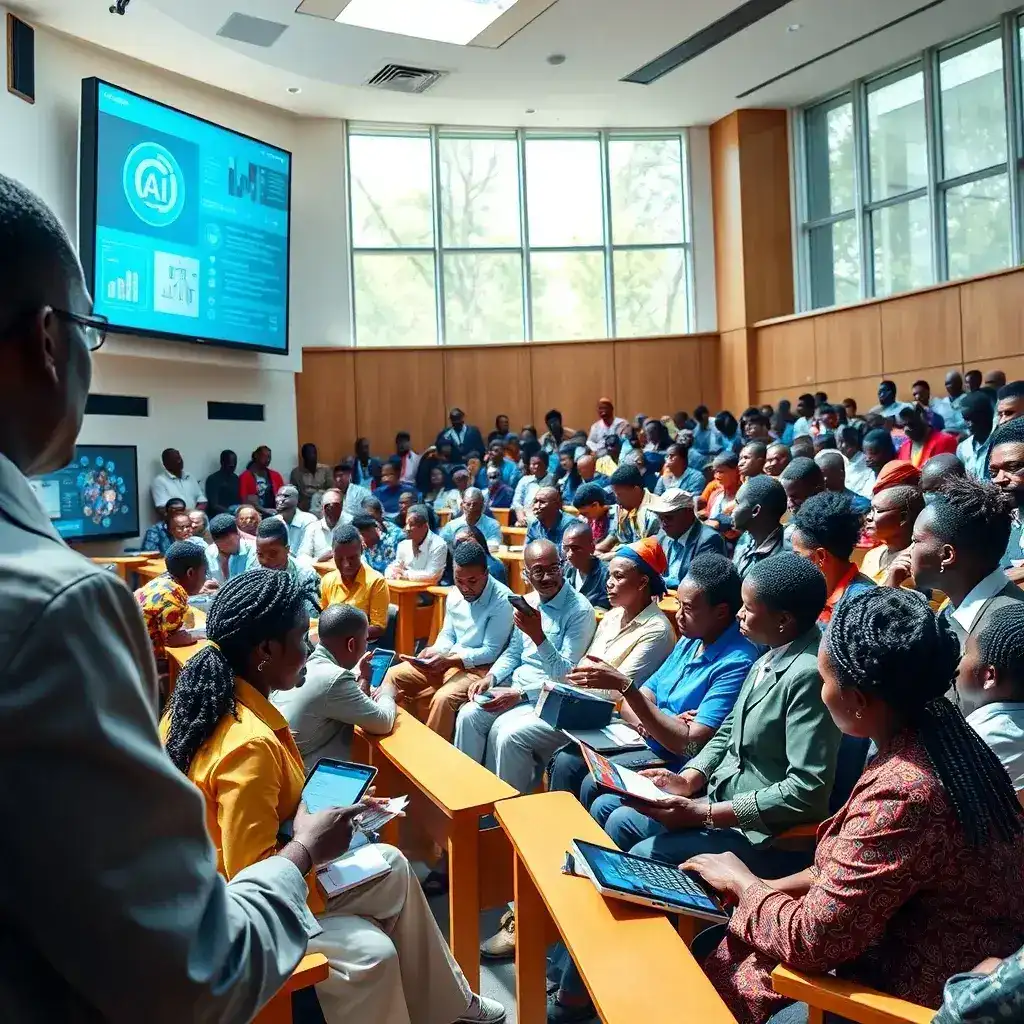
Senior High School teachers in Ghana are being trained to integrate Artificial Intelligence (AI) and digital technology into their classrooms, aiming to enhance teaching and learning experiences. The initiative, spearheaded by the Ghana Science Association, took place during a significant workshop at the Kwame Nkrumah University of Science and Technology (KNUST) in Kumasi, drawing over 150 educators from the Ashanti region. The program focused on equipping teachers with the knowledge to leverage AI tools, preparing students for an increasingly digital future.
Context: The Growing Influence of AI in Education
Experts at the workshop emphasized that AI is already transforming educational landscapes globally, making it imperative for teachers to adapt and effectively utilize these emerging technologies. Professor Jacob Agbenorhevi, Head of the Department of Food Science and Technology and former President of the KNUST branch of the Ghana Science Association, highlighted that AI should serve as a supplement to human intellect, not a replacement.
Professor Agbenorhevi drew parallels to historical technological advancements, stating that AI is the latest evolution in tools designed to simplify tasks. “From time to time we see new skill tools that come for us to use in our everyday life. Recently it is AI… If one is not abreast with these tools, it will be difficult impacting the future generation,” he explained. He stressed the importance of teachers understanding how to use these tools and impart that knowledge to their students.
He further advised responsible AI usage, noting that these tools should enhance efficiency rather than foster laziness. “A tool should not make you lazy but it will make you do things faster or better. It does not mean you are going to throw away your human intelligence… it is like using a hammer to crack a nut. It makes the work easier, but you still have to work,” he elaborated. Teachers, he added, have a crucial role in guiding students on the ethical and effective application of AI.
AI as a Transformative Educational Tool
Dr. Emmanuel Ahene from the Department of Computer Science and Chairman of the Local Organizing Committee described AI as a pivotal technological shift. “We are living in one of the most significant technological shifts in human history. Artificial Intelligence, once science fiction, is now embedded in our phones, search engines, healthcare systems, and financial analysis,” he remarked.
Dr. Ahene outlined AI’s potential to streamline teaching processes, such as accelerating lesson plan creation and providing tailored support for students with diverse learning needs. “AI can help teachers build lesson plans in minutes, simplify complex topics, and support learners at different ability levels. The opportunities are enormous,” he stated.
He cautioned that failing to integrate AI training for teachers could leave Ghanaian students at a disadvantage. “If we do not equip our senior high school teachers with this knowledge, our students will fall behind compared to their counterparts in countries already embracing AI in education,” Dr. Ahene warned, underscoring the workshop’s objective to prepare educators for the future of digital learning.
Preparing for an AI-Driven Future Workforce
Professor Alexander Kwarteng, President of the Ghana Science Association KNUST Branch and Editor of Everyday Science in Schools Magazine, highlighted the critical role of AI in future careers. “AI has come to stay. By 2030, about 90% of jobs available will be AI-related. Therefore, it is extremely important that our STEM teachers get familiar with what AI is as quickly as possible,” he asserted.
He pointed out that AI can significantly alleviate teachers’ workload, particularly in managing large class sizes. “Teachers are burdened with marking because of large class sizes. With AI, it will be possible to set questions and even assist in marking, allowing teachers more time to assess learning effectively,” Prof. Kwarteng explained. Furthermore, AI can enhance student comprehension of abstract scientific and mathematical concepts through visual aids.
Comparing AI’s impact to the evolution of transportation, Prof. Kwarteng stressed the necessity of adaptation. “A hundred years ago, travel was by horse or wooden transport. Today we have vehicles that move much faster. In the same way, society is changing, and we must adapt to AI or risk being left behind.” He also noted the high demand for the training, with numerous institutions requesting broader access.
Teachers’ Enthusiasm and Future Outlook
Teachers attending the workshop expressed eagerness to implement AI in their teaching. Comfort Akosuah Serwaa Mensah, a Mathematics teacher, hopes to use AI to refine lesson preparation and enhance students’ problem-solving skills. “AI will help students handle critical and challenging questions,” she noted.
Esi Kosma Debrah, a Biology teacher, emphasized the need for Ghanaian schools to align with global educational trends. “We want to be at par with the international world. Outside Ghana, schools are already incorporating AI into teaching and learning,” she said. She anticipates the training will sharpen her skills for effective classroom application and boost student interest in science.
Expanding AI Integration Nationwide
Organizers plan for this workshop to be part of a broader strategy by the Ghana Science Association to advance science education and digital literacy in schools across the country. They are actively seeking partnerships and support to extend these training programs to more educators, fostering a stronger collaborative network among teachers.
As AI continues its global educational integration, participants in Kumasi are determined that Ghanaian teachers will not merely adapt but will actively contribute to leading this transformative shift in education.










Leave a Reply