
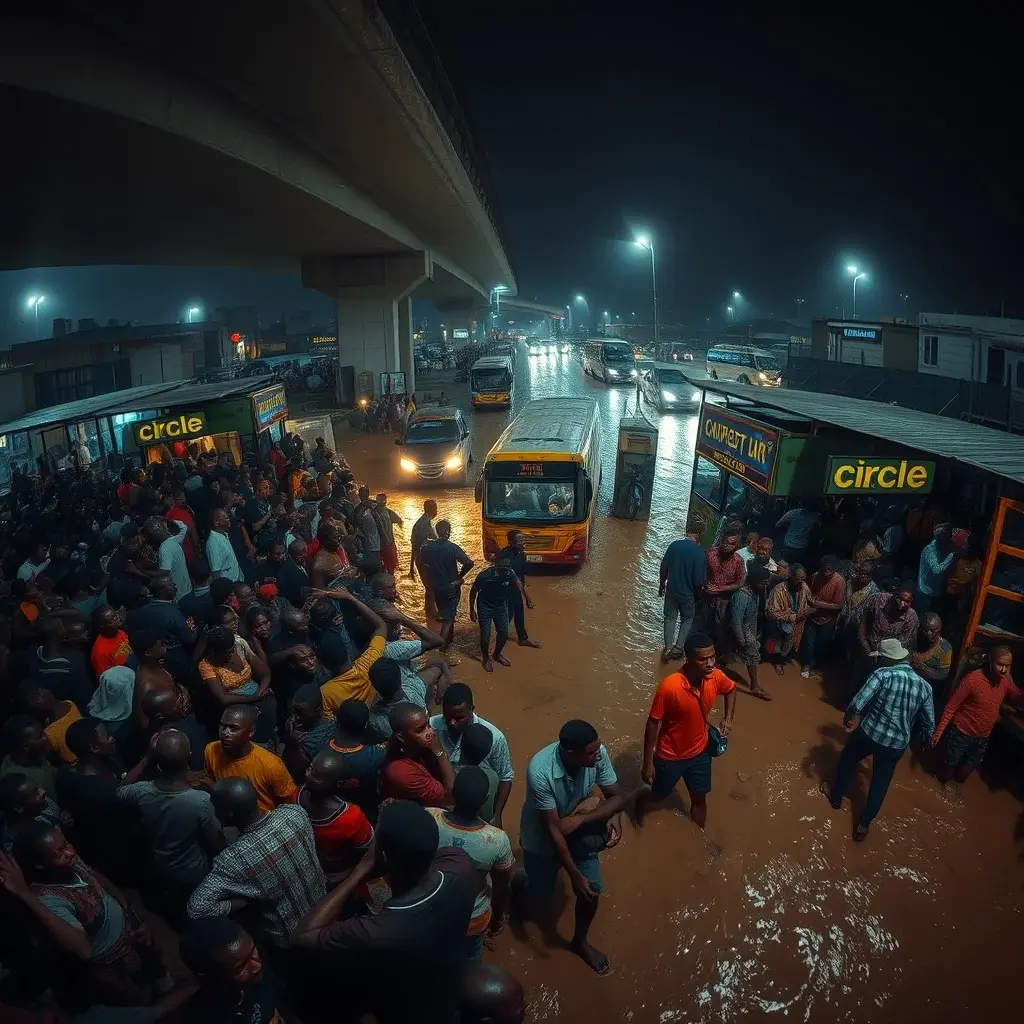
Thousands of commuters in Accra endured a night of frustration and hardship on Friday evening after a torrential downpour flooded major transport terminals, leading to severe shortages of public transport and widespread paralysis of movement across the capital. Scenes of desperation unfolded at hubs like the Kwame Nkrumah Interchange (Circle) and 37 Military Hospital Station as stranded passengers battled long queues, limited vehicle availability, and chaotic scrambles for scarce seats.
Commuters Stranded Amidst Flooding and Chaos
As heavy rains swept through Accra on Friday, transforming routine commutes into a nightmare, transport terminals became scenes of significant distress. At approximately 9 p.m., Joy Digital cameras captured hundreds of commuters gathered at the Circle transport terminal. They huddled under flyovers and around the loading areas, anxiously awaiting the sporadic arrival of commercial vehicles amidst queues stretching for meters.
The situation at Circle was characterized by exhaustion and desperation. Floodwaters had carried debris and plastic waste into sections of the terminal, forcing commuters to navigate muddy paths and waterlogged areas. This added to the challenge of maintaining positions in increasingly restless queues.
Whenever a commercial vehicle arrived, orderly lines quickly devolved into frantic rushes as numerous passengers vied for the limited available seats. Many commuters were left stranded after multiple unsuccessful attempts to board a vehicle. Others sought temporary refuge under the interchange, monitoring the weather and hoping for an improvement in transport conditions.
This distressing scenario was mirrored at other major transport hubs across the city. Commuters at the 37 Military Hospital Station reported similarly dire experiences, with queues extending far beyond the designated loading zones. One commuter shared on social media, “A day I will never forget in my life… at 37 Station EII, hmmm, I was the 97th person in line.” This sentiment resonated widely, with many residents recounting similar difficulties at various transport centers.
Long-Standing Transportation Challenges Exacerbated by Rain
While Friday’s rainfall significantly intensified the crisis, many commuters noted that the transportation challenges are not new. For months, residents traveling to and from densely populated suburban areas such as Ashaiman, Kasoa, Amasaman, Adenta, Oyibi, and Pokuase have voiced concerns about the increasing difficulty in accessing reliable transportation, particularly during peak hours.
Factors contributing to these persistent issues include rising operational costs for transport operators, deteriorating road conditions in certain areas, pervasive traffic congestion, and a general reduction in the number of commercial vehicles operating on specific routes. Even on normal days, long queues are a common sight at major terminals like Lapaz, Kaneshie, Madina, and Ashaiman.
However, the onset of heavy rains typically exacerbates the situation. Many drivers choose to shorten their routes or suspend operations altogether to avoid potential vehicle breakdowns and damage caused by flooding.
Questions Over Public Transport Capacity and Past Initiatives
The recent disruption has reignited public discussion regarding the urgent need for a more efficient and dependable mass transit system. Such a system is crucial for accommodating large numbers of commuters, especially during emergencies and adverse weather conditions.
Many residents pointed to the decline of the Quality Bus System (QBS), popularly known as the Ayalolo initiative. This project was initially launched to provide high-capacity bus services along designated corridors in Accra, aiming to reduce travel times and enhance mobility through dedicated bus lanes and modern infrastructure.
However, the initiative faced significant implementation challenges, funding constraints, and operational difficulties, which limited its full potential. Expressing disappointment, one commuter remarked, “A reliable transport system. Ghanaians ask for the most basic of things Chale. If the Ayalolo plans was followed with dedication a lot of this will have been avoided. But nah!?”
Government Interventions and Expert Recommendations
Successive governments have acknowledged Accra’s growing transportation needs and have implemented various measures to improve mobility. The Ministry of Transport, in collaboration with transport agencies, has been working on modernizing urban transport systems, increasing fleet capacity, and strengthening state-supported bus services.
In recent years, the government has facilitated the acquisition of new buses for operations of Intercity STC Coaches Limited and Metro Mass Transit Limited to meet increasing passenger demand. Plans are also in motion to expand public transportation networks through the procurement of additional buses and the implementation of improved route management systems designed to enhance reliability and reduce commuter waiting times.
Government officials state that the acquisition of modern buses is part of a broader strategy to bolster public transportation and decrease reliance on informal transport services. These sector reforms also aim to support efforts to revive and expand organized mass transit systems capable of serving the rapidly growing urban population.
Urban transport experts emphasize that while these interventions are necessary, sustained investment in dedicated bus infrastructure, strategic route planning, terminal upgrades, and effective traffic management systems are essential for achieving long-term improvements.
Urgent Calls for Resilient Solutions
As the rainy season progresses, residents are increasingly demanding comprehensive solutions to the recurring transportation difficulties that emerge during periods of heavy rainfall. Many commuters believe the current situation necessitates immediate intervention from transport authorities, city managers, and municipal assemblies to improve drainage around transport terminals, enhance road conditions, and expand public transport capacity.
Transport analysts also highlight the importance of accelerating investments in mass transit infrastructure to prevent weather-related disruptions from repeatedly stranding thousands of citizens. For many who experienced Friday night’s ordeal, however, policy discussions offered little immediate solace. As midnight approached, numerous stranded passengers abandoned their long waits and began the arduous journey home on foot, navigating flooded streets and dark roads after hours of unsuccessful waiting. Their experience underscores the critical and urgent need for a resilient and efficient transportation system capable of serving the burgeoning population of Ghana’s capital, particularly during extreme weather events.










Leave a Reply