
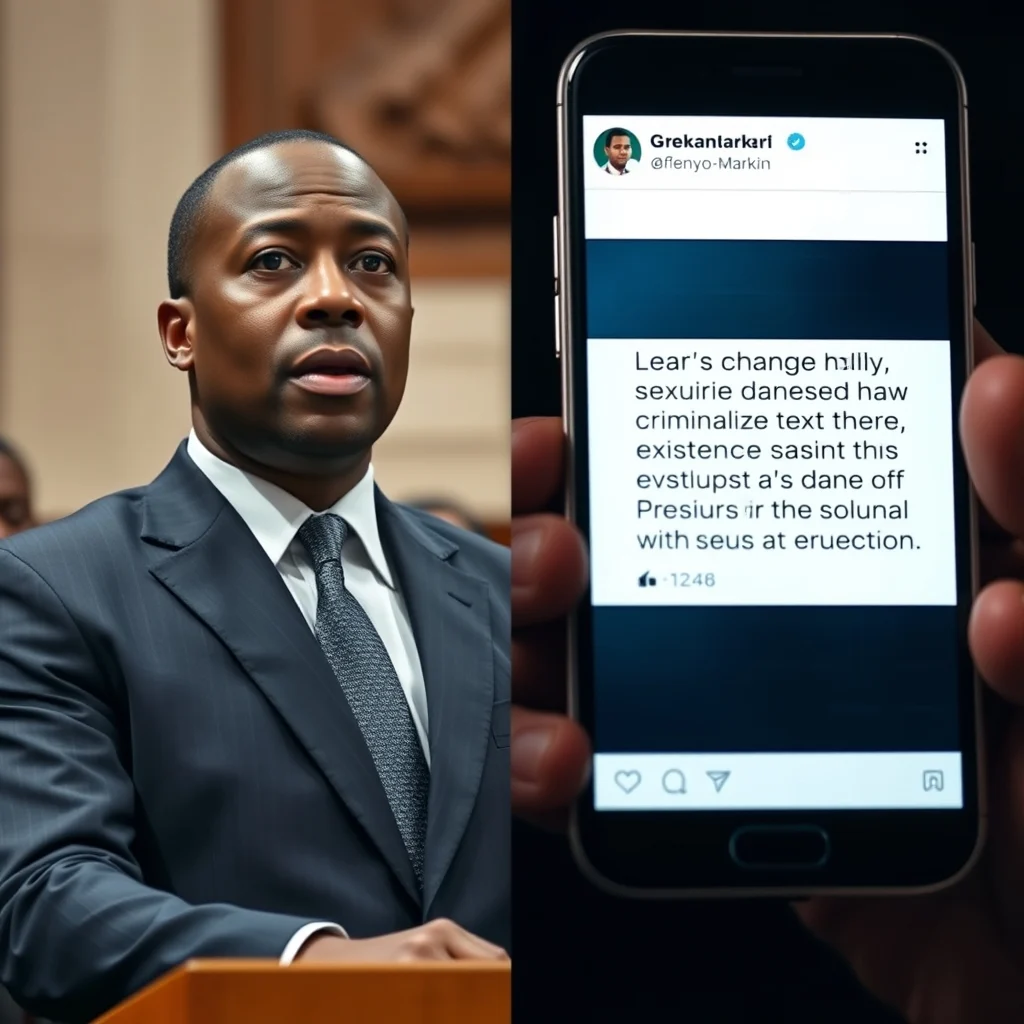
Minority Leader Alexander Afenyo-Markin has publicly disavowed a viral social media post that seemingly criticized Ghana’s anti-gay bill, stating his account was compromised. The post, which circulated online before its removal, argued that a law criminalizing existence based on sexual orientation crosses a line no civilized parliament should approach. However, Afenyo-Markin’s denial is complicated by his own documented history of expressing similar sentiments.
Background of the Controversy
The controversy centers on a social media post that appeared on Afenyo-Markin’s account, stating: “A law that imprisons people for their sexual orientation or who they choose to love does not protect society. It simply selects a group of human beings and makes their existence a crime. That is a line no Parliament in the civilised world should cross.” Afenyo-Markin’s office later claimed his account had been compromised, without providing specific details about the alleged breach.
A Pattern of Stated Opposition
The denial might have been less contentious if not for Afenyo-Markin’s prior public statements. On November 28, 2023, during a TV3 interview, he expressed his personal view: “Personally, I don’t think that somebody claiming to be a lesbian or gay should go to jail by virtue of that.” He reiterated this point in the same interview.
Further reinforcing this position, on February 15, 2024, on the floor of Parliament, Afenyo-Markin argued that jailing individuals for their sexuality “would not be the solution.” He warned that passing the bill with custodial provisions “will be retrogressive.” He drew on his experience from a prison visit during his law studies, suggesting incarceration does not reform but exacerbates the conduct the bill aimed to address.
Adding to this, Afenyo-Markin authored a paper titled “The Case for Non-Custodial Sentencing and Plea Bargaining in Addressing Same-Sex Sexual Relationships.” In this paper, he advocated for a justice system shifting from punitive to restorative approaches, emphasizing the inherent dignity of every person, irrespective of their identity or conduct.
Interpreting the Discrepancy
The deleted post’s content aligns closely with Afenyo-Markin’s previously articulated views. This presents three potential interpretations: one, the account was genuinely compromised, and an unknown third party coincidentally posted a statement mirroring his known positions; two, the post was authentic, and the hacking claim serves as a way to retract the statement without a formal retraction; or three, Afenyo-Markin holds a consistent personal conviction against criminalization, but this conflicts with his caucus’s institutional stance, and the post (whether genuine or fabricated) has highlighted this tension.
The Undisputed Record
Regardless of the deleted post’s authenticity, Afenyo-Markin’s statements in the TV3 interview, his parliamentary speech, and his academic paper remain on the record. These documented instances clearly show his arguments against imprisoning individuals for their sexual orientation over several years.
If the deleted post was indeed a fabrication, it remarkably aligned with his prior stances. Conversely, if the post reflected his genuine beliefs, then the hacking claim itself becomes the element requiring further explanation, rather than the content of the post.
Looking Ahead for the Bill
The Human Sexual Rights and Family Values Bill is currently awaiting transmission to President Mahama’s desk. Speaking at Chatham House in London, President Mahama noted concerns about quorum and procedural irregularities during the bill’s passage. He outlined three potential actions: assenting to the bill, referring it to the Council of State, or returning it to Parliament. He indicated the bill still has “quite a while to go” before becoming law.
Speaker of Parliament, Alban Sumana Kingsford Bagbin, has also urged Members of Parliament to reconsider the bill’s passage. He emphasized that the legitimacy and authority of any law depend on the integrity of the process by which it was enacted, not solely on its objectives.
Should the bill be returned to Parliament for any reason, the debate surrounding its criminalization framework is likely to be reopened. Afenyo-Markin’s documented positions, including the statement he now disowns, will undoubtedly form part of this ongoing discussion.










Leave a Reply