
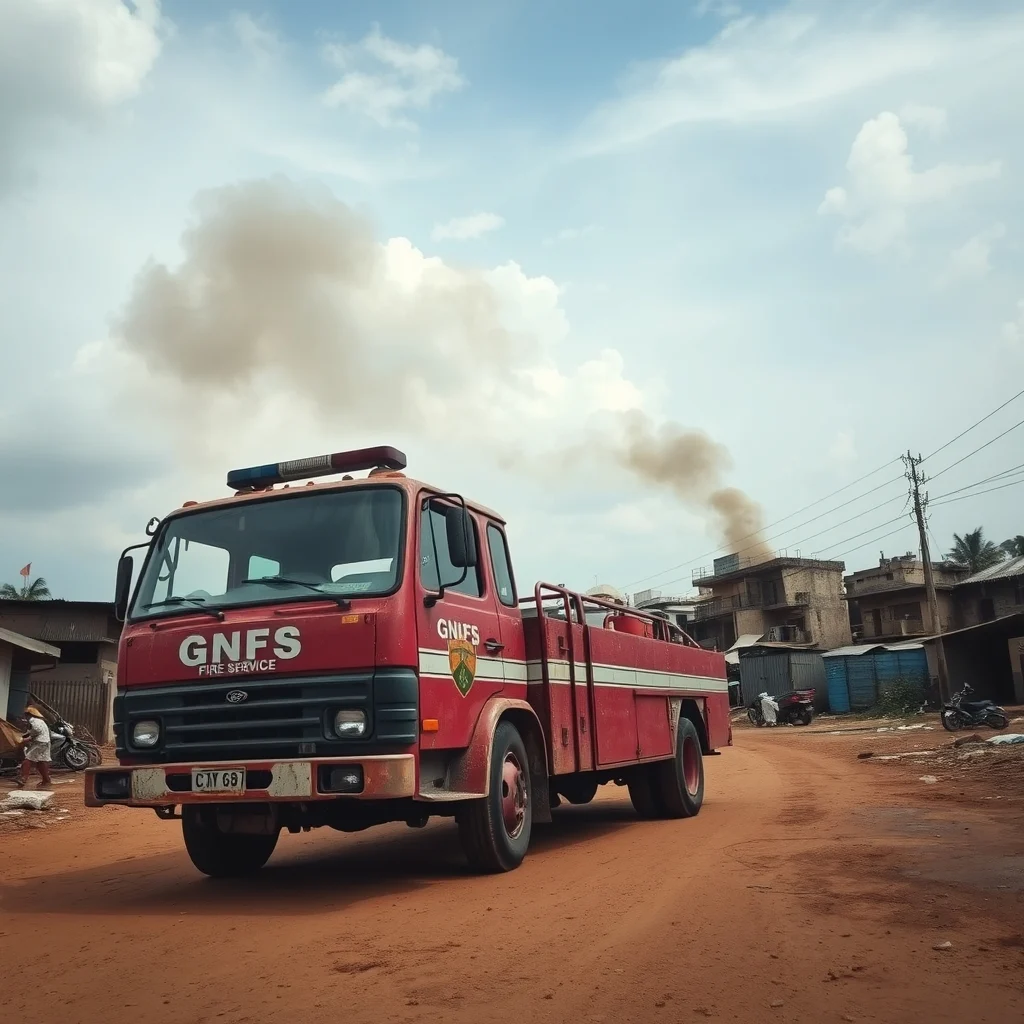
The Ghana National Fire Service (GNFS) in the Tema Region is grappling with severe operational limitations stemming from an aging fleet of fire tenders, a critical lack of functional fire hydrants, and inadequate road infrastructure. These deficiencies are significantly compromising the service’s ability to respond effectively to emergencies, according to regional officials.
Aging Fire Tenders Strain Resources
Divisional Officer Grade II (DO II) Ebenezer Yenzu, the Tema Regional Public Relations Officer for the GNFS, revealed that the region’s firefighting vehicles have far surpassed their operational lifespan. The last substantial delivery of new fire tenders to the area occurred approximately 15 years ago.
International standards, Yenzu explained, recommend the replacement or complete re-engining of emergency vehicles after five years of service. This aging fleet poses a constant risk of mechanical failure during critical operations.
A recent fire incident in Prampram starkly illustrated this problem. Six fire tenders were dispatched to the scene, but four of them broke down due to mechanical issues before the firefighting efforts could be concluded. This left only two operational units to manage the situation.
In such scenarios, the GNFS has been compelled to seek assistance from private water tankers to supplement their resources and prevent fires from escalating. This reliance on external, often costly, resources highlights the strain on the service’s core capabilities.
Lack of Hydrants Creates Water Access Challenges
Adding to the logistical hurdles, the industrial heartland of the Tema Region suffers from a significant absence of active fire hydrants. Fire crews are frequently forced to identify and utilize alternative, often less efficient, water sources during emergencies.
The GNFS has repeatedly appealed to the Ghana Water Limited (GWL) to address this deficit by improving water supply infrastructure and installing functional hydrants in strategically vital locations across the region. Reliable and easily accessible water sources are paramount for effective firefighting.
Poor Roads and Traffic Congestion Delay Response Times
Beyond equipment and water access, poor road conditions and pervasive traffic congestion present formidable obstacles to meeting international emergency response benchmarks. Yenzu noted that response times, ideally eight minutes or less, are often drastically exceeded.
For instance, reinforcement crews traveling from Katamanso to Akuse can endure delays of up to 30 minutes solely due to the state of the roads and traffic bottlenecks. These extended travel times are critical in situations where every minute counts.
The problem is exacerbated when fire stations closer to an incident experience mechanical breakdowns with their own tenders. This necessitates dispatching units from more distant stations, further compounding response delays.
Public Education Yields Positive Results
Despite these systemic challenges, the GNFS has achieved notable successes through persistent public education and community sensitization campaigns. Yenzu reported that out of 318 fire incidents recorded in the region during the first quarter of the year, an encouraging 126 were successfully extinguished by community members before firefighters arrived.
This statistic underscores the effectiveness of ongoing educational initiatives, empowering residents to recognize fire hazards and take immediate action during the early stages of an outbreak. Community preparedness is proving to be a vital, albeit supplementary, component of the region’s overall fire safety strategy.
Direct Communication Recommended
To mitigate delays associated with national call-routing systems, the Service urges residents to contact the Tema Regional Control Room directly during fire outbreaks. The emergency line is 0303 202 554.
Looking Ahead
The ongoing issues with aging equipment, insufficient hydrants, and poor infrastructure in the Tema Region highlight an urgent need for strategic investment and infrastructure development. The effectiveness of the GNFS hinges on addressing these foundational challenges. Future efforts will likely focus on securing funding for fleet modernization, collaborating with utility providers to expand hydrant networks, and advocating for road improvements. The success of public education campaigns also suggests that continued community engagement will remain a critical element of the region’s fire safety approach, potentially bridging the gap until infrastructural improvements can be fully realized.










Leave a Reply