
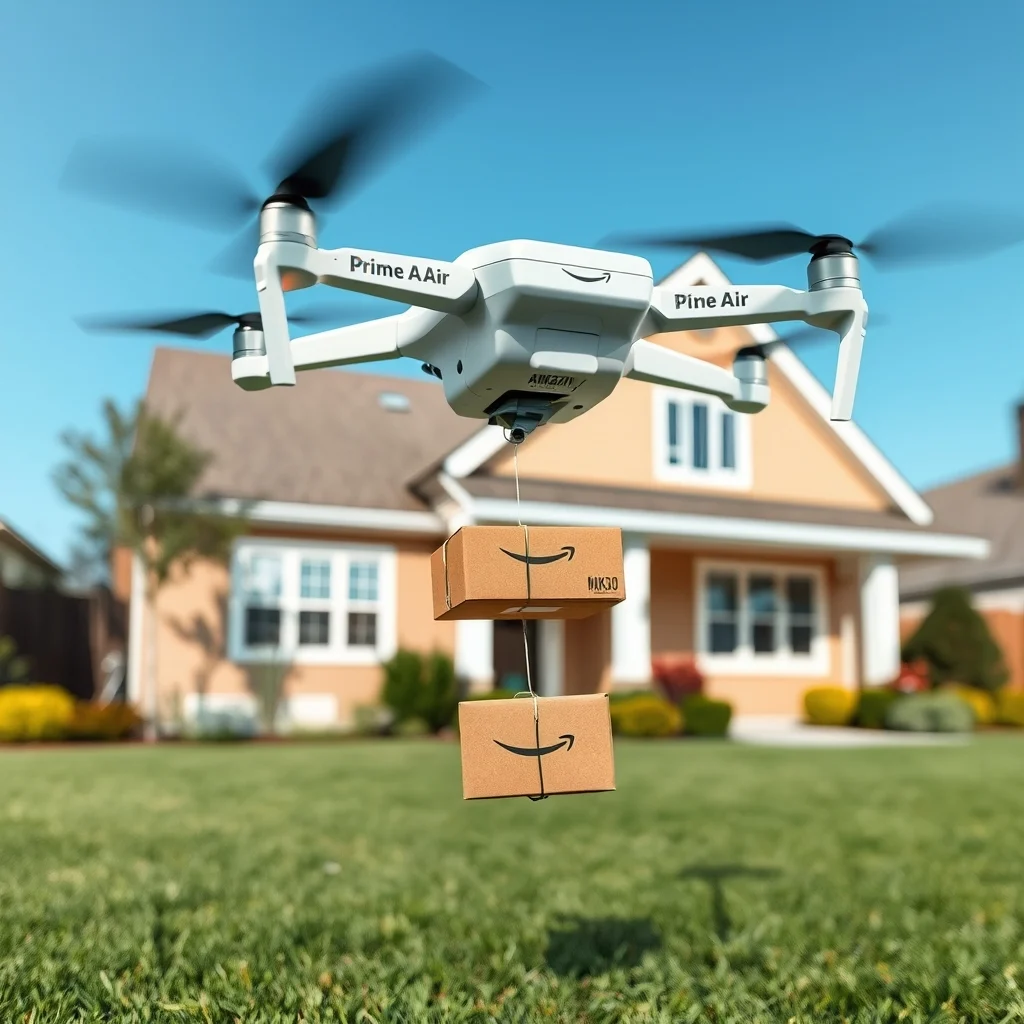
Amazon has officially launched its first drone delivery service in the UK, commencing operations in Darlington, County Durham. The groundbreaking initiative, which began recently, allows for the delivery of packages weighing under 5lb (2.2kg) to customers within a 7.5-mile (12km) radius of the company’s fulfilment centre, marking a significant step in the evolution of e-commerce logistics.
The pilot program focuses on everyday items such as beauty products, batteries, and cables, aiming to provide ultra-fast delivery for urgent needs. Amazon is confident in the demand for such rapid services and plans to gradually expand its drone delivery capabilities based on the success of this initial trial.
Context and Early Adopters
The adoption of drone delivery is the culmination of over a decade of development by Amazon. Rob Shield, a local farmer who provided his farm for early testing, shared his experience. Initially, the novelty led to frequent orders of various items, from stationery to snacks, simply to observe the drone’s operation.
“We had people come just to see it,” Shield remarked, highlighting the public fascination with the technology. He also noted the practical shift from novelty to necessity, ordering items like tape measures when needed for immediate tasks.
David Carbon, vice president of Amazon Prime Air, emphasized the customer-driven demand for speed. “The certainty is people have never told us they want their stuff slower,” he stated. Carbon illustrated potential use cases, such as delivering fever medication to children quickly, eliminating the need for a store visit.
Operational Details and Capabilities
In Darlington, Amazon’s drones are currently capable of making up to 10 flights per hour, potentially completing 100 deliveries daily on weekdays. The service operates within a 7.5-mile (12km) radius of the fulfilment centre.
The drones used are Amazon’s latest model, the MK30, equipped with advanced sensors designed to detect and avoid obstacles, including trampolines, washing lines, people, and other aircraft. Precise GPS navigation guides the drones to release packages at a designated drop-off point, typically 12ft (3.6m) above the ground.
“This is effectively an autonomous drone that can do what a pilot does in a flight deck. It can do what ground crews do, and it can deliver a package,” Carbon explained, noting the high safety standards employed.
Challenges and Limitations
Despite the technological advancements, widespread drone delivery faces hurdles. Dr. Anna Jackman, an associate professor of geography at the University of Reading, pointed out the challenges in densely populated urban environments. “The reality is [drone deliveries] don’t work well in high-rise buildings,” she noted.
While concepts like rooftop deliveries and central hubs are being explored, current infrastructure is not yet optimized for such scenarios. In Darlington, the requirement for a garden or yard for delivery highlights these practical limitations.
Amazon has faced minor setbacks, including an incident in February where an MK30 drone lost GPS signal and clipped a building in Texas, causing it to fall. Amazon has since adjusted its delivery parameters for similar building types. “This was an example of ‘things that we learn as we go along’,” Carbon commented, while highlighting that 170,000 flights had proceeded safely.
Regulatory Landscape and Future Outlook
For commercial drone operations to become routine, flying beyond the visual line of sight (BVLOS) is essential. Amazon is operating under this model in Darlington, with remote monitoring by operators and coordination with local air traffic control at Teeside Airport.
Darlington was chosen for its strategic mix of residential areas, major roads, and proximity to an airport, offering a diverse testing ground. The service has received approval from the Civil Aviation Authority for a trial period extending until the end of the year, with temporary protected airspace secured until mid-June, which is expected to be extended.
Darlington Borough Council has granted temporary planning permission, acknowledging the experimental nature of the scheme. A spokesperson stated, “It’s great to see Darlington at the forefront of such a pioneering scheme which highlights our borough as an area of innovation, development and investment.”
The launch timeline was longer than initially anticipated, with Amazon having previously suggested a 2023 start. However, Amazon remains committed to the commercial viability of drone delivery. “We wouldn’t be doing it if it wasn’t commercially viable. It’s a business, right? Absolutely, it can be commercially viable, and that’s the goal that we’re going after,” Carbon affirmed.
Broader Industry Trends
Amazon’s move follows trials by other organizations, including the NHS using drones for blood supplies in London and Royal Mail testing them for remote communities in Orkney. These parallel efforts underscore a growing industry trend towards integrating drone technology into logistical networks.
The success of Amazon’s Darlington trial could pave the way for wider adoption, potentially influencing delivery speeds, costs, and accessibility across the UK. As the regulatory environment evolves and technology matures, drone deliveries may transition from a novelty to a commonplace feature of the retail landscape.
Looking ahead, the key factors to watch will be the expansion of the service area, the ability to overcome urban delivery challenges, and the continued development of safety protocols. The long-term economic feasibility and public acceptance will also play crucial roles in shaping the future of drone-based e-commerce.










Leave a Reply