
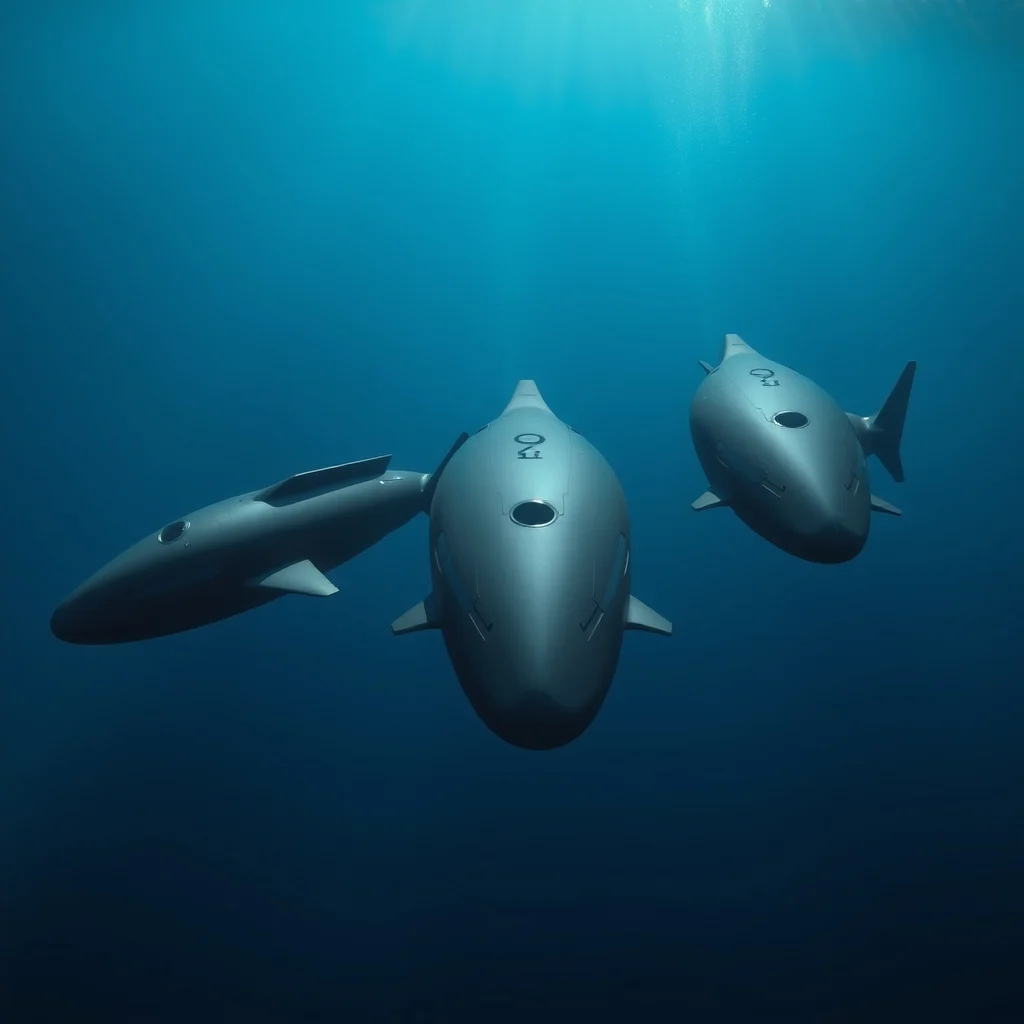
The United States, United Kingdom, and Australia have announced a joint initiative to develop advanced underwater drone technology, aiming to bolster defence capabilities and safeguard critical undersea infrastructure. This new project, slated for completion by next year, marks a significant step forward for the Aukus military alliance and its commitment to developing cutting-edge defence solutions. The UK has committed £150 million ($201 million) to the effort, as revealed by British Defence Secretary John Healey.
Defence Ministers Address Aukus Progress in Singapore
The announcement was made by the defence ministers of the three nations during a security summit in Singapore. This development comes as Aukus faces scrutiny over the pace of its projects. Defence Secretary John Healey acknowledged past criticisms, stating, “for too long in Aukus, we talked too much and delivered too little,” but asserted that “that has now changed under our three governments.”
Aukus: A Strategic Alliance for Advanced Capabilities
Launched in 2021, the Aukus defence pact aims to foster cooperation in developing nuclear submarines and sharing military expertise among the three countries. The alliance is widely perceived as a strategic response to China’s expanding maritime influence in the Indo-Pacific region and rising tensions in disputed areas like the South China Sea.
The uncrewed undersea vehicle (UUV) initiative represents the first major project under Pillar Two of Aukus, which focuses on collaborative development of “advanced capabilities” including long-range hypersonic missiles, undersea robotics, and artificial intelligence.
Underwater Drones: A New Frontier in Defence
A joint statement outlined that the UUV project will focus on developing “cutting edge payloads and enabling systems.” These advanced drones are envisioned for a range of missions, including protecting seabed infrastructure, conducting offensive strikes, performing surveillance and reconnaissance, and executing logistics operations. British Defence Secretary John Healey further elaborated that sensors and weapons systems would be integrated into the UUVs, providing forces with “advanced battle technologies.”
These capabilities are intended to counter emerging threats, particularly to vital undersea cables and pipelines that support global communication and energy networks. Healey indicated that such advancements would strengthen deterrence across the Pacific, Atlantic, and Arctic waters.
Addressing Undersea Threats: Russia and China in Focus
This announcement follows recent concerns about the security of undersea infrastructure. Just last month, Healey accused Russia of conducting covert operations targeting cables and pipelines in waters north of the UK, an allegation Moscow has denied. In December, the UK and Norway formalized a pact to jointly monitor Russian submarines in the North Atlantic specifically to protect undersea cables.
British officials report a significant increase in Russian vessel activity in UK waters, with a 30% rise observed in recent years. The UK’s extensive network of approximately 60 undersea cables is considered increasingly vulnerable. Elsewhere, Chinese vessels have been implicated in suspected damage to undersea cables near Taiwan and within Swedish territorial waters. Similar incidents have also been reported in the Baltic Sea.
When questioned by the BBC at the Singapore summit, the three defence ministers declined to comment on whether the UUV project specifically targeted Russian and Chinese undersea activities, or whether progress on Aukus projects had been slow.
Pillar One: Nuclear Submarine Development Continues
Under Pillar One of the Aukus agreement, the UK and Australia are set to develop and operate nuclear-powered attack submarines. For Australia, this represents a substantial enhancement of its military capabilities, making it only the second nation after the UK to gain access to Washington’s advanced nuclear propulsion technology.
However, the ambitious submarine project has faced persistent questions in Australia regarding its timeline and feasibility. The Aukus submarines are not expected to be ready until the 2040s. In the interim, the US and UK will rotate their existing nuclear-powered submarines through Australian waters, with Australia planning to acquire second-hand US nuclear submarines in the 2030s.
Addressing these concerns prior to the summit, Australian Defence Minister Richard Marles emphasized the necessity of the Aukus submarine program, stating there was no “plan B.” U.S. Defence Secretary Pete Hegseth affirmed that the submarine rotation plan remains on track, with U.S. Navy personnel scheduled to deploy to Australia later this year. Australian officials confirmed that the HMAS Stirling naval base in Western Australia will be equipped to host the rotational submarine force by the end of 2027, with substantial work underway to establish a construction yard in South Australia for the future Aukus submarines.
Future Implications and What to Watch Next
The accelerated development of underwater drone technology under Aukus signals a proactive approach to safeguarding critical maritime infrastructure and enhancing strategic deterrence. The success of this UUV project could set a precedent for future collaborative advanced capability developments within the alliance. Readers and industry observers will be watching closely to see how quickly these new autonomous systems are deployed and whether they effectively address the growing concerns over undersea threats. Furthermore, continued progress and transparency regarding the ambitious nuclear submarine program under Pillar One will remain a key focus, especially as geopolitical dynamics in the Indo-Pacific continue to evolve.










Leave a Reply