
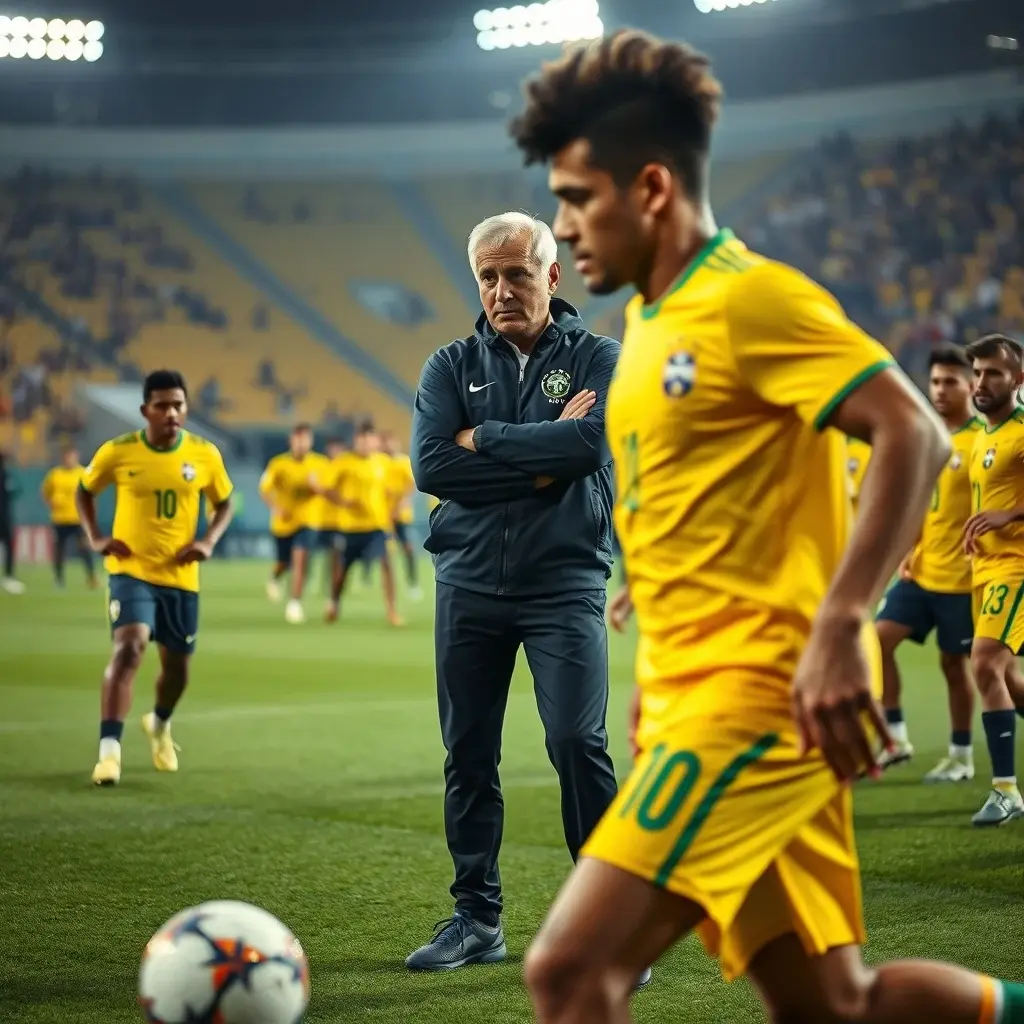
Brazil, under the guidance of seasoned coach Carlo Ancelotti, enters the 2026 FIFA World Cup facing significant challenges and a renewed sense of purpose following a turbulent qualification campaign. The Seleção endured their worst-ever qualifying run, marked by historic home and away defeats, internal political strife within the Brazilian Football Confederation (CBF), and the eventual sacking of their previous head coach. Despite these setbacks, the forgiving South American qualification format, offering six direct spots to ten teams, provided a lifeline, sparking optimism for both qualification and a strong tournament showing under Ancelotti’s leadership.
A Difficult Road to Qualification
The journey to the 2026 World Cup was fraught with peril for Brazil. Their qualifying campaign was marred by unexpected defeats, including losses to Argentina, Colombia, Uruguay, Paraguay, and Bolivia. A particularly historic moment was their first-ever home defeat in World Cup qualifying, falling 4-1 to Lionel Messi’s Argentina in Buenos Aires in March 2025. This alarming performance led to the dismissal of head coach Dorival Júnior and even cast doubt on Brazil’s participation in the tournament.
However, the landscape shifted dramatically with the appointment of Carlo Ancelotti in May 2025. The Italian manager, renowned for his unparalleled success at the club level, took on the monumental task of revitalizing the five-time world champions. His arrival injected a fresh wave of hope, transforming the narrative from mere qualification to genuine title contention.
Ancelotti’s Tactical Approach and Squad Concerns
Ancelotti has consistently favored a dynamic 4-2-4 formation since taking the helm, a system he aims to implement at the World Cup. This tactical setup relies on robust defensive midfielders to support the attack and create width. However, the team faces significant hurdles due to a string of key player injuries, including prominent figures like Eder Militão, Rodrygo, and Estêvão.
The coach acknowledged these limitations, stating in March, “Considering the players we have at our disposal, we believe the best model of play for us is to go with four up front.” A notable concern within this system is the perceived lack of high-caliber full-backs, a position historically dominated by Brazilian legends such as Cafu, Roberto Carlos, Marcelo, and Dani Alves.
Neymar’s Inclusion and Reliance on Pace
The question of Neymar’s inclusion in the squad dominated discussions leading up to the final selection. At 34 years old, the Santos forward ultimately secured a place in Ancelotti’s 26-man roster, with the coach citing his recent continuity and good physical condition. “We realized that in this last period he had continuity and was in good physical condition,” Ancelotti explained.
Despite his inclusion, Neymar is unlikely to be a starter. Brazil’s tactical approach, as demonstrated in recent friendlies against France and Croatia, leans heavily on counterattacks and exploiting the blistering pace of players like Vinícius Júnior. This strategy mirrors Ancelotti’s successful tactics during his tenure at Real Madrid, aiming to leverage speed and individual brilliance on the break.
The Manager and Star Power
Carlo Ancelotti’s resume is legendary, boasting a record five Champions League titles and unparalleled success across major European leagues. At 66, embarking on the challenge of coaching Brazil represents a unique chapter in his illustrious career. “Coaching Brazil is highly motivating,” he told Estadão in 2025. “I believe this is one of the most important moments of my career.”
Despite early struggles, including injuries and pressure surrounding Neymar’s selection, Ancelotti maintains his characteristic composure. “I’m not obsessed with winning,” he remarked to The Guardian in May. “What I have is a passion for enjoying the moments that football has given me.”
Vinícius Júnior: The Focal Point
Vinícius Júnior stands as one of the world’s elite players, yet his international statistics with Brazil—eight goals and seven assists in 47 matches—have not yet mirrored his club heroics. The 2026 World Cup presents a crucial opportunity for him to redefine his narrative in the iconic No. 10 shirt. “If Vinicius is focused on the game, focused on his football, he is the best in the world,” Casemiro stated in 2025. “In that way, he is the best. But that’s not easy, because he is constantly provoked.” Ancelotti’s strategy will likely center on maximizing Vini Jr.’s impact, particularly on the counter.
Endrick: The Rising Star
Young sensation Endrick needed a period of adjustment to reach his current form. After being overlooked at Real Madrid, a loan spell at Lyon saw him flourish, contributing 12 goals and assists in 17 Ligue 1 appearances. Ancelotti swiftly recalled him to the national team, and Endrick proved his worth as a substitute against Croatia, sparking a comeback victory.
While not expected to be in the starting XI initially, Endrick’s dynamism and impact off the bench could make him a vital weapon for Brazil as the tournament progresses.
Gabriel Magalhães: The Defensive Anchor
Gabriel Magalhães has cemented his status as one of the world’s premier center-backs during Arsenal’s ascent. At the World Cup, while attacking talents like Raphinha and Vinícius Júnior, and goalkeeper Alisson, will garner attention, Gabriel’s role in stabilizing the defense is paramount. “When you talk about the Brazilian national team, you have to work every day, work at your club so you can arrive here in top form,” Gabriel said in 2025. “I know I’m doing very well, but I also know the level I can still reach.” His leadership and defensive prowess will be crucial for Brazil’s success.
Fan Support and Expectations
Brazil’s contingent of supporters in the United States, estimated at over 2.8 million, is expected to create a home-like atmosphere. With two of their three group stage matches scheduled in regions with large Brazilian populations, venues like MetLife Stadium and Hard Rock Stadium are anticipated to resonate with the energy of the Maracanã. The presence of the organized supporters’ group Movimento Verde Amarelo, backed by fan clubs from 40 different Brazilian clubs, further ensures a vocal and passionate Brazilian presence throughout the tournament.
Looking Ahead
Brazil’s path to the 2026 World Cup, though arduous, has forged resilience and adaptability within the squad. The strategic vision of Carlo Ancelotti, coupled with the individual brilliance of stars like Vinícius Júnior and the emerging talent of Endrick, positions them as a team to watch. Key to their success will be overcoming defensive frailties, integrating Neymar effectively, and the consistent performances of their defensive bedrock, Gabriel Magalhães. The overwhelming fan support promises an electric atmosphere, potentially providing the Seleção with a crucial psychological advantage as they aim to reclaim World Cup glory.










Leave a Reply