
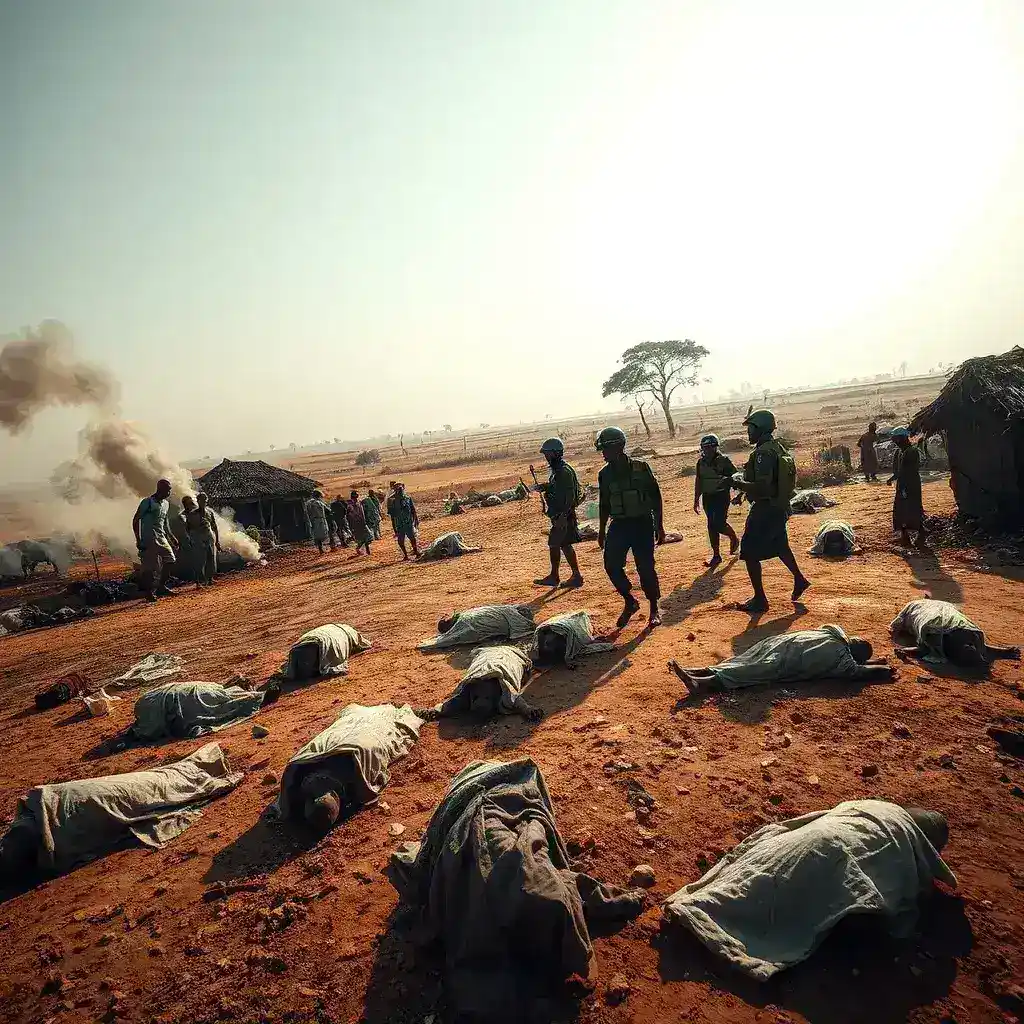
At least 69 people have been killed in coordinated attacks by the CODECO militia in the Ituri province of the Democratic Republic of the Congo in late April. Security officials confirmed the rebel group carried out the assault in the country’s restive northeast, a mineral-rich region frequently contested by armed groups vying for control over valuable resources.
Retaliatory Cycles of Violence
The killings appear to be a reprisal for an earlier clash involving the Convention for the Popular Revolution (CRP). This Hema-affiliated group recently attacked Congolese army positions near Pimbo. CODECO fighters, who claim to represent the Lendu community, responded with retaliatory strikes across several villages. The violence highlights the long-standing ethnic conflict between the Lendu and Hema communities in Ituri, a province bordering Uganda and South Sudan.
Recovery Efforts Hampered by Insecurity
The presence of armed militants significantly delayed the recovery of deceased individuals for several days. Civil society leader Dieudonne Losa reported that only 25 bodies had been buried, with more than 70 people killed according to his count. He noted that several remains have yet to be retrieved. A humanitarian source described grim scenes of bodies strewn on the ground near the village of Bassa. While security sources reported a toll of 69, including 19 militia members and soldiers, local officials suggest the number is higher.
International Response and Condemnation
The UN peacekeeping mission, MONUSCO, rescued nearly 200 people caught under fire during the initial CRP assault. MONUSCO strongly condemned the recent wave of deadly attacks targeting civilians. UN spokesman Farhan Haq confirmed that at least 34 civilians were killed in a three-day period across Ituri and North Kivu. He highlighted the dire humanitarian toll, as the violence continues to drive massive displacement across the northern parts of eastern DRC. The Ente association described the killings as a “massacre” and urged Hema community members to avoid further retaliation.
Historical Roots of Mineral Conflict
For over 30 years, the DRC has grappled with corruption and bloodshed linked to its vast mineral wealth, which includes cobalt, copper, uranium, and diamonds. This abundance of resources fuels various militia groups and contributes to a humanitarian crisis that has displaced nearly one million people in Ituri alone, according to the UN Office for the Coordination of Humanitarian Affairs (OCHA).
Resurgence of Notorious Warlords
The province has seen a resurgence of the CRP, a group founded by Thomas Lubanga. Lubanga, found guilty by the International Criminal Court for recruiting child soldiers and released in 2020, has seen his forces engaged in conflict with the national army and CODECO. These clashes are characterized by widespread civilian abuses. Paradoxically, the Congolese army has sometimes utilized CODECO as an auxiliary force despite the group’s history of violence.
Overstretched Security Forces
The Congolese military faces a complex security landscape, including the Allied Democratic Forces (ADF), which has pledged allegiance to the Islamic State. Amnesty International’s Rawya Rageh notes that Congolese authorities face multiple challenges due to competing actors like M23, ADF, and CODECO. Most forces are overstretched responding to the threat from the Rwanda-backed M23 rebel group, which has seized key cities in the eastern region.
Escalating Regional Instability and ADF Abuses
The ADF has intensified its brutal campaign, killing at least 40 people and looting homes in cross-border raids between Ituri and North Kivu. Charité Banza, leader of an Ituri civil society group, confirmed 15 victims in Ituri and 25 in North Kivu. This surge follows a previous “bloodbath” that claimed 66 lives. Despite joint Ugandan and Congolese troop deployments since 2021, Amnesty International warns that diverted forces create security gaps that rebels exploit. Local officials fear the death toll will rise as many residents remain missing, leaving civilian populations vulnerable.
Findings of War Crimes and Crimes Against Humanity
Amnesty International has formally accused the ADF of war crimes and crimes against humanity in a recent report. The group is cited for systematic kidnappings, forced labor, recruiting child soldiers, and horrific crimes against women and girls, including forced marriage and sexual violence. Secretary-General Agnes Callamard stated these abuses must not be ignored.
Continental Stakes and African Solidarity
The instability in the DRC remains a focal point for the African Union and regional bodies like the East African Community. For nations contributing to UN peacekeeping missions, the deteriorating situation challenges the doctrine of “African solutions to African problems.” The persistent presence of foreign-affiliated groups like the ADF threatens to destabilize the entire Great Lakes region.
A Call for Sustained African Leadership
The latest massacre in Ituri underscores the fragility of peace in one of Africa’s most resource-rich zones. True stability requires more than military intervention; it demands a unified continental approach to resource governance and ethnic reconciliation. As 2026 progresses, the priority must remain on protecting African lives and ensuring the nation’s wealth benefits its people, rather than fueling perpetual militia warfare.










Leave a Reply