
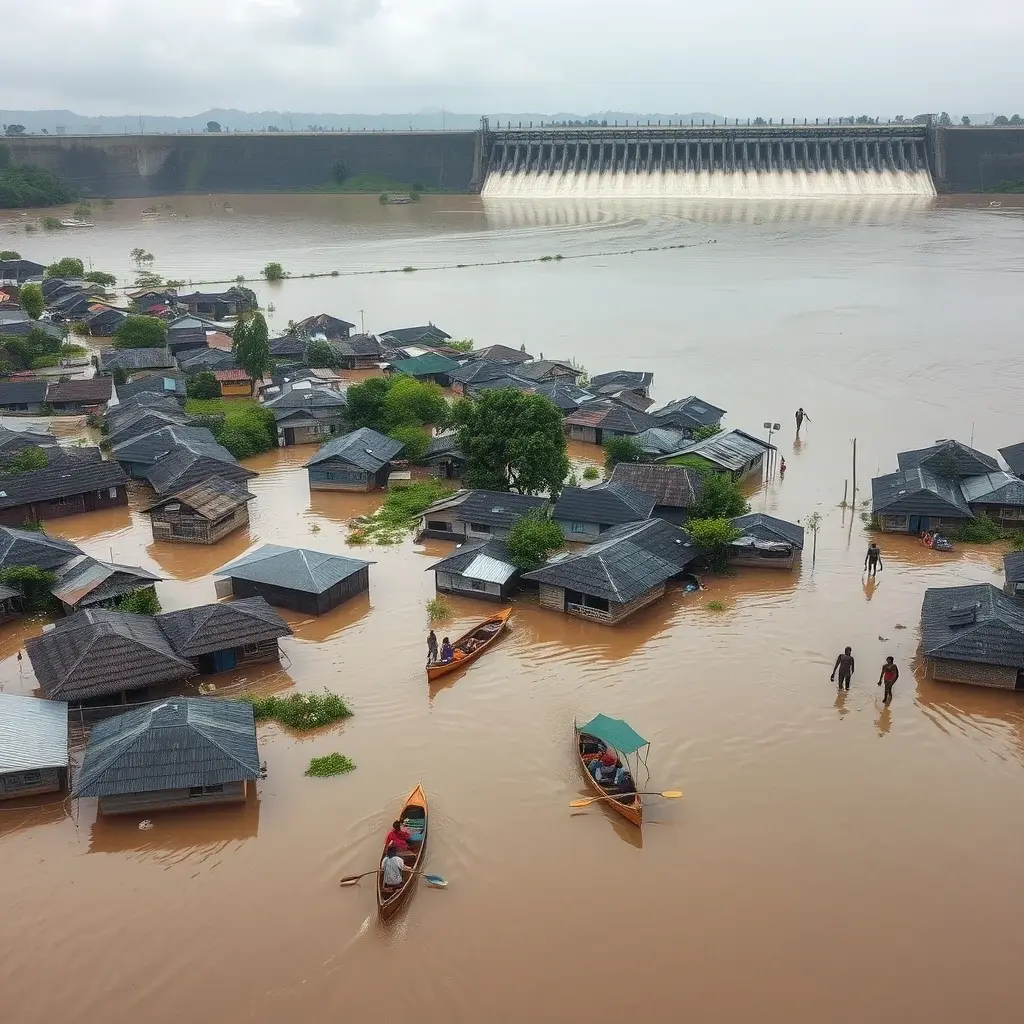
Residents in parts of Weija-Gbawe, Ghana, are grappling with severe flooding after the Weija Dam spilled its excess water, submerging homes and displacing hundreds. For four years, community-led dredging efforts had successfully kept these areas flood-free, a stark contrast to the current crisis where local leaders accuse authorities of neglecting crucial dam maintenance and failing to provide adequate notice of the spillage.
Dam Spillage Triggers Widespread Flooding
By Thursday, even as the rains subsided, residents in communities like Tetegu, Sampah Valley, and Choice were still navigating knee-deep floodwaters. They relied on canoes for essential tasks, including moving belongings, accessing food, and evacuating vulnerable individuals. The flooding followed an emergency spillage of water from the Weija Dam, initiated by Ghana Water Limited (GWL) after water levels surpassed the 48-foot maximum operating threshold. GWL stated the controlled spillage was necessary to safeguard the dam’s structural integrity.
Community Efforts Undermined by Inaction
Mawuenyega Atukpa, the Assembly Member for the affected area, highlighted the community’s emergency response measures. Residents and local leaders are actively assisting those stranded, helping to move belongings and providing canoe services. “So, we are seated here to help people carry their stuff from their homes and also help people with the canoe, especially in the flooded areas, so that the water doesn’t carry them away,” Atukpa explained. He added that some families have lost nearly all their possessions and are in dire need of food and supplies, which the community is attempting to provide.
Atukpa revealed that the absence of flooding for the past four years was a direct result of residents’ self-initiated dredging projects. “There haven’t been any flooding issues for the past four years, and this was because we, the community folks, agreed to dredge the dam ourselves since the Ghana Water Company was not paying attention to it, and we used that as an embankment for the whole community,” he stated. He pointed out that the areas where community efforts were not undertaken are precisely where the water has now breached, causing the current devastation.
Allegations of Negligence and Poor Communication
A significant point of contention raised by Atukpa is the management of the estuary, which he claims is often blocked, hindering the drainage of floodwaters. “One major challenge is that when the Ghana Water Company is about to spill water from the dam, they do not check whether the estuary is open or not. They just go ahead and spill it,” he alleged. He recounted instances where previous community efforts to clear the estuary resulted in rapid drainage, stating, “When this happened four years ago, and we went to open the estuary, within two hours the place became dry.”
Furthermore, Atukpa accused GWL of failing to provide timely and adequate notification before the latest spillage. “Secondly, the Ghana Water Company Limited did not give us any prior notice that the dam would be opened for them to spill water and that the water level would rise to that extent,” he claimed. This lack of communication, he asserted, hampered the community’s ability to prepare and respond effectively, as their local information center, typically used for such announcements, received no prior warning.
These concerns are echoed by other local authorities. The Municipal Chief Executive for Weija-Gbawe publicly stated that the Assembly was not informed in advance of the spillage, complicating preparedness and response efforts.
GWL’s Position and Calls for Long-Term Solutions
Ghana Water Limited, however, maintains that the spillage was unavoidable due to rising inflows overwhelming the dam’s capacity. GWL has issued warnings to downstream communities, urging residents to evacuate flood-prone areas in anticipation of further rainfall upstream.
Assembly Member Atukpa is now appealing for sustainable, long-term engineering solutions. “So, my humble plea is that the estuary should be constructed in such a way that it remains permanently opened,” he urged. He also stressed the need for consistent government investment in dam maintenance, particularly dredging. “Also, the government should make sure that the maintenance component, which is dredging the dam, is properly implemented because the sand in the water becomes too much.” The lack of basic drainage infrastructure in the community was also highlighted as a critical issue requiring government intervention.
Ongoing Response and Future Outlook
Emergency response agencies continue their efforts to evacuate residents and provide assistance. Many homes, roads, and businesses remain submerged days after the spillage began. Authorities have mandated evacuations in vulnerable downstream communities as floodwaters persist in some areas. The situation underscores the recurring challenges faced by communities near the Weija Dam and the urgent need for improved infrastructure and proactive management by relevant authorities.










Leave a Reply