
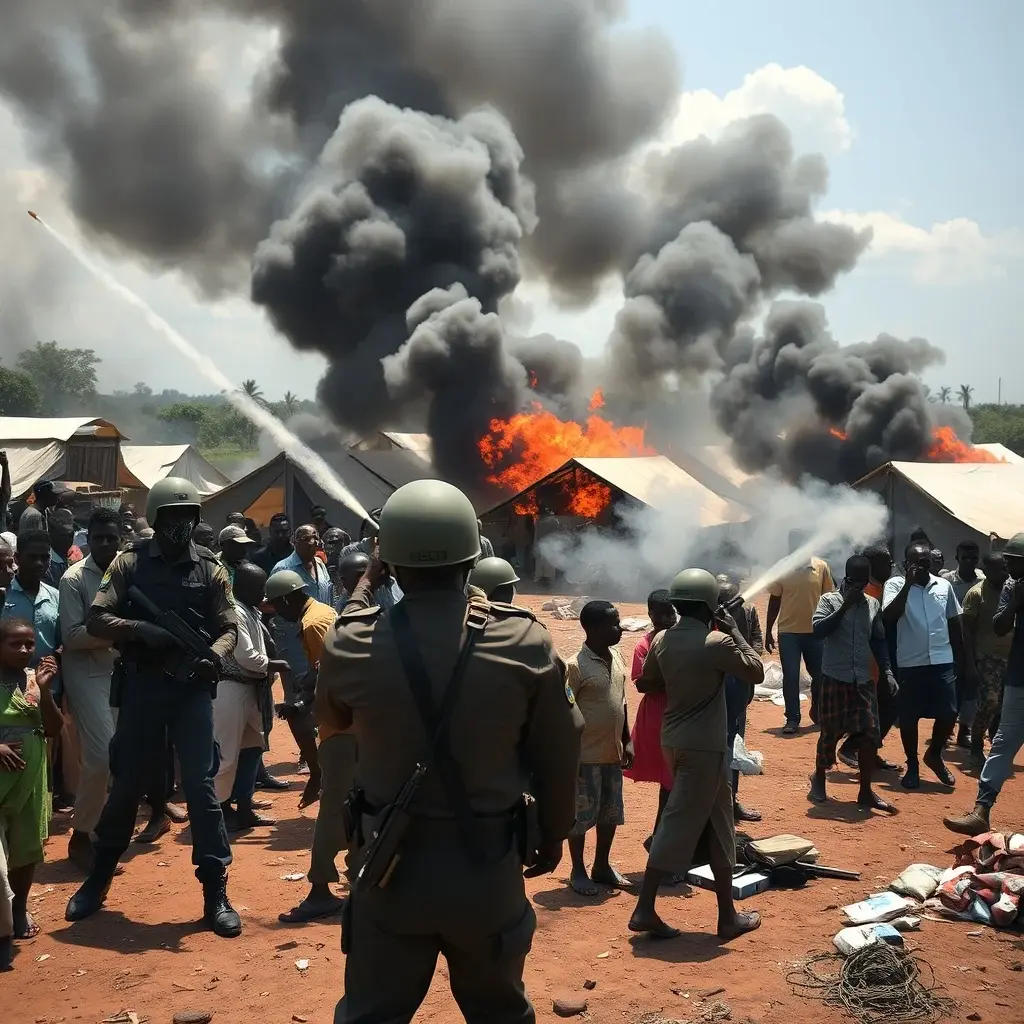
Police fired warning shots and tear gas in Rwampara, northeastern Democratic Republic of Congo, on Thursday morning to disperse a crowd attempting to claim the body of a suspected Ebola victim, a local footballer. The incident, which saw protesters burn down tents used for Ebola patients, underscores the significant challenges authorities face in enforcing safe burial practices crucial to containing the ongoing outbreak.
Context of the Outbreak
The dispute occurred in Rwampara, a town severely affected by the current Ebola outbreak, caused by the Bundibugyo strain. This particular strain of Ebola lacks an approved vaccine or treatment, complicating response efforts.
Safe burials are a critical component of Ebola containment. The bodies of victims are highly infectious, and unsafe burial practices, where family members handle the deceased without proper protective equipment, are identified as a primary driver of transmission. This was tragically demonstrated in the current outbreak when the first known case died in Bunia on April 24, and the virus spread after his body was returned to his hometown of Mongbwalu for a funeral attended by mourners who touched him.
Dispute Over Footballer’s Burial
On Thursday, the family of Eli Munongo Wangu, a well-known local footballer, refused a safe burial for him. They disputed the official suspected Ebola diagnosis and demanded to take possession of his body.
Munongo had been admitted to the hospital days prior, and a doctor confirmed he was a suspected Ebola case, with samples sent for testing. However, his mother maintained her belief that he died of typhoid fever.
Family, friends, and neighbors gathered outside the hospital to retrieve the body for a traditional burial, defying strict instructions for safe handling of suspected Ebola victims, according to senior police officer Jean-Claude Mukendi.
Escalation and Damage
Tensions escalated as soldiers attempted to mediate. Police eventually intervened, deploying tear gas and firing warning shots to disperse the crowd.
Following the police action, the crowd set fire to two tents operated by the medical charity ALIMA. These tents, equipped with eight beds, were completely destroyed, along with a body awaiting burial. Six patients who were receiving treatment in the tents were safely transferred to the main hospital, according to ALIMA.
Mistrust and Disinformation
Local customary chief Batakura Zamundu Mugeni stated that authorities are working with health officials to trace any patients who may have fled and to identify their contacts.
Mukendi attributed the unrest to “young people who do not grasp the reality of the disease.” This incident echoes past challenges in Congo, where mistrust and disinformation have significantly hampered Ebola response efforts.
During the 2018-2020 outbreak in North Kivu, hundreds of health centers were attacked by armed groups and civilians, contributing to nearly 2,300 fatalities. The current outbreak, declared by the Congolese government last Friday, is already the third largest on record.
Data and National Impact
As of Thursday, the DRC health ministry reported 670 suspected cases and 160 suspected deaths in the current outbreak.
The severity of the outbreak has also impacted national activities. Congo’s national soccer team was forced to cancel World Cup buildup events in Kinshasa. They will now continue their preparations in Belgium to comply with U.S. travel restrictions.
Looking Ahead
The incident in Rwampara highlights the critical need for community engagement and effective communication strategies to build trust and combat misinformation surrounding Ebola. Authorities will need to work closely with local leaders and families to ensure adherence to safe burial protocols without alienating communities.
The ongoing efforts to trace contacts and manage patient movements will be crucial in the coming days. Observers will be watching to see if successful community engagement can mitigate the risks of transmission driven by cultural practices and skepticism, especially in areas affected by the Bundibugyo strain for which no specific treatments exist.










Leave a Reply