
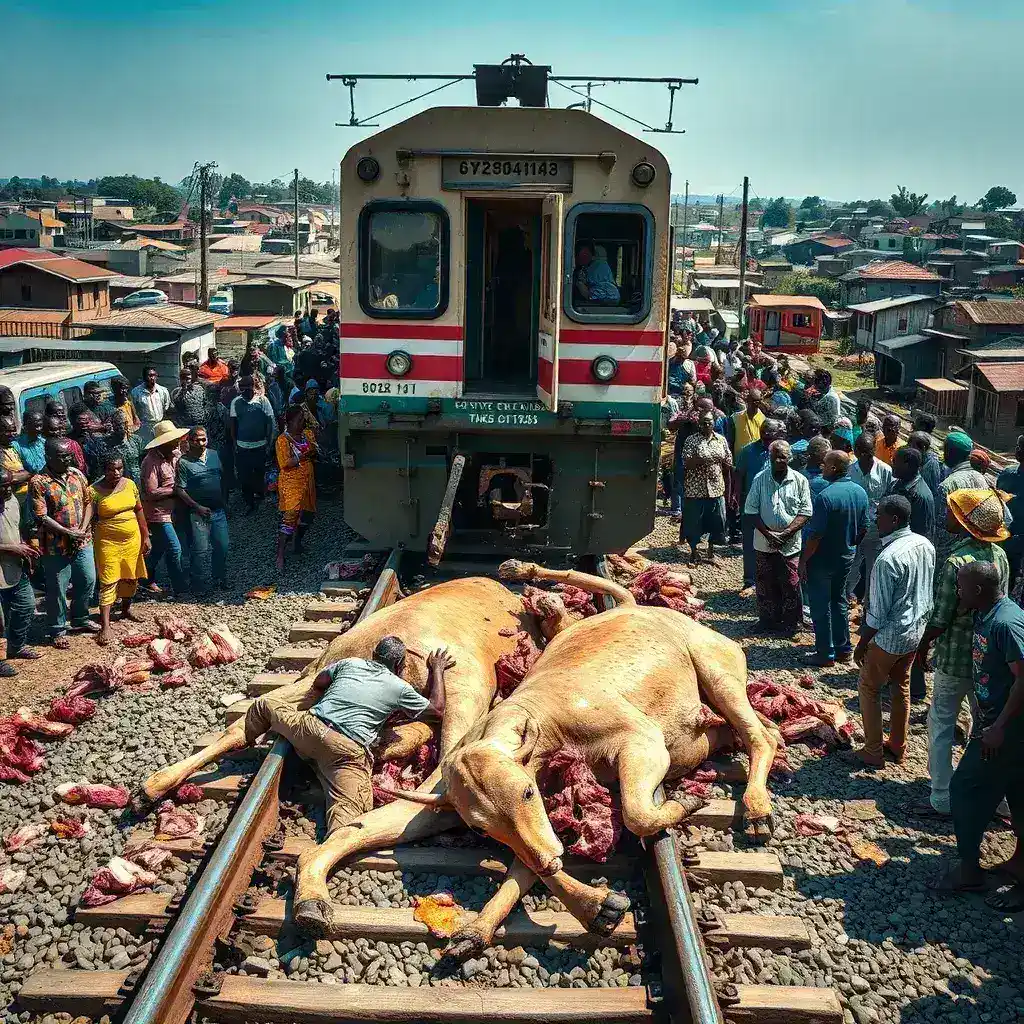
Two cows were killed and residents rushed to collect meat from the railway tracks in Accra’s Avenor area on Thursday morning after a passenger train struck the animals. The incident occurred around 7 a.m. when a train traveling from Tema to Accra collided with the cattle, causing a temporary halt to rail operations and sparking a chaotic scene of people butchering the carcasses.
Context of the Incident
The collision involved a five-coach passenger train operating on the Tema-Accra line. Such incidents, while not unheard of, highlight ongoing issues with animal husbandry and land use around critical infrastructure like railway lines. The Ghana Railway Company Limited (GRCL) has frequently appealed for stronger measures to prevent animals from straying onto tracks.
Eyewitnesses described the dramatic moments following the collision. The train, traveling at speed, first hit one cow and then a second. Fortunately, the train driver managed to bring the vehicle to a halt before it could derail or cause further damage, narrowly avoiding a more catastrophic event that could have impacted nearby shops.
On-the-Scene Reaction and Disruption
Immediately after the train stopped, a crowd of onlookers gathered. Many were seen using knives and other tools to cut portions of meat from the two deceased animals. This immediate post-accident gathering for meat is a practice observed in some communities when large animals are involved in accidents, particularly if ownership is unclear or immediate disposal is desired.
The incident significantly disrupted train services. Passengers on board the affected train were forced to seek alternative transportation to complete their journeys to Accra. Railway officials were quickly on the scene to manage the situation, assess the damage, and secure the area to ensure the safety of passengers and the public.
Mohammed Iddrissu, an eyewitness, recounted the event to JoyNews, emphasizing the near-miss. “I really thank the driver, or I will say God really saved them, because it nearly made the train move off the railway and it was going to enter people’s shops. But the driver was able to stop the train in time,” he said.
Official Response and Safety Concerns
Daniel Asiedu, the Area Railway Manager for GRCL, confirmed the incident and clarified that there was no derailment, contrary to some initial reports. He stated, “Our train was running from Tema to Accra around 7:40 a.m. when we received reports that it had hit a cow on the track. Let me clarify that there was no derailment. However, the impact disrupted operations and we had to manage the situation carefully.”
Mr. Asiedu used the incident to reiterate calls for stricter enforcement against encroachment on railway lines. He appealed for greater support from local authorities to protect railway infrastructure from such intrusions, which pose significant safety risks. “We will need support from authorities to help us deal with people who are encroaching on the railway infrastructure and to protect our assets,” he stated.
Efforts were underway to clear the tracks and remove the animal carcasses to restore normal train operations. GRCL officials indicated that services were expected to resume later in the day after the necessary recovery and safety checks were completed. Investigations into the exact circumstances of the accident are ongoing.
Implications and Future Outlook
This incident serves as a stark reminder of the persistent challenges faced by railway operators in urban and peri-urban areas. The practice of allowing livestock to roam freely near active railway lines poses a significant danger not only to the animals but also to passengers and railway infrastructure.
Authorities are advising residents and cattle owners living along railway corridors to be more vigilant and ensure their animals are kept away from the tracks. The GRCL is expected to intensify its public awareness campaigns and work with local government agencies to implement preventative measures. The long-term solution likely involves better land management, stricter regulation of livestock, and improved fencing or barriers along vulnerable sections of the railway network.
Moving forward, the focus will be on preventing recurrence. This could involve increased patrols by railway authorities, the installation of more robust warning systems, and potentially more severe penalties for cattle owners whose animals are found on the tracks. The cooperation of the local community in safeguarding this vital transportation artery will be crucial.










Leave a Reply