
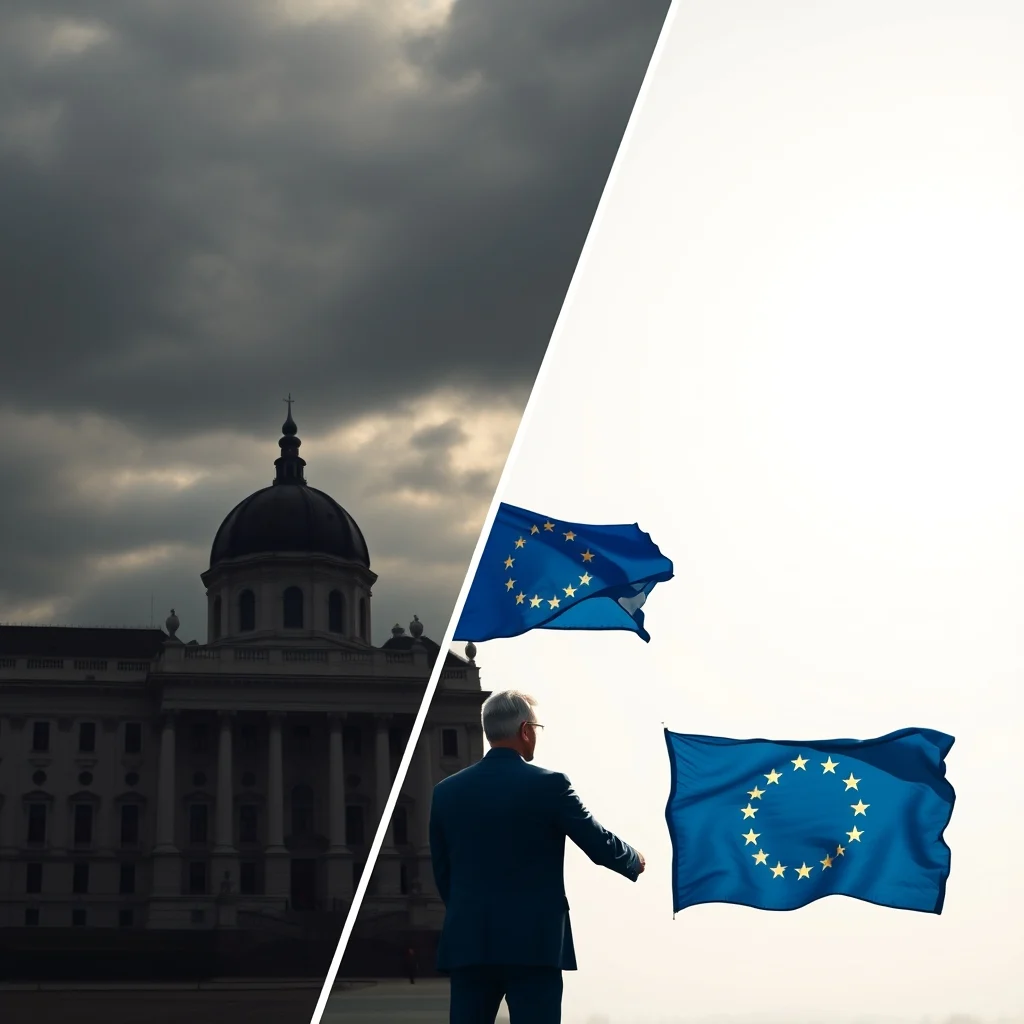
European Commission President Ursula von der Leyen announced today that the EU will release €16.4 billion in frozen funds to Hungary, contingent on the new government led by Prime Minister Péter Magyar implementing a series of reforms. The decision marks a significant shift in EU-Hungary relations and a major win for Magyar, who took office less than three weeks ago after a decisive election victory over Viktor Orbán.
Magyar hailed the agreement as a “historic breakthrough,” while von der Leyen stated, “we can already feel a strong wind of change across Hungary.” The substantial financial package is intended to bolster Hungary’s economy, which has been impacted by the previous government’s policies.
Rebuilding Trust and Unlocking Funds
The funding had been suspended by the European Union due to concerns over democratic backsliding and allegations of corruption under Orbán’s Fidesz-led administration. Unlocking these funds was a central promise of Magyar’s Tisza party during the recent election campaign.
Von der Leyen commended Magyar’s government for taking steps to rebuild trust with the EU. “We will take no shortcuts, we will address all issues,” she assured, indicating a commitment to thorough oversight of the reform process.
A significant portion of the funds, €10 billion, originates from a COVID-19 recovery facility. Magyar’s government faced an August deadline to meet stringent “super-milestones” related to anti-corruption and rule-of-law measures to access this money.
“Strong signals that Hungary is turning the page” were noted by von der Leyen. These include Hungary’s decision to join the European Public Prosecutor’s Office, revise public procurement laws, and address issues with public interest trusts, which under the previous government were used to place government loyalists in control of institutions like hospitals and universities.
Economic and Social Investment
An additional €6.4 billion will be released from EU cohesion funds, designated for strengthening the economic and social infrastructure across the 27-member bloc.
Magyar emphasized the importance of the deal, noting that the EU funding represents approximately 13% of Hungary’s total national budget. He highlighted that talks with the EU had progressed rapidly, leading to an agreement that is “really, really important for the Hungarian people.”
The unlocked funds are earmarked for critical sectors including health, transport, and education. Specifically, €1.5 billion will be allocated to enhance Hungary’s electricity grid, with a focus on renewable energy sources like solar and wind power.
Furthermore, €2 billion is designated for the procurement of new intercity trains, aiming to modernize the country’s public transportation network.
Addressing Corruption and Political Change
Magyar directly challenged his predecessor, accusing Viktor Orbán of misleading the Hungarian public about the reasons for the EU funding freeze. Magyar asserted that the “corruption was at an incredible rate in Hungary” under the previous government.
He reiterated his long-standing argument that EU funds would be restored upon Hungary’s adoption of anti-corruption measures and regulations against cronyism. “These steps and just a few weeks were enough to conclude a political agreement about these incredibly important funds,” he stated.
Viktor Orbán resigned as a Member of Parliament last month and is facing a party congress in June to decide his future as Fidesz party chairman. His potential return to the premiership appears to be further complicated by recent actions from Magyar’s Tisza party.
Tisza has proposed a constitutional amendment to limit a prime minister to a maximum of eight years in office, a move that would effectively bar Orbán from seeking the top position again. The party secured a two-thirds majority in the recent election, granting it the power to enact constitutional reforms.
Rejoining EU Programs
In a related development, the European Commission president confirmed that Hungarian students will once again be permitted to participate in the Erasmus exchange program. This program had been suspended for students from over 20 Hungarian universities since December 2022, following the previous government’s decision to place these institutions under political control via public interest trusts.
The swift unblocking of funds and the positive signals from Budapest suggest a new era of cooperation between Hungary and the European Union. The focus now shifts to the implementation of the promised reforms and their impact on Hungary’s governance and economy.










Leave a Reply