
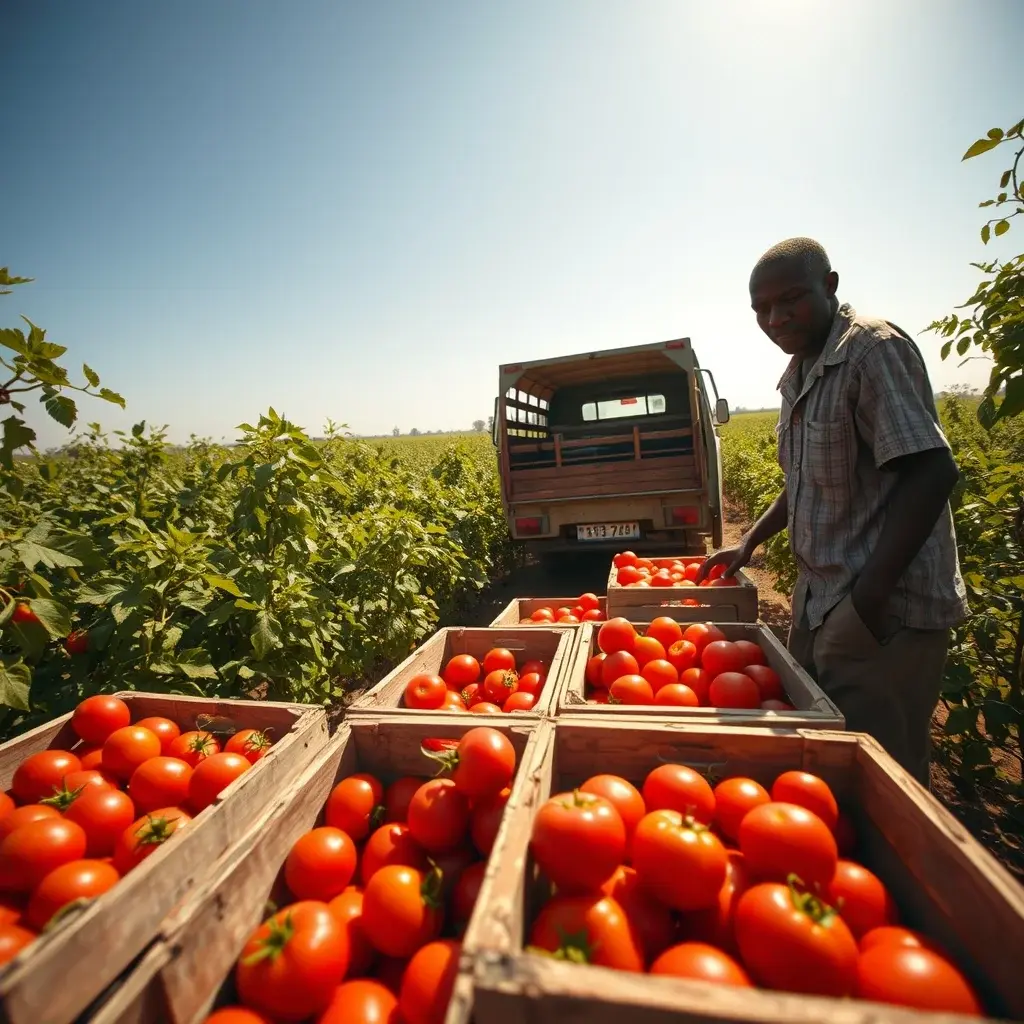
In a quiet field forty kilometers outside a major African city, a recent tomato harvest revealed a potent lesson about wealth creation, challenging conventional notions of investment and highlighting a significant untapped economic engine. The discovery was made by a professional who, initially viewing land acquisition as a wealth preservation strategy, witnessed firsthand how a neighbor, Willy Kibuuka, was actively generating substantial income through simple, effective farming practices, prompting a reevaluation of the continent’s economic potential.
Context: Global Uncertainty and Local Potential
The global landscape is marked by increasing geopolitical tensions, shifting trade routes, and tightening development financing. Conversations around food security, debt, and economic uncertainty are prevalent in boardrooms and policy circles, leading many to focus on external shocks and their implications for Africa’s future. Amidst this backdrop of global instability, the author’s personal experience offered a stark contrast, pointing towards a more localized and accessible path to prosperity.
The Tomato Harvest: A Microcosm of Enterprise
What began as a professional’s attempt to preserve wealth through land ownership transformed into an observation of active wealth creation. The author encountered a neighbor, Willy Kibuuka, harvesting tomatoes from his farm. Kibuuka’s operation was already yielding significant results, with two trucks loaded and a potential third harvest in sight. The sales from approximately sixty crates per truck, at an estimated $135 per crate, suggested an income of close to USD 8,100, with the season not yet concluded.
The simplicity of Kibuuka’s operation was striking. There was no visible sophisticated infrastructure or expensive machinery, dispelling common associations with innovation. Yet, Kibuuka was successfully moving product at scale, capturing value through basic production methods. When questioned about distant geopolitical events like the closure of the Strait of Hormuz, Kibuuka showed little concern, dismissing them as irrelevant to his immediate operations.
Focus on Execution Over Headlines
Kibuuka’s perspective on market fluctuations was particularly insightful. He viewed price increases as a normal part of business, emphasizing that survival depended on knowing when to harvest and how to price the crop. This focus on timing, markets, and execution stood in contrast to the author’s own preoccupation with global headlines and uncertainty. Kibuuka’s prosperity was directly tied to entrepreneurial decisions, not abstract global risks.
Furthermore, Kibuuka appeared to be mitigating post-harvest losses, a persistent challenge in African agriculture. Efficient logistics and market absorption ensured that value was captured before it dissipated. This observation highlighted a critical difference: while many professionals grapple with theoretical risks and unrealized potential, individuals like Kibuuka are actively engaged in execution and value capture.
Bridging the Intention-Action Gap
The author reflected on the disparity between their own resources—more land, education, networks, and capital—and Kibuuka’s active success. This led to the concept of the intention-action gap, where information and capability are present, but activation is lacking. Africa, with nearly 60% of the world’s uncultivated arable land, faces a similar challenge, often discussed in terms of food insecurity and unrealized agricultural potential. This statistic could be viewed as a vast intention-action gap in economic development.
This reflection extends to urban professionals who own land but keep it dormant while discussing opportunities elsewhere. The experience suggests that resources are not the primary differentiator, but rather behavior—preserving assets versus activating them.
Stories of Activation and Emerging Prosperity
Conversations with peers revealed further examples of this ‘activation’ phenomenon. One friend shared the story of an onion farmer near Nairobi who, after initial failures, began generating approximately $30,000 per month from 12 acres. Another highlighted export opportunities in banana puree, showcasing diverse value chains beyond traditional farming.
These narratives underscore that Africa’s prosperity is not a future aspiration but a present reality being built. The challenge lies in recognizing, amplifying, and participating in this growth. Aggie Asiimwe Konde of AGRA emphasizes that farmers are entrepreneurs who continuously test, adapt, and absorb risk, with prosperity often favoring those who act before certainty arrives.
Implications and Future Outlook
The author poses a challenge to professionals in boardrooms and urban centers: to assess the collective idle land and consider activating these dormant assets. The potential for widespread prosperity hinges on moving beyond discussions of opportunity to showcasing existing achievements. For the author, this experience shifted perspective, prompting exploration into organic farming with an export lens for their own land, recognizing it as a dormant enterprise rather than mere preserved capital.
At a time of global uncertainty, Africa’s next prosperity story may not be found in distant solutions but in the quiet activation of its own resources. The continent’s task is to recognize, tell, and build upon the prosperity already growing in its fields. What to watch next is whether more professionals and landowners will bridge the intention-action gap, transforming passive assets into active engines of economic growth.










Leave a Reply