
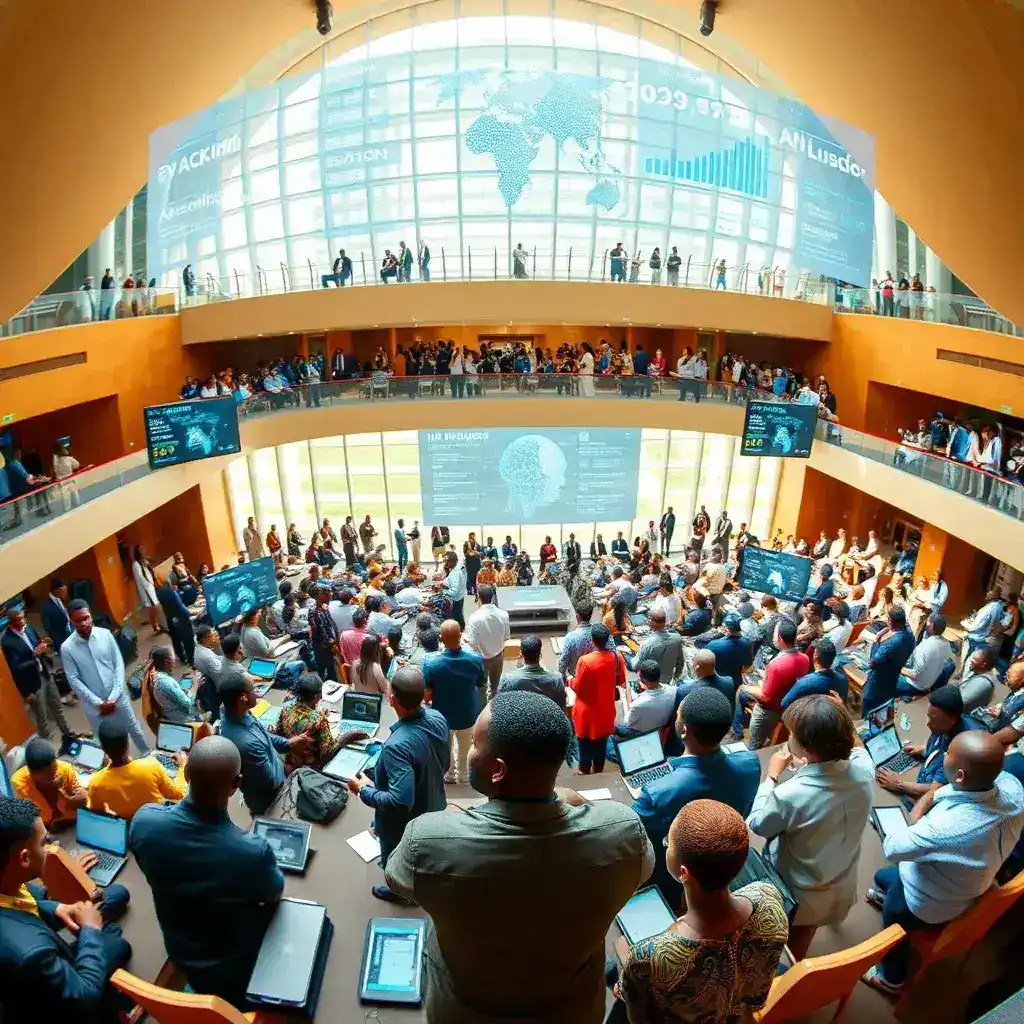
Ghana is set to host the Pan African AI & Innovation Summit 2026 in Accra from September 22nd to 23rd, marking a pivotal moment for the continent’s engagement with artificial intelligence. The summit, held at the Kempinski Hotel, aims to move discussions beyond mere excitement or apprehension, positioning AI as a critical layer of economic infrastructure for future competitiveness, akin to essential services like roads, broadband, and payment systems. This strategic focus coincides with Ghana’s recent launch of its National Artificial Intelligence policy, signaling a clear national intent to guide and deploy AI for development priorities.
The government’s commitment is underscored by a planned investment of US$250 million in an AI Computing Centre, with an initial US$20 million allocated for immediate implementation. This significant financial backing provides a tangible foundation for Ghana’s AI ambitions. The upcoming summit is designed to facilitate the conversion of these policy intentions into productive capital, requiring collaboration among policymakers, businesses, investors, and development partners across Ghana and the wider African continent.
For businesses, AI presents a powerful tool for enhancing productivity and reducing operational costs. Applications range from improving customer service and credit assessment to strengthening fraud detection, optimizing inventory management, and automating routine tasks. AI’s ability to process complex data swiftly can also lead to faster, more informed decision-making.
Financial institutions, in particular, stand to benefit immensely from AI. With vast amounts of customer data at their disposal, banks, insurers, and fintech companies can leverage AI to understand consumer behavior, detect fraudulent transactions, personalize financial products, and crucially, expand services to previously underserved populations. In a continent where many small businesses lack access to formal credit, responsible AI-driven risk assessment could unlock significant financial inclusion.
However, the rapid advancement of AI also brings inherent risks. Poorly designed systems can perpetuate existing biases, leading to the exclusion of vulnerable groups. The misuse of personal data and the creation of opaque decision-making processes that citizens cannot challenge are also significant concerns. In the financial sector, where AI influences access to loans, insurance, and employment, principles of fairness, transparency, and accountability are paramount.
Ghana’s proactive steps to enhance data protection and regulate AI, including automated decision-making and cross-border data flows, are therefore critical. Building trust is identified as a fundamental component of economic infrastructure in the digital age. Without public trust, individuals may hesitate to share data, investors may shy away from funding digital platforms, and businesses could face challenges in scaling their services.
A key theme for the Pan African AI Summit will be digital sovereignty. For Africa to build a competitive AI economy, it must avoid complete reliance on external control over its data, computing power, AI models, and technical standards. This does not preclude international collaboration; rather, it emphasizes the need for partnerships structured around mutual value, local capacity building, and long-term ownership.
The proposed AI Computing Centre in Ghana is envisioned as a national asset supporting research, innovation, enterprise development, and public-sector modernization. It aims to provide crucial access to advanced computing resources for universities, startups, government agencies, and private firms that currently lack such capabilities. However, computing power alone is insufficient without a skilled workforce.
Ghana and the broader African continent must invest heavily in AI literacy, data science, software engineering, cybersecurity, ethics, and sector-specific digital skills. The nations that thrive in the AI era will be those that equip their populations to adapt, build, and govern these powerful tools. Initiatives like the University of Ghana Digital Youth Village and the Responsible AI Lab are already contributing to developing this essential talent pipeline.
Empowering the youth is central to this strategy, given Africa’s status as the continent with the youngest population globally. Training young Africans solely to use AI applications developed elsewhere will perpetuate the continent’s role as a market. Conversely, equipping them to build, localize, and commercialize AI solutions can transform Africa into a significant producer of AI technology.
The importance of local languages and contexts cannot be overstated. AI systems that fail to understand African languages, cultural nuances, market dynamics, and institutional frameworks will offer limited value. Investment in African language datasets, local research, and culturally relevant AI applications is therefore a foundational requirement for inclusive innovation.
The private sector’s active participation is crucial, as AI adoption is ultimately driven by businesses. Technology transformation should not be viewed solely as a government initiative. Business leaders are urged to identify practical AI use cases within their operations—areas where costs are high, decisions are slow, customers are underserved, or data is currently underutilized.
Investors are encouraged to look beyond the hype surrounding AI. The most impactful AI opportunities in Africa may lie not in consumer-facing apps, but in critical sectors such as agricultural intelligence, health diagnostics, regulatory technology, insurance analytics, logistics optimization, public finance management, local-language education, and tools to boost SME productivity.
The Pan-African AI Summit in Accra is positioned as a platform for tangible action, aiming to foster bankable AI projects, establish ethical standards, promote regulatory coordination, facilitate research partnerships, secure startup financing, launch public-sector pilots, and secure measurable commitments. Ghana has a significant opportunity to establish itself as a leader in responsible AI development on the continent.
Achieving this leadership hinges on effective execution, requiring the alignment of policy, infrastructure, finance, regulation, and talent development. The goal is to ensure that AI benefits all segments of society, from farmers and financiers to students and software engineers, and from small enterprises to large institutions. The optimistic outlook for AI in Africa, when governed wisely, is its potential to amplify human capabilities, enabling public servants to deliver better services, teachers to reach more students, doctors to make faster diagnoses, entrepreneurs to reduce costs, and financial institutions to serve previously invisible customers.
As Accra prepares to host global leaders for the summit, the message is clear: Africa’s AI future must be ethical, inclusive, and economically productive. The continent must define its own AI trajectory, and Ghana’s emerging AI agenda provides a vital starting point. The immediate task is to translate strategy into functional systems, ambition into concrete investment, and innovation into widespread prosperity. Further insights and discussions can be found at panafricanaisummit.com.










Leave a Reply