
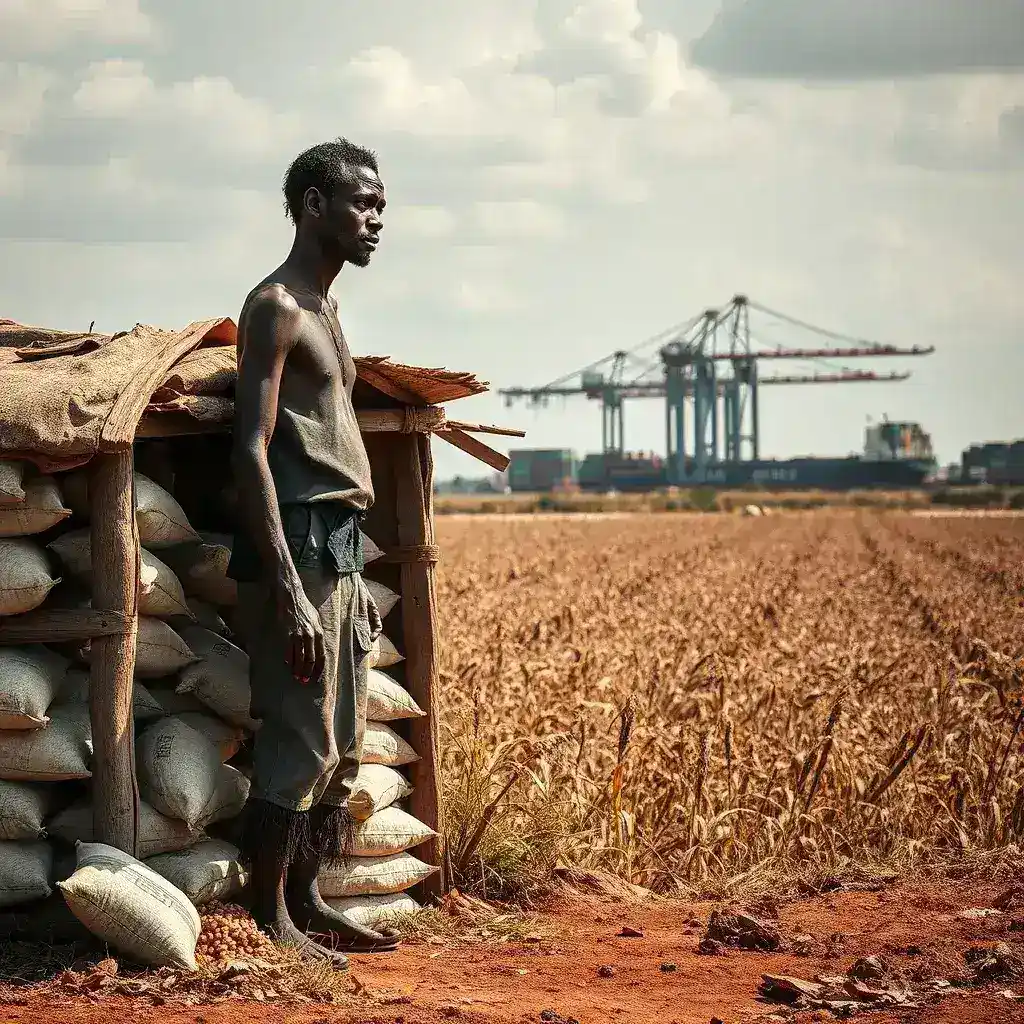
Across Ghana’s agricultural heartlands, from the Bono Region to the Volta Basin, over five million smallholder farmers are facing an unprecedented crisis. Harvests are rotting in fields and storage, not due to natural causes, but because an influx of artificially cheap imported rice and maize has flooded the market. Compounding this economic hardship, a government program intended to support farmers, the ‘Feed Ghana Programme,’ has distributed dead hybrid maize seeds, rendering entire seasons of effort and investment futile. This situation unfolds against a backdrop of seemingly positive macroeconomic indicators, including a declining inflation rate and a resurgent Ghanaian cedi, creating a stark paradox of plenty where national economic success appears to be achieved at the direct expense of its agricultural backbone.
The Manufactured Glut: Policy Over Production
Ghana is currently grappling with an artificial glut of grain, with estimates suggesting over 1.2 million metric tonnes of unsold maize, rice, and soya beans from the last harvest remain in storage and on farms, according to the Chamber of Agribusiness Ghana (CAG). This surplus is not a result of bumper harvests but of deliberate policy choices that have systematically sidelined local producers. The Peasant Farmers Association of Ghana (PFAG) reports that over 200,000 metric tonnes of unsold paddy rice and maize were still stuck in warehouses and on farms by November 2025, leaving farmers vulnerable to post-harvest losses.
The financial repercussions are severe, with the CAG warning that US$330 million, equivalent to GH¢5 billion, worth of paddy rice alone remains unsold. This crisis has been exacerbated by a surge in cheap imports and rampant smuggling of substandard grains, forcing local farmers to sell their produce below production cost. The traditional cycle of selling harvested crops to fund the next planting season has been broken, as local millers and processors opt for cheaper imported alternatives.
The Cedi’s Double-Edged Sword
The recent appreciation of the Ghanaian cedi, which rallied approximately 35 percent against the US dollar in 2025, has been hailed as a significant economic achievement. However, this macroeconomic success has had detrimental effects on domestic agriculture. Economist Prof. Godfred Bokpin notes that an overly strong cedi can make imports cheaper than local goods, thereby hurting domestic production, especially in a country with a structurally weak productive base.
The national president of the PFAG, Wepia Addo Awal Adugwala, explains that while a stronger cedi lowers the cost of imported inputs like fertilizer, it creates a price squeeze for local producers. Consumers are drawn to the lower prices of imported commodities, diverting jobs and investment away from Ghanaian growers who are already under severe financial strain. Furthermore, Ghanaian farmers face higher borrowing rates compared to international counterparts due to agriculture being classified as a high-risk sector by banks, making price competition with imports structurally unviable.
Ministerial Permits Fueling the Import Tide
A critical factor enabling the influx of cheap imports lies with the Ministry of Food and Agriculture. Only the Minister of Food and Agriculture has the authority to grant import permits for milled rice and maize grain. Every bag of imported rice and maize undercutting local farmers exists because a permit was signed by the ministry. Despite local farmers struggling with unsold produce, import permits continue to be issued, undermining national efforts toward food self-sufficiency. Imani Africa highlights weak border controls and poor enforcement of standards as further aggravating factors.
The Chamber of Agribusiness Ghana has raised alarms about alleged collusion between smuggling syndicates and corrupt border officials, leading to significant revenue loss through tax evasion. This situation not only jeopardizes farmer incomes but also weakens the domestic value chain, increasing Ghana’s dependence on foreign imports. The Chamber has called for a three-month moratorium on rice imports and the establishment of a Strategic Grain Reserve Procurement Programme, proposals that have yet to be implemented.
The ‘Feed Ghana’ Betrayal: Dead Seeds and Lost Seasons
The distribution of non-viable seeds under the government’s ‘Feed Ghana Programme’ represents a profound betrayal of trust. Farmers, already burdened by unsold harvests, invested in land preparation and planting, only to find that the hybrid maize seeds provided by the government failed to germinate. Investigations revealed that the seeds supplied to farmers were over a year old, supplied to the government before that. In Ghana’s tropical climate, seeds stored for extended periods, especially without controlled temperature and humidity, rapidly lose viability and the capacity to germinate.
This failure is not merely an administrative oversight but an agricultural crime against vulnerable populations. Seed experts and planting guides universally warn against using old seeds due to low germination rates. Technocrats within the Ministry of Food and Agriculture are aware of these risks. The distribution of expired seeds resulted in farmers losing not only their investment in ploughing, harrowing, planting, and fertilizer but also an entire growing season. This echoes historical issues with input programs, including the original ‘Planting for Food and Jobs’ (PFJ) programme, where farmers reported low germination rates and the use of poor-quality seeds, often attributed to ‘political interferences’ and delayed distribution.
NAFCO’s Unaccountable Intervention
While the government announced the release of substantial funds, totaling GH¢200 million, to the National Food Buffer Stock Company (NAFCO) to intervene in the grain market and set a floor price for paddy rice, farmers report no visible purchases by approved buying companies. The PFAG has called for transparency, demanding NAFCO publish a list of contracted companies, purchase locations, and quantities. The lack of accountability raises serious concerns about whether these funds were effectively used to support local farmers or if they were diverted to support imports.
NAFCO’s history is marred by governance issues, including the prosecution of its former CEO and his wife for alleged embezzlement of GH¢78 million. Critically, NAFCO only established its legally mandated audit committee in October 2025, having operated without an internal auditor for fifteen years prior. This institutional weakness has exposed the company to operational lapses and raises doubts about the effective use of public funds intended to support smallholder farmers.
The Looming Famine: A Self-Inflicted Crisis
The divergence between official statistics and the lived reality of Ghanaians is stark. While inflation has fallen, food prices remain high, and food insecurity has increased, with approximately 8 million people struggling with insufficient food consumption, according to AGRA’s November 2025 Food Security Monitor. The Ghana Statistical Service reports food insecurity at 38.1 percent as of Q3 2025. Cheaper food prices on paper have not translated into improved food security for the population, and for farmers, lower farm-gate prices mean ruin, not relief.
The current crisis has significant future implications. Farmers unable to service loans from the previous season, or who lost their investment due to dead seeds, are unlikely to plant in the upcoming season. This could transform today’s surplus into a future shortage. Mills and processing plants operating below capacity or shutting down due to a lack of local supply will further collapse the value chain. The loss of faith among farmers, particularly the youth, due to repeated government failures, threatens to decimate Ghana’s agricultural workforce and productivity for years to come.
The government, the Minister of Food and Agriculture, and NAFCO face critical questions regarding import permit issuance, the source and quality of distributed seeds, the actual procurement of local grains, and the reasons for processors favouring imports. The integrity of Ghana’s agricultural sector hinges on reversing the current trajectory by suspending import permits, mandating institutional procurement from local sources, enforcing transparency at NAFCO, and upholding seed quality as a public trust. Failure to act will ensure that while macroeconomic indicators may improve, the foundation of Ghana’s food security crumbles, leaving farmers with nothing worth planting for.










Leave a Reply