
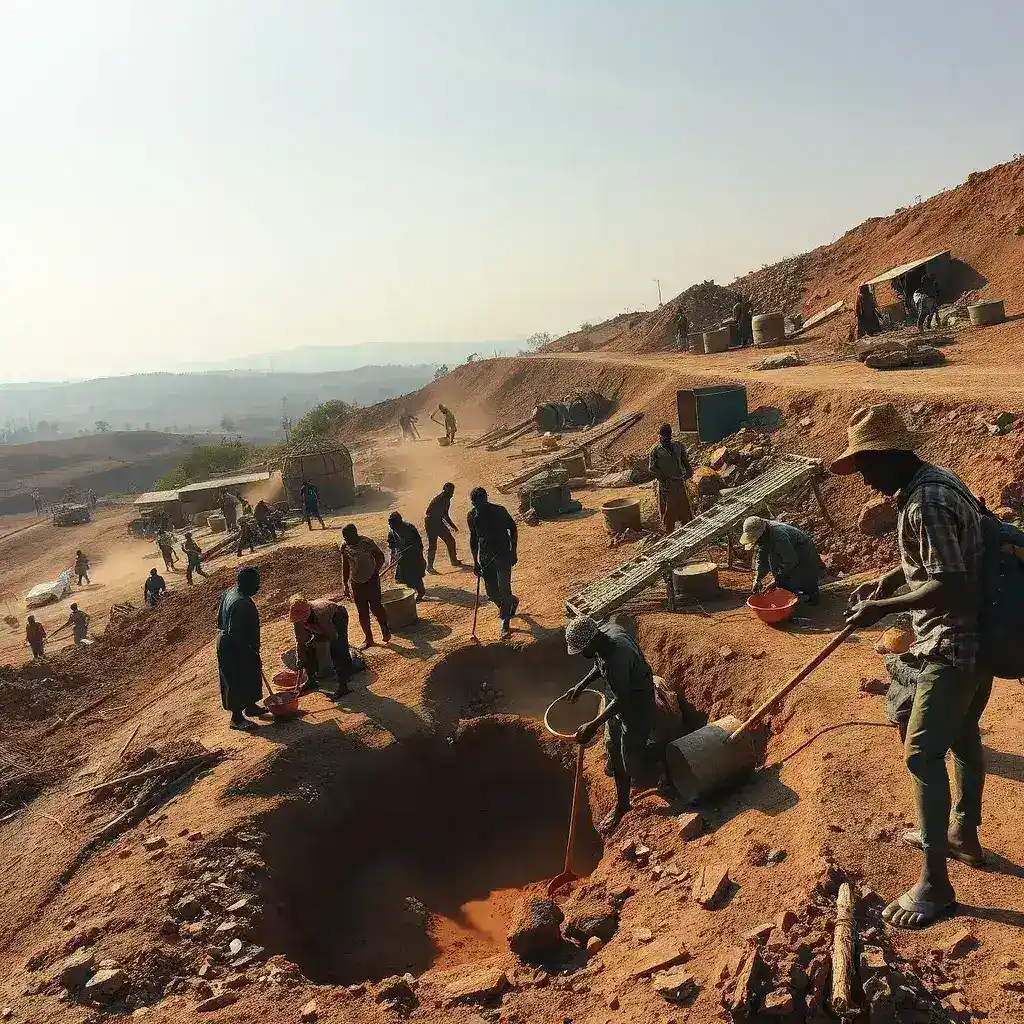
Accra, Ghana – The Artisanal and Small-Scale Mining (ASM) sector in Ghana, responsible for over half of the nation’s gold production, contributes a mere fraction of the sector’s tax revenue, contributing less than 2% according to the Ghana Chamber of Mines. This stark disparity was a central theme at the 2026 West African Mining and Power Expo (WAMPEX), where industry leaders discussed the challenges of revenue mobilization from this significant, yet largely informal, economic contributor.
The Scale of ASM Production
Data presented by Chamber President Mr. Michael Edem Akafia and CEO Ing. Dr. Kenneth Ashigbey revealed that the ASM sector accounted for approximately 52% of Ghana’s total gold output in 2025. This substantial share underscores the sector’s critical role in the national economy and its potential as a source of government revenue.
Disproportionate Tax Contribution
Despite its dominant production figures, the ASM sector’s contribution to national coffers remains disproportionately low. The Chamber of Mines highlighted this imbalance, stating that the sector’s tax revenue is less than 2% of the overall gold sector’s contribution. This raises significant questions about the effectiveness of current tax collection mechanisms and the challenges of integrating informal economic activities.
Reasons for the Revenue Gap
Officials attributed the low tax contribution primarily to the largely informal nature of ASM operations. This informality makes it difficult to track production accurately, formalize operators, and ensure compliance with tax regulations. The decentralized and often hidden nature of small-scale mining activities presents a complex challenge for tax authorities.
Calls for Formalization and Policy Reform
In response to these findings, the Ghana Chamber of Mines is advocating for stronger measures to bring more ASM operators into the formal economy. The goal is to enhance revenue mobilization without negatively impacting the livelihoods of the thousands of individuals dependent on artisanal mining. This involves finding a delicate balance between regulation and support for the sector.
WAMPEX 2026 Discussions
These discussions took place within the broader context of WAMPEX 2026, an expo focused on accelerating sustainable development in West Africa through responsible mining and power generation. The event provided a platform for stakeholders to share insights and collaborate on solutions for the region’s complex resource management challenges.
Expert Perspectives
Industry analysts have noted that similar challenges of integrating informal mining sectors exist across many resource-rich African nations. The key lies in developing tailored policies that acknowledge the socio-economic realities of ASM while ensuring fair contribution to national development. This often requires a multi-faceted approach involving government agencies, industry bodies, and the mining communities themselves.
Implications for Ghana’s Economy
The low tax contribution from a sector that produces over half of the gold output represents a significant missed opportunity for Ghana. Increased formalization could unlock substantial revenue for public services, infrastructure development, and poverty reduction initiatives. Conversely, failing to address this gap could perpetuate economic inequalities and hinder sustainable growth.
Looking Ahead
The focus now shifts to how effectively Ghana can implement policies aimed at formalizing the ASM sector. Stakeholders will be watching to see the development of new regulatory frameworks, the provision of support services for small-scale miners, and the technological innovations that can improve traceability and compliance. The success of these efforts will be crucial for enhancing Ghana’s fiscal health and ensuring that its rich mineral resources contribute more equitably to national development.










Leave a Reply