
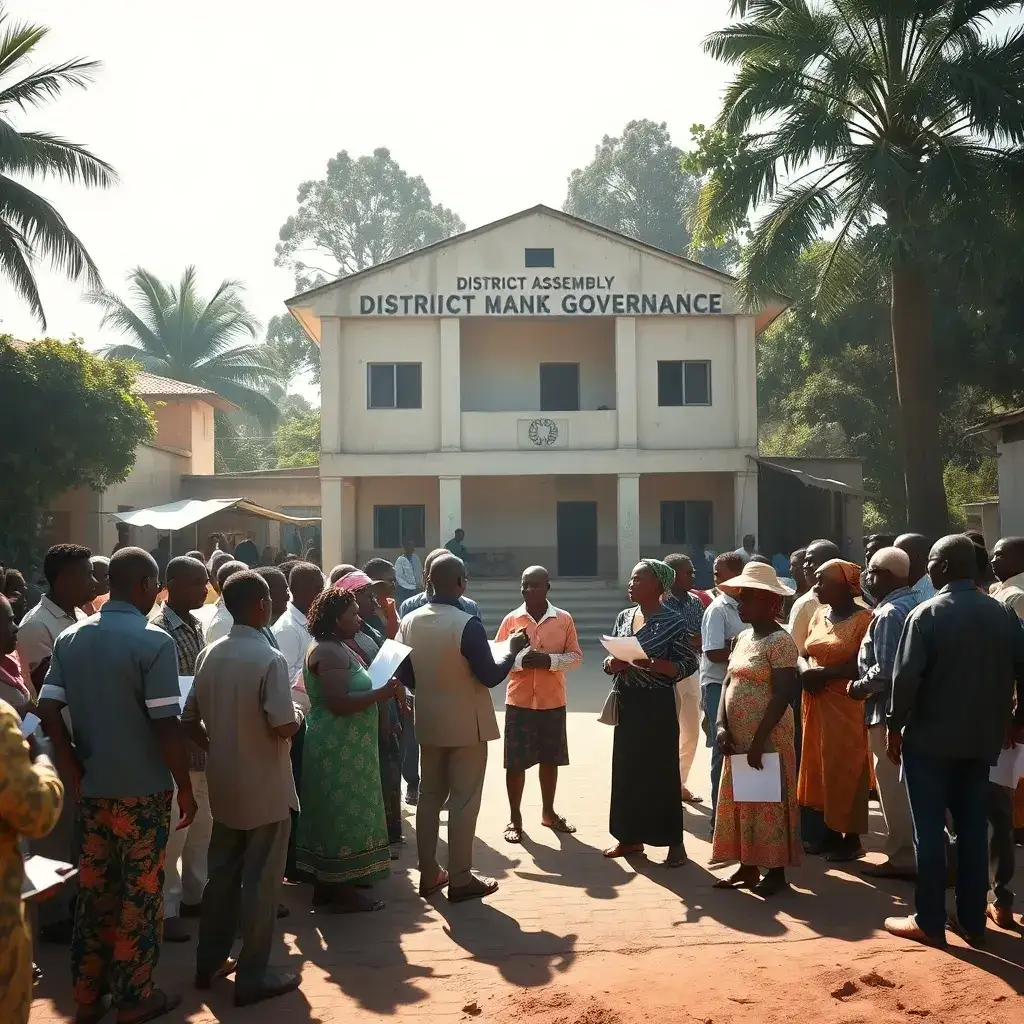
Ghana is on the cusp of a significant political reform, with Parliament advancing constitutional amendments to allow citizens to elect their Metropolitan, Municipal, and District Chief Executives (MMDCEs) on a non-partisan basis. This move, championed by the Mahama administration and supported by nearly seven in ten Ghanaians according to an Institute of Economic Affairs survey, represents a rare moment of broad consensus. However, this widespread agreement raises critical questions about the underlying system into which these newly elected officials will step, a system that the reform bill, while promising, does not inherently fix.
The Promise of the Reform Package
The reform extends beyond the election of MMDCEs, encompassing a more comprehensive approach to local governance. A proposed phased rollout of elections, rather than a simultaneous national implementation across all 261 districts, acknowledges that many districts are not yet ready for elected leadership. This phased approach is to be guided by a new Devolution Commission, which will determine district readiness based on defined benchmarks.
Complementing this, the Ministry of Local Government plans to establish a University of Local Governance and Development, elevating the existing Institute of Local Government Studies. A new National Decentralisation Policy for 2025-2029 is also under consideration. This package is the most integrated local governance reform seen in Ghana for a generation, reflecting an honest appraisal of current capacities.
However, the phased approach introduces new questions: readiness will be assessed by specific standards and on an unspecified timeline. The reform package offers no clear consequences if districts fail to meet these benchmarks, nor does it detail the resource allocation implications of this staggered implementation. Without these answers, the Devolution Commission could become a tool for indefinite postponement rather than a driver of progress.
The Systemic Weaknesses on the Ground
The foundation upon which these elected MMDCEs will operate is constitutionally weak and routinely violated. The District Assemblies Common Fund (DACF), mandated by Article 252 of the 1992 Constitution for quarterly disbursements, has consistently faced non-compliance from successive administrations. By 2024, parliamentary reports indicated arrears of GH¢3.5 billion over just two years, and a 2019 Supreme Court ruling affirming a minimum five percent of national revenue for the fund had not led to consistent adherence.
These arrears represent more than just unpaid funds; they signify a decade-long practice of rolling over debts, with payments in recent years settling obligations from as far back as 2014 and 2016. An elected MMDCE will inherit this fiscal deficit, as a popular mandate cannot compensate for an empty treasury. The reform bill offers no provisions to rectify this fundamental fiscal architecture.
Institutional Deficiencies Undermining Decentralisation
Beyond fiscal challenges, institutional weaknesses plague Ghana’s local governance. Sub-district structures, such as unit committees, town councils, and area councils, designed to link district assemblies with communities, have largely been dormant. Decades of decentralisation have shown these structures suffer from inadequate staffing, poor logistics, and a weak revenue base, leading citizens to bypass them in favour of Members of Parliament (MPs) and traditional chiefs.
Research indicates that in some electoral areas, the lack of perceived benefit prevents the fielding of candidates for unit committee positions, contributing to low voter turnout in district-level elections, sometimes as low as 30 percent. Accountability mechanisms rely on engaged citizens, but the current structures have failed to foster this engagement.
The 2016 Local Governance Act, intended to strengthen participatory governance, failed to overcome these constraints. A comparative study found that central control over personnel and finance, weak sub-structures, and low citizen accountability remained largely unchanged. The current bill, like its predecessors, risks outrunning institutional reality with legal ambition.
The Non-Partisan Fiction
A particularly contentious aspect is the proposal for non-partisan elections of MMDCEs. While constitutionally sound, this concept is often theoretical within Ghana’s political economy. The country’s major political parties have historically leveraged control over local government appointments for patronage, influencing development project allocation and contractor relationships.
Both the National Democratic Congress (NDC) and the New Patriotic Party (NPP) have demonstrated practices that prioritize party membership in MMDCE selection. There is no inherent structural change in the reform bill that would insulate local government from partisan interests.
The reality of formally non-partisan assembly member elections already illustrates this dynamic. Party structures often coalesce around preferred candidates, directing resources and influencing outcomes, regardless of the constitutional label. The 2019 referendum on MMDCE elections, which failed partly due to mistrust between parties regarding fair play at the local level, underscores this issue. The proposed non-partisan approach addresses a symptom rather than the underlying patronage incentives that drive partisan involvement.
What Serious Reform Requires
These criticisms are not an argument against the reform bill itself, but a call for it to be accompanied by necessary supporting measures. Addressing the DACF shortfall requires a legislative solution: an automatic, revenue-based transfer mechanism that removes ministerial discretion and includes a plan for liquidating existing arrears. The DACF administrator’s 2026 request for such a mechanism should be prioritized.
The University of Local Governance and Development Bill needs to precede MMDCE elections. Capacity building should be proactive, equipping officials in districts assessed for readiness, rather than reactive. The current sequencing, with the ULGD Bill still awaiting cabinet approval, suggests a misalignment.
Furthermore, the benchmarks for district readiness, to be determined by the Devolution Commission, must be publicly defined, debated in Parliament, and enshrined in legislation, not left to administrative discretion. Transparency in this process is crucial to prevent the phased rollout from becoming a political tool for manipulating election timelines based on party advantage.
The Underlying Question for Ghana’s Future
Ghana has a history of enacting local governance legislation—the 1993 Act, the 2016 Act, and a 2017 amendment—each met with initial enthusiasm but ultimately stalled by a lack of institutional development. This pattern suggests a systemic reluctance to undertake the harder work of institution building following legislative pronouncements.
While the current reform package is more coherent than its predecessors, with a wiser phased approach, acknowledgment of capacity gaps, and a coordinating policy framework, these are paper solutions. Ghana’s track record in translating policy into practice is not encouraging.
The bill is likely to pass, and elections will eventually be held. The true test will emerge in the years that follow, when elected MMDCEs in resource-constrained, institutionally thin districts, operating within established patron networks, attempt to deliver the development promised by their democratic mandates. The success of these reforms will hinge on the strength of the institutions built alongside the bill, not just the bill itself. The critical question for Ghana now is not whether to hold these elections, but whether the nation is finally prepared to commit to building the robust system that these elections presuppose.







Leave a Reply