
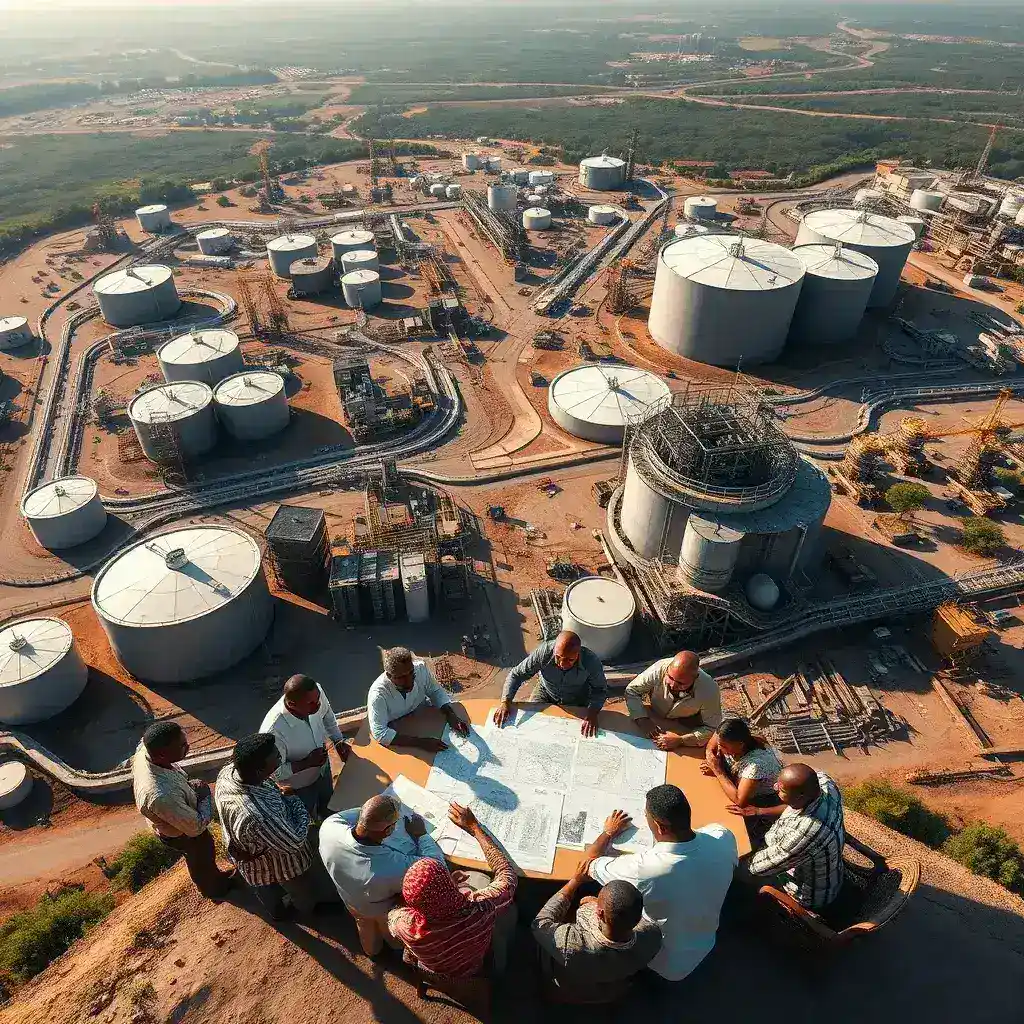
Ghana’s ambitious Petroleum Hub project, initiated in 2021, is currently facing a critical juncture concerning land acquisition, with the Petroleum Hub Development Corporation (PHDC) working to resolve disputes over the allocated 5,000 hectares. This significant national undertaking, envisioned to transform Ghana into a major energy corridor, has encountered predictable challenges common to large-scale projects, including community agitations and concerns over land size and compensation.
Navigating Project Hurdles
Major national projects often face initial challenges, including land acquisition issues, local content demands, funding constraints, resource exploitation concerns, and environmental sustainability questions. Ghana’s history shows numerous examples where landmark projects initially met resistance but eventually became foundational pillars through dialogue and leadership. This phenomenon is not unique to Ghana, as Nigerian billionaire Aliko Dangote revealed his refinery project faced five years of land-related blockages from industry “mafias”.
The Land Size Controversy
The Petroleum Hub Project, Ghana’s most ambitious national undertaking since its 2021 inception, has been significantly impacted by land acquisition challenges. Upon the Dr. Toni Aubynn-led management’s assumption of leadership at PHDC, key obstacles included limited national awareness, local agitations over land ownership, concerns about the project’s scale, and crucially, the timely payment of compensation to landowners. Over a year later, most major obstacles have been resolved, leaving compensation payments and minor disagreements over land size as the primary hurdles.
A central point of contention is the debate over the 5,000 hectares allocated for the project, largely fueled by the Coalition of Concerned Nzema People. This group has questioned the legitimacy of the land acquisition, claiming it contradicts President John Dramani Mahama’s statement on June 30, 2025, during a meeting with the Western Regional House of Chiefs. At that meeting, President Mahama reportedly stated, “We believe that 5,000 hectares can comfortably start the project and then we can acquire additional land as and when we need it, instead of tying down 20,000 hectares of our people’s land.”
Clarifying Presidential Directives
The Coalition of Concerned Nzema People has argued that the President misspoke, intending to refer to acres instead of hectares. However, official records indicate President Mahama explicitly used the term “hectares” twice in his speech. Further developments in December 2025 saw President Mahama issuing directives to the Ministers for Energy and Green Transition and for Lands and Natural Resources. His instruction to the latter explicitly directed the Lands Commission to expedite the acquisition of 5,000 hectares, approximately 12,356 acres.
Following this directive, the Minister for Lands and Natural Resources instructed the Lands Commission to collaborate with PHDC. This collaboration led to the publication of the Declaration of Intent by the State to Compulsorily Acquire the Land in the Daily Graphic on April 21, 2026. This declaration, made under the Lands Act, 2020 (Act 1036), followed a rigorous review process involving multiple state bodies, including the Lands Commission, the Ministry of Lands and Natural Resources, the Office of the Attorney-General, the Council of State, and the Presidency. Any inconsistency in the land size would likely have been flagged during this extensive vetting.
Scale and Global Benchmarks
Critics also appear to overlook the project’s vast scope. Ghana’s Petroleum Hub is modelled on international examples like the Rotterdam port in the Netherlands (12,500 hectares) and Surbana Jurong in Singapore (3,500 hectares). A mere 5,000 acres (approximately 2,023 hectares) would be insufficient for a development planned to include three refineries with a combined capacity of 900,000 barrels per day, five petrochemical plants, 10 million cubic metres of storage, and an “oil city.” The current 5,000 hectares is a significant reduction from the original 20,000 hectares initially considered.
Implications for the Future
The Petroleum Hub is envisioned as more than just an energy facility; it is a blueprint for a prosperous city, aiming to uplift the Jomoro district, transform the Western Region, and enhance Ghana’s global standing as an energy hub. While some may continue to advocate for further reductions in land size, the broader interests of Jomoro, the Western Region, and Ghana must now take precedence. The time is approaching for all stakeholders to move beyond protests and fully embrace this generational opportunity, as the future prosperity of the region and the nation hinges on its successful implementation.










Leave a Reply