
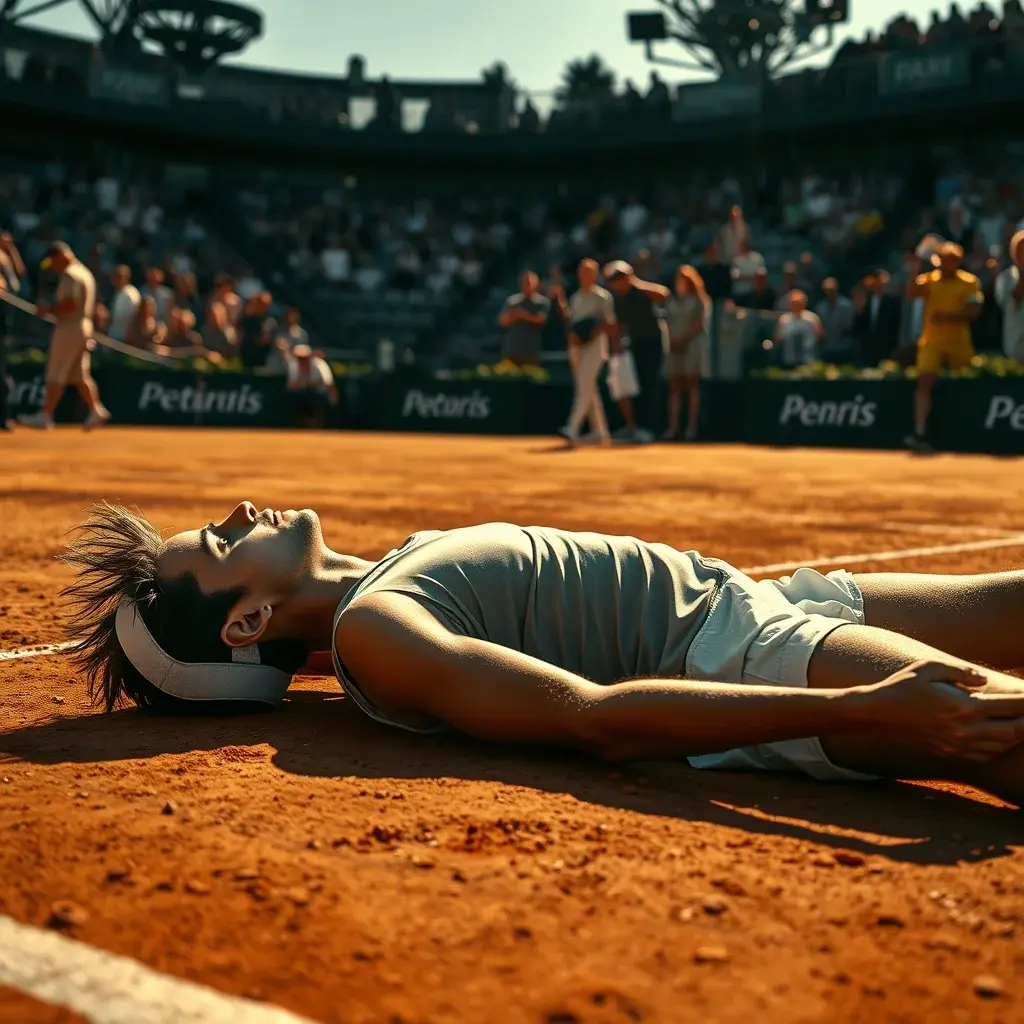
Czech tennis player Jakub Mensik collapsed on court following his gruelling second-round victory at the French Open on Wednesday, succumbing to extreme heat and cramp after a marathon match that lasted over four and a half hours. The incident occurred amidst a persistent heatwave in France, with temperatures soaring into the mid-30s Celsius.
Mensik, 20, battled through a five-set thriller against Argentina’s Mariano Navone, ultimately winning 6-3 2-6 6-4 1-6 7-6 (13-11). However, the physical toll of the match, played under intense sun on an exposed outer court at Roland Garros, became evident immediately after the final point. He struggled to move, requiring eight match points to secure the win, and fell to the ground, visibly overcome with emotion and physical distress.
Intense Conditions and Player Struggles
The Czech rising star, whose career has already been marked by injury, was attended to by medical staff who applied ice packs to his head, neck, and chest to help cool him down. His opponent, Navone, showed sportsmanship by crossing the net to congratulate and assist Mensik. Despite initial efforts, Mensik was unable to walk off the court unaided and was eventually taken away in a wheelchair, though he later reported undergoing recovery sessions.
Mensik described the conditions as “insane,” particularly playing in direct sun for such an extended period. He highlighted the inadequate recovery time between points and during changeovers, noting that ball kids could not always provide towels and that the one-minute changeovers offered little respite from the heat.
He also expressed frustration at being penalized for exceeding the time limit between points, which he felt affected his serve. “When I hit the last winner, the emotions went out and my body just turned off,” Mensik stated to the media, emphasizing the severity of the heat’s impact.
Tournament Protocols and Player Concerns
The French Open organizers monitor temperatures using wet bulb sensors and have protocols in place, including potential 10-minute breaks after the second set for women’s matches and the third set for men’s matches, if certain thresholds are met. Matches can be suspended if temperatures continue to rise, though no French Open match has reportedly been halted due to extreme heat.
Novak Djokovic, a three-time champion, also experienced a lengthy match on Court Philippe Chatrier, which features a roof. He played for three hours and 44 minutes against Valentin Royer, eventually winning in four sets. Djokovic suggested that scheduling matches later in the evening could be a consideration for Grand Slams facing extreme weather conditions.
Other players have voiced concerns about the heat. Women’s 15th seed Marta Kostyuk noted the conditions were tough and dehydrating, though not as severe as the 2024 Olympics at the same venue. Casper Ruud, a former finalist, reported feeling like he was “walking around like a zombie” and feared heatstroke after cramping in 33C temperatures earlier in the week.
Scheduling and Player Advantage
The scheduling of matches appears to play a significant role in player experience. Alexander Zverev, a runner-up in 2024, benefited from playing in the cooler evening session, defeating Tomas Machac in straight sets in just under two hours. His match, played when temperatures had dropped to around 18C, offered a stark contrast to the daytime conditions faced by Mensik and others.
The physical demands placed on athletes during prolonged exposure to high temperatures raise questions about player welfare and the adequacy of current tournament regulations. The incident involving Mensik underscores the potential risks associated with extreme weather in endurance sports.
Looking Ahead
As the heatwave is forecast to continue, all eyes will be on how the French Open organizers adapt their scheduling and protocols. The focus will be on player safety and whether further measures are implemented to mitigate the risks of heat-related illnesses. Fans and players alike will be watching to see if tournament officials consider adjustments, such as more frequent and longer breaks, or a greater reliance on shaded or covered courts during peak heat, to ensure the well-being of competitors in future extreme weather events.










Leave a Reply