
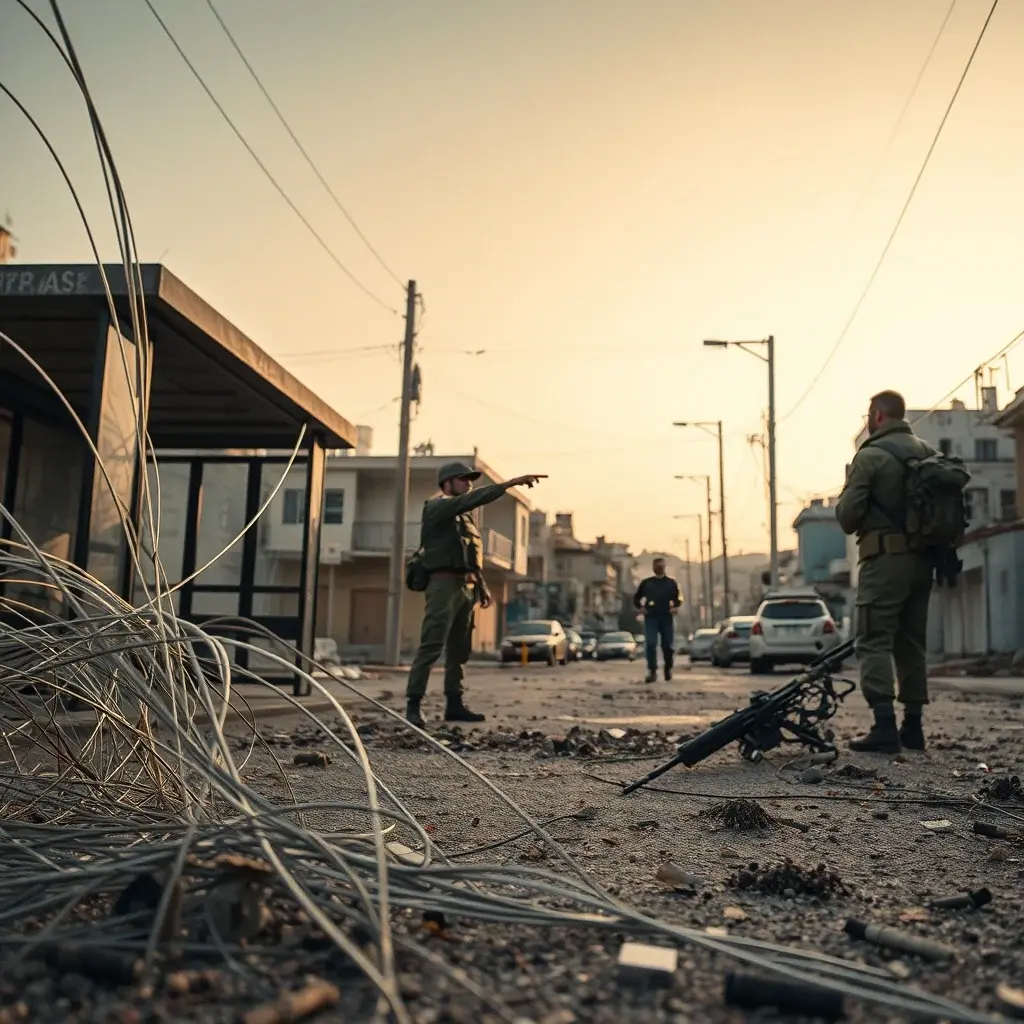
Hezbollah has intensified its use of fiber-optic drones, also known as First-Person View (FPV) drones, against Israeli soldiers and civilians along the Lebanese border. This tactic, learned from the conflict in Ukraine, has become Hezbollah’s primary weapon in recent weeks, posing a significant and evolving threat as fighting continues despite a supposed ceasefire.
The shift in Hezbollah’s arsenal comes as the group increasingly employs these small, explosive-laden drones that are difficult to detect and jam due to their low flight path and tethered optical wire connection to operators. These drones allow for real-time visual targeting, enabling them to pursue targets on the ground, a capability that has instilled a new sense of fear in Israeli border communities.
A New Era of Border Warfare
Recent attacks highlight the effectiveness and danger of these FPV drones. On Wednesday, an Israeli soldier was killed and two others injured in an attack near the border community of Shomera. Since a ceasefire took effect six weeks prior, eight Israeli soldiers and one civilian defense contractor have been killed by these drones, according to reports from the Alma Research Center, an Israeli think tank monitoring the conflict.
While most attacks target Israeli forces occupying parts of southern Lebanon, Hezbollah is also increasingly targeting Israeli communities. The Alma Research Center has documented over 100 drone attacks on Israeli towns since April. Shomera, a town accustomed to rocket fire, now finds itself facing a more insidious threat. “The problem is you don’t feel them coming. You’re sitting there, and suddenly it arrives,” stated Sami Zanetti, Shomera’s council chief. “And if you run away, it follows you.” He pointed to a scarred bus stop, a victim of a drone attack that occurred minutes after a school bus had departed.
The Fiber-Optic Advantage
Unlike rockets or mortars that provide a few seconds’ warning, FPV drones offer little to no reaction time. Their lack of a radio signal makes them immune to jamming, and their optical tether allows operators to guide them with precision. “With rockets, I’ve got 15 seconds to go into a bomb shelter. With drones, you have no way of knowing when it will fall,” Zanetti added.
Amichai Ben David, a local farmer, described how his family rushed indoors as soldiers engaged a drone that flew down his street. “The missiles stopped because of the ceasefire – and the drones started coming instead,” he said. “They have cameras attached – if there’s a soldier in uniform, or they don’t like the look of someone, it simply drops and explodes.”
Hezbollah’s Capabilities and Motivations
The Alma Research Center estimates that Hezbollah possesses dozens of trained drone operators and a substantial stockpile of these inexpensive drones, costing approximately $300-$400 each. Sarit Zehavi, head of the center, suggests that the increased frequency of attacks may be influenced by Iran, aiming to destabilize the region amidst ongoing geopolitical negotiations.
Captain Adi Stoler, a spokesperson for the Israel Defense Forces (IDF), stated that Hezbollah’s goal is to inflict maximum casualties. “When they see that Israeli soldiers are finding more ways to protect themselves physically, then they try to harm civilians in civilian communities,” she explained. “They go outside more, they live their life, take their children to school, and if [Hezbollah] can harm them while they’re doing that, that’s what they’ll do.”
Israel’s Response and Challenges
In response to the escalating drone threat, Israeli officials have called for stronger retaliatory measures. Finance Minister Bezalel Smotrich suggested that for every drone attack, Israel should target 100 buildings in Hezbollah’s stronghold. Prime Minister Benjamin Netanyahu has vowed to deliver a “crushing blow” to Hezbollah, acknowledging the drone issue and stating that a special team is working on a solution.
However, Israeli forces have faced criticism for a perceived slow response in adapting to this threat, lagging behind lessons learned from Ukraine’s experience with Russian FPV drones. Alma’s researchers had warned in early 2024 about the potential adoption of these drones by Hezbollah. “We knew this was coming because it was obvious Hezbollah would adopt the methods from Ukraine,” Zehavi noted.
While the IDF categorizes the drone threat as tactical rather than existential, Captain Stoler acknowledged it as a significant challenge that requires rapid solutions. A military official cited “gaps in weapons development” as a primary bottleneck, emphasizing the need for continuous improvements in detection and interception capabilities.
Developing Countermeasures
In response, Israeli forces have begun deploying netting to entangle the drones and are exploring advanced technological solutions. Several Israeli defense companies are developing countermeasures, including interceptor drones, specialized anti-drone ammunition, and automated firing systems with electro-optical sensors. One such system, under development by Smart Shooter, integrates sensors with a soldier’s weapon for enhanced threat analysis and targeting.
Despite these efforts, reports suggest that current defensive systems are not fully adequate. Israel’s preferred military strategy currently involves destroying drone storage facilities and neutralizing operators before they can launch attacks, as demonstrated by recent IDF footage of a strike on a drone operator in southern Lebanon.
Escalating Conflict and Future Outlook
The battlefield adaptation is mirrored by a public relations war, with Hezbollah releasing videos of its drone attacks. The IDF, in turn, has issued expanded evacuation orders for southern Lebanon, encompassing areas up to 40km from the border.
Residents in border communities like Shomera are calling for more decisive action. “How do we stop this? Go deeper into Lebanon, with a very strong attack,” urged farmer Amichai Ben David. Council chief Sami Zanetti expressed a desire for either “real peace” or all-out war, urging the government to “clear out the terrorists once and for all.”
Looking ahead, the effectiveness of new countermeasures, potential Israeli ground operations, and the influence of international diplomacy will be crucial in shaping the future of this evolving conflict. The adaptability and low cost of FPV drones suggest they will remain a persistent challenge, forcing continuous innovation in defensive strategies along the volatile Israeli-Lebanese border.










Leave a Reply