
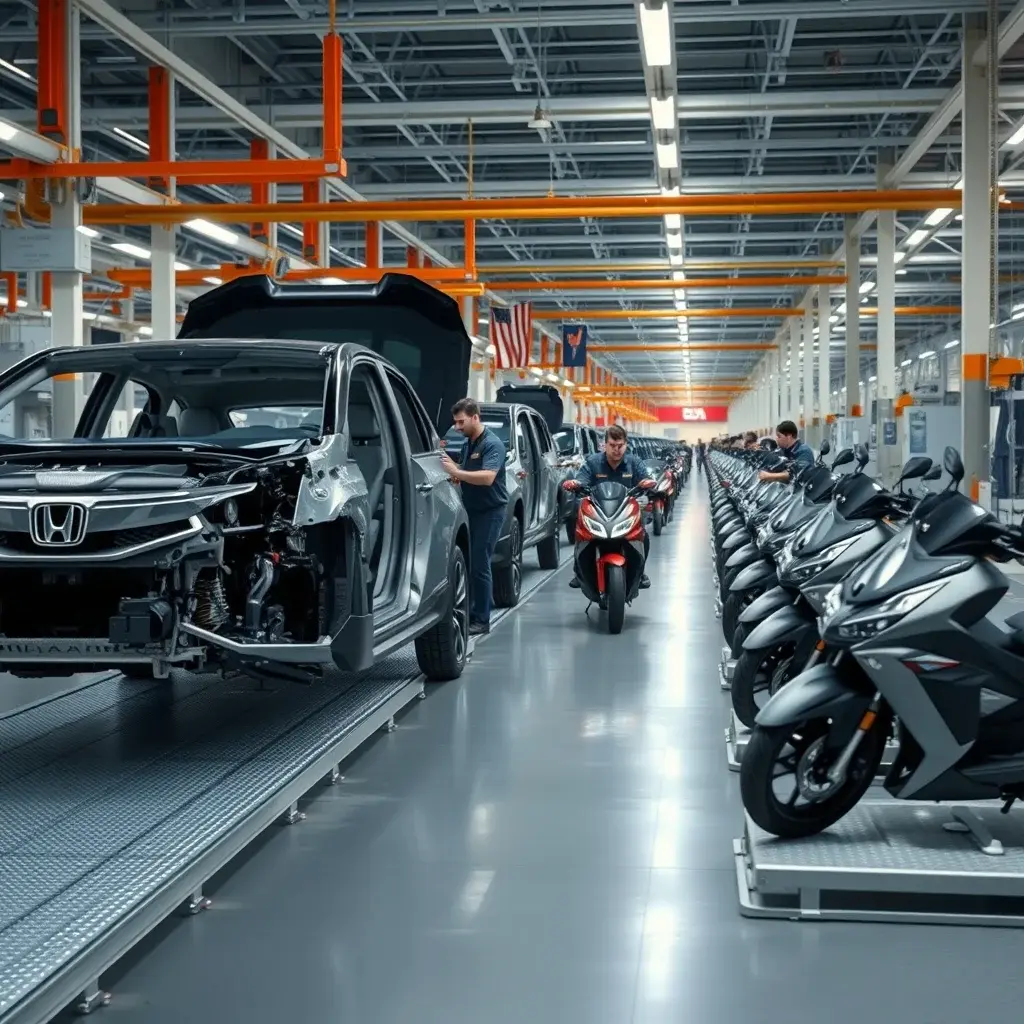
Japanese automotive giant Honda has posted its first annual operating loss in seven decades, reporting a ¥423 billion ($2.68 billion) deficit for the fiscal year ending March 2026. The significant financial downturn is attributed to misjudged investments in the electric vehicle (EV) sector, a market where demand has fallen short of the company’s projections. This situation has prompted Honda to revise its EV production targets and seek cost reductions, including sourcing parts from China.
Shifting Market Dynamics and Policy Impacts
The company’s financial struggles are compounded by external factors, including shifts in US policy. The removal of federal tax incentives for EV purchases, previously offering up to $7,500, and the imposition of tariffs on imported vehicles and parts by the US government in 2025, have significantly impacted profitability for major automakers. These tariffs, though reduced from 25% to 15%, created additional financial headwinds.
Honda, a long-established player in the automotive industry since its stock market listing in 1957 and Japan’s second-largest car manufacturer, faces challenges in adapting its vast operations to the volatile EV market. Analysts suggest that the company’s scale and legacy infrastructure make rapid adjustments to fluctuating EV demand difficult.
Strategic Pivot: Back to Core Strengths
In response to these challenges, Honda is recalibrating its strategic focus. The company announced it will scale back ambitious EV production goals, including abandoning its target for EVs to constitute 20% of new car sales by 2030 and its aim for a fully electric vehicle lineup by 2040. Instead, Honda plans to concentrate on its historically strong motorcycle business, financial services, and hybrid vehicle manufacturing.
The company has identified North America, Japan, and India as key growth markets moving forward. However, plans for EV and battery production facilities in Canada have been suspended. Honda anticipates further EV-related losses, projecting ¥512 billion for the fiscal year ending March 2027.
Expert Analysis and Industry Reaction
Danni Hewson, head of financial analysis at AJ Bell, described the situation as a “bleak milestone” for Honda, but not entirely unexpected. She commented, “Like many legacy automakers, it gambled on motorists making a quick move to EVs – and lost as the world shifted.” Hewson pointed to a confluence of factors, including political shifts, cost of living pressures, and competition from Chinese manufacturers, as reasons for Honda’s rollback on EV plans and the need to absorb substantial costs.
While recent increases in petrol prices, partly influenced by geopolitical events such as the US-Israel war with Iran, have seen a modest rise in EV demand, Hewson noted that companies like Honda are forced into difficult, on-the-fly adaptations. “This is tough for businesses of this scale,” she stated, warning that the EV market is likely to experience further “twists and turns.”
Future Outlook and What to Watch
Honda’s strategic shift signals a broader trend among legacy automakers grappling with the complexities of the EV transition. The company’s decision to re-emphasize hybrid technology and its profitable existing divisions suggests a more cautious approach to electrification. Investors and industry observers will be closely monitoring how effectively Honda can execute this revised strategy, particularly in its priority markets. The success of its motorcycle division and financial services will be crucial in offsetting continued EV-related expenditures. Furthermore, the evolving landscape of EV adoption, influenced by consumer preferences, government policies, and technological advancements, will continue to shape the strategies of all major automotive manufacturers. The competitive pressures from new entrants and established players alike will likely lead to ongoing market realignments.










Leave a Reply