
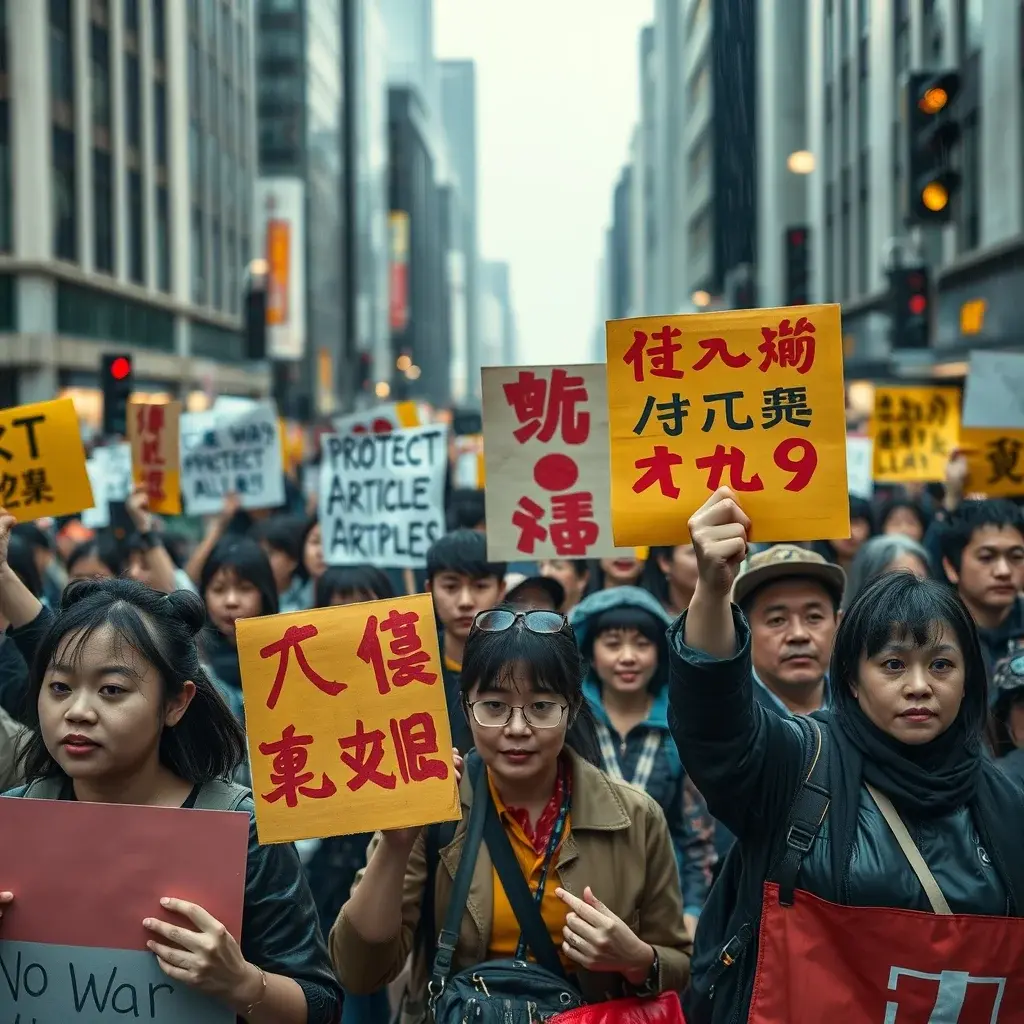
Thousands of Japanese citizens have taken to the streets in Tokyo and other major cities since October 2025, participating in some of the largest anti-war demonstrations seen in decades. The protests are a direct response to Prime Minister Sanae Takaichi’s administration pushing to significantly alter Japan’s post-war pacifist constitution, including lifting restrictions on arms exports and expanding the nation’s military role, moves proponents argue are vital for regional security.
Context: A Pacifist Legacy Under Pressure
Following its defeat in World War Two, Japan adopted a constitution that famously includes Article 9. This article renounces war as a sovereign right and prohibits the maintenance of armed forces, a cornerstone of Japan’s post-war identity and a significant departure from its militaristic past.
However, in recent decades, conservative leaders, particularly within the ruling Liberal Democratic Party, have sought to revise or reinterpret Article 9. They argue that the evolving geopolitical landscape, characterized by an assertive China, unpredictable North Korea, and regional instability, necessitates a stronger defence posture.
The current administration, led by Prime Minister Takaichi, has accelerated these efforts. On April 21st, a significant policy shift occurred when the government lifted its long-standing ban on exporting lethal weapons. This decision, framed as a necessary measure to support allies in a deteriorating security environment, has been a major catalyst for public outcry.
Main Body: A Nation Divided on Defence
The recent lifting of the arms export ban has struck a particularly sensitive chord with the Japanese public. Protests, often characterized by restraint due to cultural norms valuing social harmony, have seen a significant surge in participation. The demonstrations are notable for attracting a diverse age range, with many younger Japanese in their twenties and thirties joining seasoned activists.
Protesters express anger over what they perceive as a lack of public consultation and a rush to change fundamental national principles. Many view Article 9 not just as a legal document but as a moral commitment born from the devastation of World War Two and the atomic bombings of Hiroshima and Nagasaki. For survivors and their descendants, the memory of war fuels a fierce desire to uphold pacifism.
Jiro Hamasumi, a survivor of the atomic bombing, recently stated at the Nuclear Non-Proliferation Treaty review conference, “Nuclear weapons were used because we went to war. No more war, no more hibakusha.” His sentiment echoes the core message of the anti-war movement: a deep-seated fear of Japan being drawn back into conflict.
The demonstrations are not confined to Tokyo, with rallies reported in other major cities like Osaka, Kyoto, and Fukuoka. Social media platforms, particularly X, have played a crucial role in organizing and amplifying these protests, with younger generations actively sharing information and encouraging participation.
Expert Perspectives and Data Points
While the protests highlight significant public opposition, national opinion remains divided. Recent opinion polls offer conflicting insights, with some indicating growing support for a more robust military capable of deterring aggression, while others reveal persistent resistance to constitutional changes.
Supporters of increased defence capabilities argue that Japan’s current security environment is fundamentally different from the post-war era. They believe that a more flexible and capable military is essential for deterrence, alliance support, and crisis response in an increasingly volatile region.
Conversely, opponents warn that incremental changes and the loosening of export restrictions could gradually erode the pacifist clause. They express concern that a strengthened military posture might inadvertently lead Japan into overseas conflicts, contradicting its post-war identity.
Implications: The Future of Japanese Identity and Security
The current wave of protests signifies a critical juncture for Japan’s national identity and its role in global security. The debate over Article 9 reflects a fundamental choice between adhering to a pacifist legacy shaped by historical trauma and adapting to a perceived more dangerous contemporary world.
The government’s push for enhanced defence capabilities, coupled with significant public dissent, indicates a period of intense internal deliberation. The speed at which these changes are being debated and implemented, contrasted with Japan’s traditional approach to gradual reform, is a key factor to watch.
Looking ahead, the trajectory of these anti-war movements, the government’s response, and the evolving geopolitical pressures will shape Japan’s future security posture and its place on the international stage. The nation’s ability to balance its historical commitment to peace with the demands of regional security will be a defining challenge.










Leave a Reply