
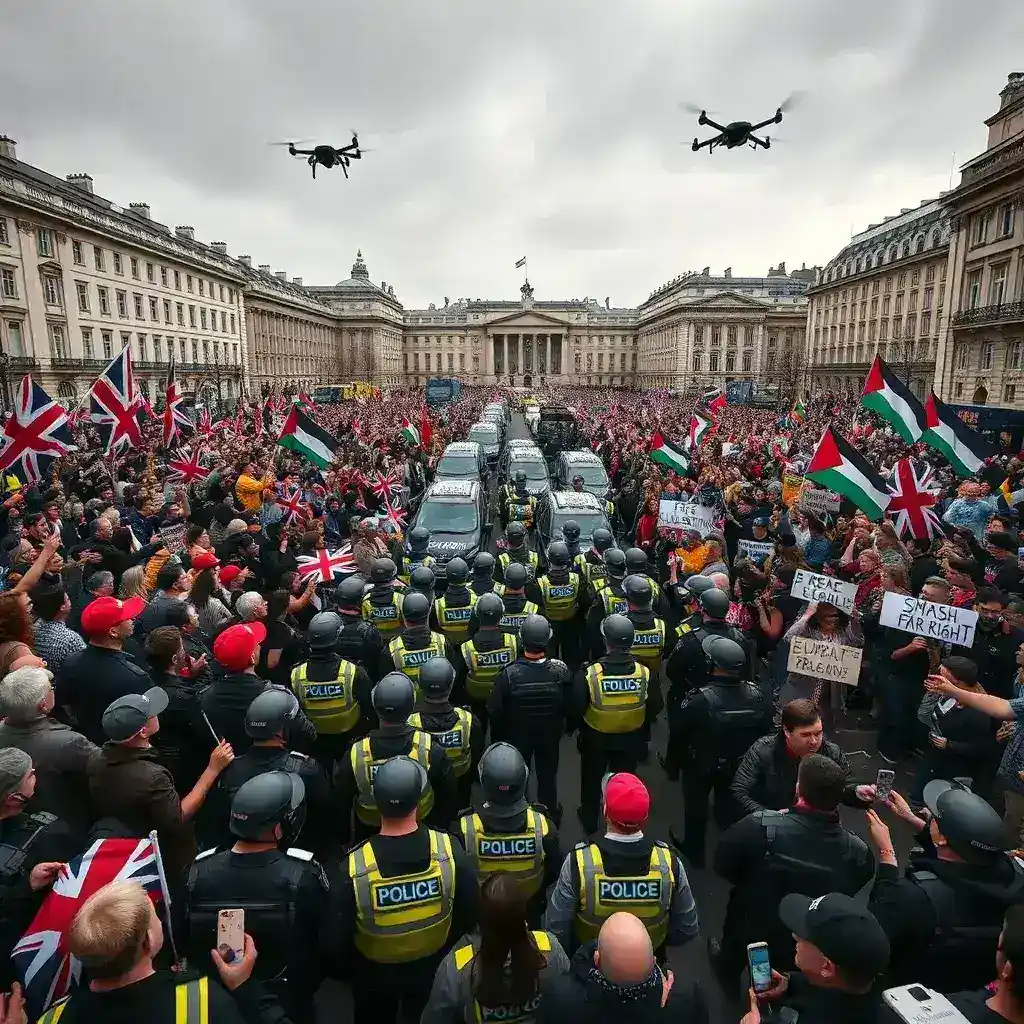
Tens of thousands converged on London Saturday for two major, opposing demonstrations – the far-right “Unite the Kingdom” rally and a pro-Palestinian march marking Nakba Day – coinciding with the FA Cup Final at Wembley Stadium. Over 4,000 police officers were deployed in a significant operation to manage the events, establishing a “sterile zone” between the two marches and utilizing advanced surveillance including drones and live facial recognition technology.
Massive Policing Operation Amidst High Tensions
The Metropolitan Police classified the policing operation as one of the most significant in recent years, with Deputy Assistant Commissioner James Harman estimating its cost at £4.5 million. The force implemented stringent controls, including restricted march routes and timings, to mitigate potential clashes.
Advanced surveillance measures were a key feature of the operation. Drones monitored protest routes, and CCTV feeds from the FA Cup final were scrutinized to identify individuals potentially travelling to join the demonstrations. The Met also employed live facial recognition cameras at key transport hubs like Euston and King’s Cross St Pancras stations, a first for protest policing, to identify individuals of interest.
Despite these measures, arrests were made. The Met reported 11 arrests by 13:00 BST, though specific connections to either march were not immediately detailed. Earlier, two men were arrested near Euston station on suspicion of grievous bodily harm (GBH) following an incident in Birmingham, reportedly intending to attend the “Unite the Kingdom” rally.
Divergent Demonstrations Converge on the Capital
The “Unite the Kingdom” rally, organized by figures including Tommy Robinson (Stephen Yaxley-Lennon), saw participants gather in Kingsway before proceeding towards Whitehall and a rally in Parliament Square. Many waved Union flags and chanted slogans such as “we want Starmer out.” Reports from the scene indicated a range of motivations among attendees, from a desire for government change to feelings of discrimination against white working-class people.
Simultaneously, the pro-Palestinian march, coinciding with Nakba Day, commenced in Kensington and moved towards Waterloo Place. Nakba Day commemorates the displacement of Palestinians during the 1948-49 war surrounding Israel’s creation. Participants displayed flags and signs with slogans like “smash the far right” and “Free Palestinian Hostages,” with many wearing keffiyehs as a symbol of solidarity.
Government and Police Stance on Protest and Hate Speech
The government took action to prevent foreign nationals deemed to be “far-right agitators” from entering the UK. On Friday, it was announced that eleven such individuals, including US-based influencer Valentina Gomez, were blocked from entering the country to attend the “Unite the Kingdom” event.
Political leaders condemned the divisive nature of some protests. Sir Keir Starmer stated, “The organisers are peddling hatred and division, plain and simple. We will block those coming into the UK who seek to incite hatred and violence.” He emphasized that those causing havoc or intimidation would face the full force of the law.
The Crown Prosecution Service (CPS) issued new guidance to prosecutors, encouraging them to consider whether protest materials constitute offenses of stirring up hatred. Specialist officers were prepared to make swift arrests and charges for hate speech crimes, including chants referencing “intifada” at the pro-Palestinian march.
Director of Public Prosecutions Stephen Parkinson clarified, “This is not about restricting free speech. It is about preventing hate crime and protecting the public, particularly at a time of heightened tensions. Where the line into criminality is crossed, we will not hesitate to prosecute.”
Expert Views and Organisational Concerns
Lord Mann, the government’s independent advisor on antisemitism, stressed the responsibility of event organizers to vet speakers and ensure they remain within legal boundaries. “The police have a difficult job in handling protests and the organisers of demonstrations should ensure that people they platform… have a responsibility to ensure their speakers stay within the law,” he told the BBC.
John Rees of Stop the War, a pro-Palestinian march organizer, questioned the decision to allow the “Unite the Kingdom” march on the same day as Nakba Day commemorations, suggesting the police response should have been to deem it unacceptable. The Met, however, stated that discussions with “Unite the Kingdom” were already underway when the Nakba Day march application was made.
Nick Aldworth, former Met Police superintendent, noted the challenges in prosecuting spontaneous inflammatory remarks made by speakers during protests, stating that while police would seek to enforce the law, proving such offenses in court could be difficult.
Implications and Future Watch
The significant police presence and the deployment of advanced surveillance technologies highlight the growing challenges authorities face in managing large-scale, potentially volatile public demonstrations. The coordinated efforts to prevent foreign agitators and the CPS guidance on hate speech indicate a hardening stance against incitement and extremism.
The convergence of political protests with major sporting events raises questions about future event planning and public safety management. The effectiveness of live facial recognition in such operations and the legal complexities surrounding free speech versus hate speech will likely remain key areas of focus for law enforcement and legal bodies. Observers will be watching how these incidents influence future protest regulations and the balance between democratic rights and public order.





Leave a Reply