
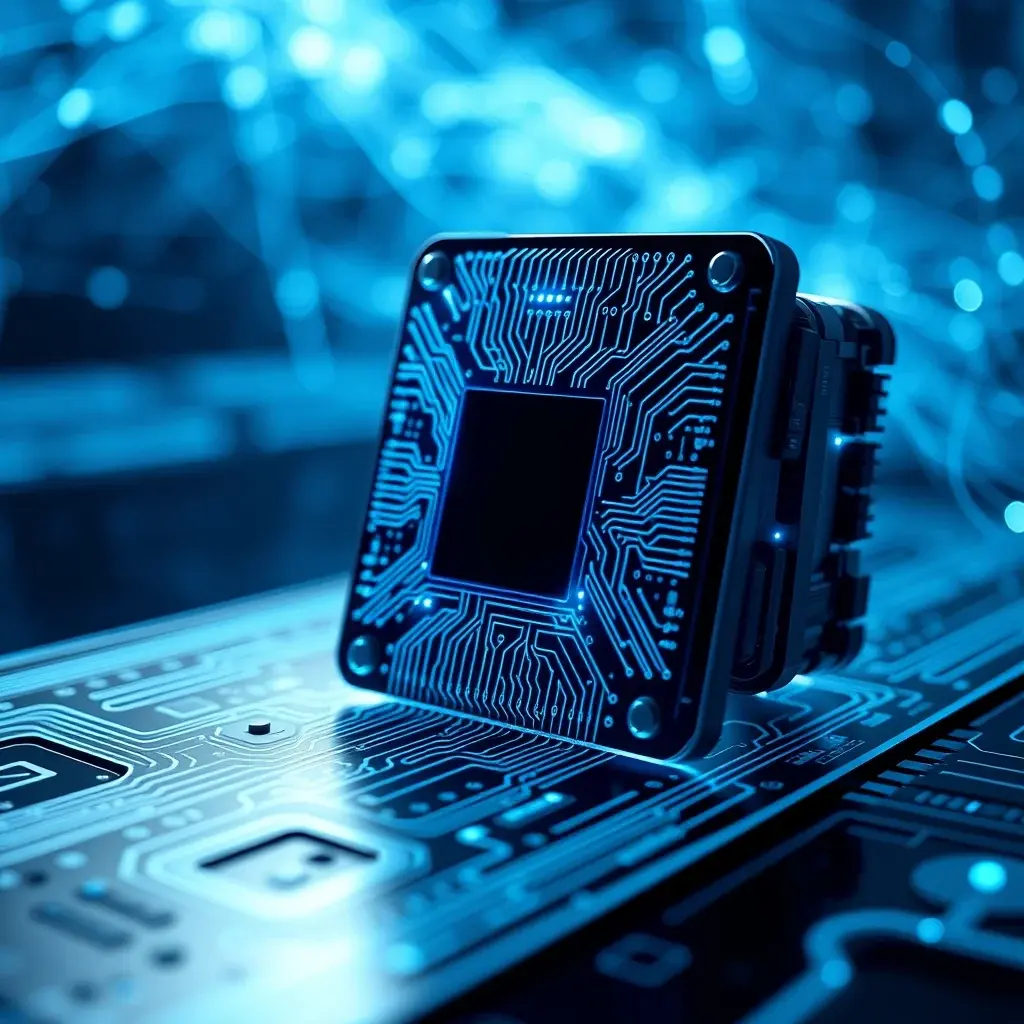
Microsoft announced this week that its new quantum chip, codenamed Majorana 2, demonstrates a thousand-fold increase in reliability compared to its predecessor, potentially accelerating the timeline for quantum computers to solve commercially valuable problems by 2029. This breakthrough addresses a critical challenge in quantum computing: the extreme fragility and instability of qubits, the fundamental units of quantum information.
The core of quantum computing lies in qubits, which hold the potential to tackle complex calculations far beyond the reach of current supercomputers. However, these qubits are notoriously susceptible to environmental interference, leading to errors and data loss. Microsoft’s Majorana 2 chip significantly extends the operational lifespan of its qubits, maintaining their quantum state for an average of 20 seconds, a dramatic improvement from the mere milliseconds achieved by the first Majorana chip.
Bridging the Gap to Usable Quantum Computing
This leap in qubit stability is being likened by Microsoft executives to the difference between a smartphone needing daily charging and one that could last for years. Zulfi Alam, corporate vice president of Microsoft Quantum, expressed confidence, stating, “We will have a quantum machine in 2029 that can solve commercially viable, reasonable problems.” While this timeline is ambitious, it hinges on further advancements, as a fully functional machine would likely require millions of qubits, a stark contrast to the 12 qubits present in the current iteration of the Majorana chip.
Microsoft has dedicated two decades to developing its unique approach to quantum computing, known as “topological” quantum computing. This method leverages the theoretical properties of quasiparticles, first predicted by physicist Ettore Majorana in the 1930s, and requires manipulating a novel state of matter. The second-generation Majorana chip refines this approach, notably by replacing aluminum with lead as a superconductor, enhancing its effectiveness.
Navigating Skepticism and Validation
Assessing the full impact of Microsoft’s claims is challenging due to the company’s policy of withholding detailed technical information for commercial confidentiality. Nevertheless, the announcement comes amid a global race to harness quantum computing’s power for tasks such as drug discovery, materials science, and complex optimization problems.
Microsoft’s pursuit of topological qubits has not been without controversy. The company previously retracted a 2018 paper in the journal Nature after claiming to have found evidence of the Majorana quasiparticle, leading to considerable skepticism from some experts. Henry Legg, a physicist at the University of St Andrews, had previously characterized Microsoft’s quantum research as having “moved firmly away from science and entered the realm of faith.”
Jason Zander, executive vice president of Microsoft Quantum and Discovery, defended the company’s work, emphasizing scientific rigor and welcoming debate. He stated, “We stand behind it 100%… the key thing I would tell people, go read the papers and look what’s there, go talk to the experts that we have given deep information to.” Microsoft is currently participating in a final-stage quantum development program with the US defense research agency Darpa, sharing proprietary data for assessment.
However, the paper accompanying the latest announcement has not yet undergone peer review, a crucial step for scientific validation. Scientists interviewed by the BBC expressed a desire for more publicly accessible information and independent verification.
The Promise of Quantum for Societal Challenges
If Microsoft’s advancements prove successful, quantum computers could dramatically accelerate solutions to pressing global issues. Zander highlighted potential applications like removing microplastics from the environment or developing more efficient fertilizers for agriculture, tasks that could take decades with current computational methods. He envisions a collaborative future where humans, artificial intelligence, and quantum computers work in tandem to compress problem-solving timelines.
“It’s not about eliminating humans, it’s about giving humans tools that can help them accelerate that process, that’s actually going to help society, I think,” Zander remarked.
The Enduring Qubit Quandary
Despite Microsoft’s progress, the fundamental challenge of qubit fragility persists across the entire quantum computing industry. Maintaining the delicate quantum states of qubits requires extreme isolation from environmental noise, such as temperature fluctuations and vibrations. While many companies are vying to build scalable quantum computers, no definitive success has been publicly announced.
Some in the field also caution against underestimating the capabilities of classical computing. Sir Demis Hassabis, co-founder of Google Deepmind, recently noted in a book that the ultimate limits of conventional computers remain unknown, suggesting that traditional machines may still hold untapped potential.
What’s Next in the Quantum Race
The coming years will be critical for validating Microsoft’s claims and observing the progress of other players in the quantum computing arena. The focus will be on independent verification of the Majorana 2 chip’s performance and the successful scaling of qubit counts. Continued advancements in error correction and qubit stability will be key determinants in whether quantum computers can transition from theoretical promise to practical, world-changing tools by the end of the decade.










Leave a Reply