
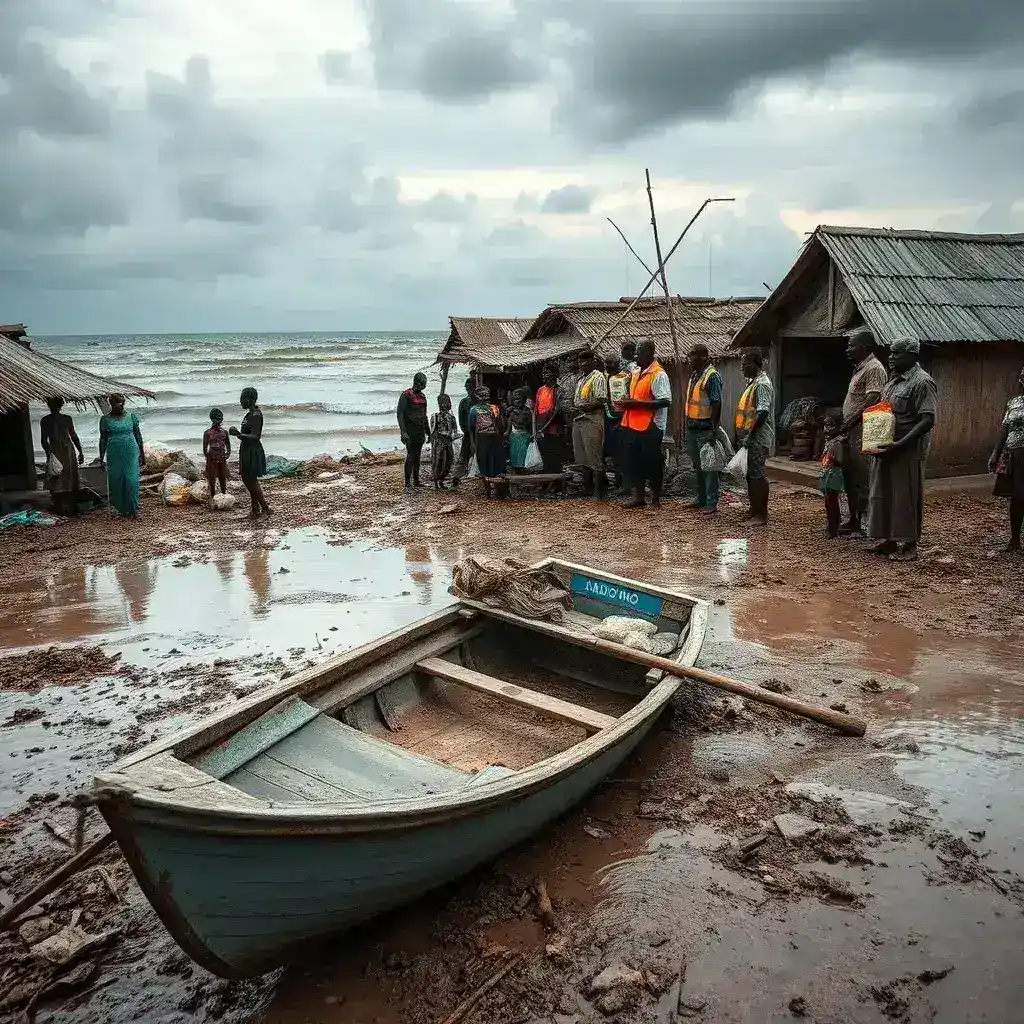
The National Disaster Management Organisation (NADMO) delivered critical relief supplies to victims of devastating tidal waves in Ghana’s Anlo District this week, following widespread destruction that has severely impacted local communities and livelihoods. The intervention aims to address immediate needs while exploring long-term solutions to the recurring natural disaster.
A high-level NADMO delegation, spearheaded by Director-General Joseph Bikanyi Kuyon, visited Fuveme in the Anlo District, one of the hardest-hit areas. The tidal waves, exacerbated by unusual seawater intrusion into the Volta River, have caused significant damage to homes and infrastructure.
Context of the Disaster
The Anlo District, situated along Ghana’s coast and the Volta River estuary, is particularly vulnerable to tidal surges and coastal erosion. This recent event saw seawater breaching the banks of the Volta River, a phenomenon that has become increasingly concerning for downstream communities.
This intrusion of saltwater into the freshwater system disrupts vital agricultural activities, primarily irrigation for crops. Furthermore, it has led to a noticeable decline in fish populations, directly threatening the livelihoods of the region’s farmers and fisherfolk who rely heavily on these resources for their income and sustenance.
NADMO’s Response and Relief Efforts
Upon arrival, the NADMO team, accompanied by Volta Regional Director Pascal Agbagba and Anlo District Chief Executive Sandra Seyram Kpedor, toured the affected areas. They engaged with local leaders to gain a comprehensive understanding of the damage and to discuss sustainable strategies for mitigating the recurring tidal wave menace.
Director-General Kuyon emphasized the urgency of the situation, stating that the seawater intrusion requires immediate attention. “We are working with government and other stakeholders to provide both relief and long-term solutions,” he assured affected residents.
As an immediate intervention, NADMO distributed essential relief items to households impacted by the tidal waves. These supplies included staple foods such as bags of rice, maize, and peas, alongside vital non-food items like cartons of cooking oil, soap, and mosquito nets, crucial for maintaining hygiene and health in the aftermath of the disaster.
Commitment to Long-Term Solutions
In a statement released via Facebook, NADMO reiterated its commitment. “The intervention forms part of our commitment to safeguarding lives and livelihoods in communities affected by tidal waves, while working with stakeholders to find lasting solutions to the menace,” the organization stated.
NADMO affirmed its dedication to supporting the affected communities, ensuring their safety and well-being. The organization also highlighted its ongoing efforts to pursue long-term interventions to address the root causes of the tidal wave challenges.
The NADMO delegation included several senior officials, underscoring the national significance of the response. Notable attendees were Deputy Director-General (Operations) Hon. Teddy Addi-Safori, Deputy Director-General (Technical Services) Ahmed-Rufai Aggudey, Director of Operations Col. Lawrence Ahli, and Director of Inspectorate Richard Amo-Yartey.
Implications and Future Outlook
The recurrent nature of these tidal wave events in the Anlo District highlights a growing vulnerability to climate change impacts, particularly sea-level rise and altered weather patterns. The disruption to agriculture and fishing poses a significant economic threat to the region.
For the residents of Anlo, this relief is a temporary but necessary measure. The focus now shifts to the implementation of the “long-term solutions” promised by NADMO and government stakeholders. These could potentially involve coastal defenses, improved infrastructure, or relocation strategies for the most vulnerable communities.
The effectiveness of these long-term measures will be crucial in determining the resilience of the Anlo District against future tidal wave incursions. Communities and authorities will be watching closely to see if sustainable strategies can be developed to protect lives and livelihoods from the encroaching sea.










Leave a Reply