
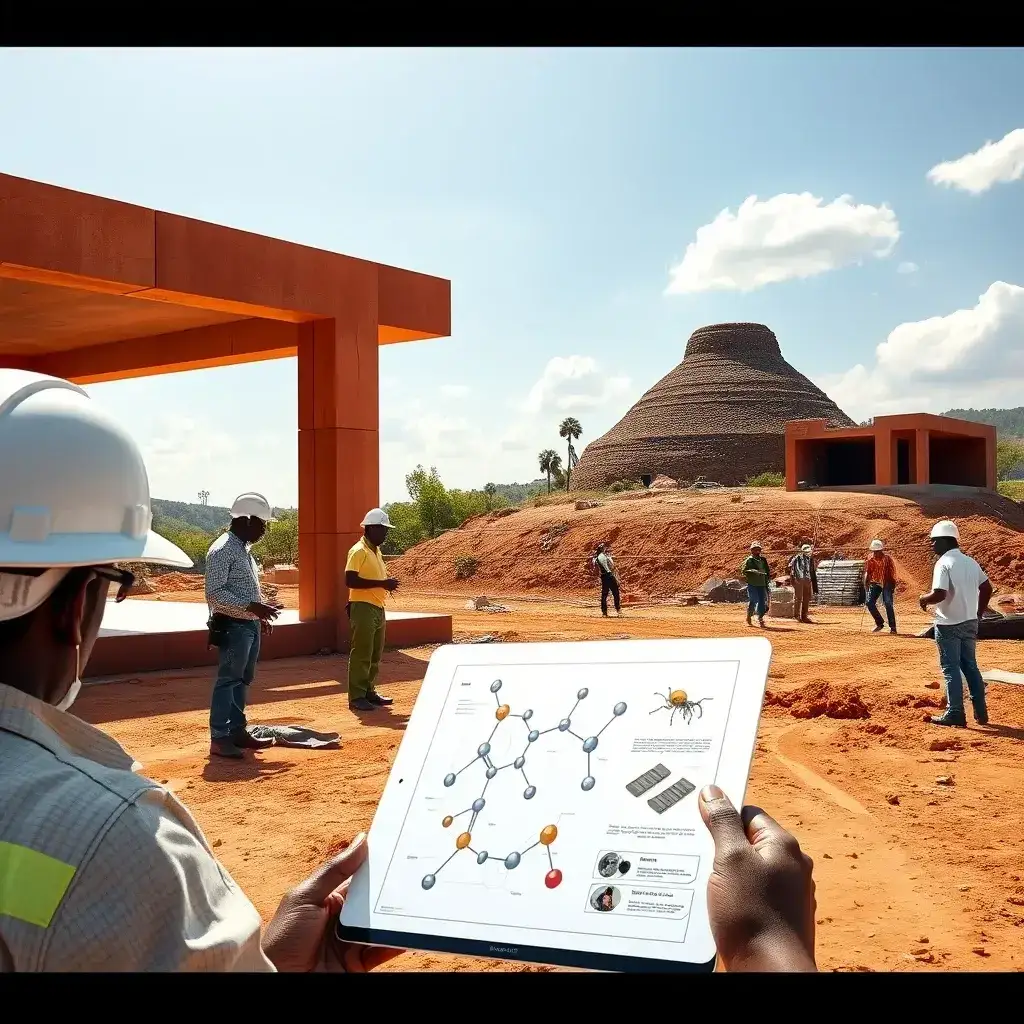
Scientists at Kwame Nkrumah University of Science and Technology (KNUST) in Ghana are employing quantum computing methods to validate the use of locally sourced laterite-clay and agricultural fiber composites in construction. This groundbreaking initiative, spearheaded by the TCC-CIMET research center, aims to overcome a significant barrier in Ghana’s building code, potentially enabling the widespread adoption of low-carbon, sustainable materials for the first time.
Ghana’s Untapped Construction Resource
Ghana possesses abundant natural resources in its laterite-clay deposits and agricultural bio-waste, such as palm-nut shells and coconut husks, which are generated in large quantities annually. Despite their availability, these materials have not been integrated into the country’s approved load-bearing construction specifications.
The primary obstacle to their adoption is not scarcity but certainty. Regulators and construction professionals require predictable performance standards, including data on strength, durability, and long-term structural behavior. Without this crucial data, natural composites struggle to gain approval for public infrastructure and large-scale building projects.
Past Successes and Current Challenges
Previous research under the RENABUMA (Reinterpreting Natural Building Materials) project has demonstrated the practical feasibility of these local materials. Researchers have successfully constructed pavilions using clay, wood, and natural fibers, proving that Ghana’s earth can indeed be shaped into habitable structures.
The BUCABUMA (Building Capacity in Circular Natural Materials) project further extends this work, incorporating digital fabrication and circular economy principles across a five-country African consortium funded by the European Commission. Both projects have utilized local materials like laterite, clay, bamboo, and various natural fibers through digital design and frugal fabrication methods.
However, a significant constraint has been the slow generation of material performance data. Conventional laboratory testing for a single validated mix design can take months of iterative cycles. Scaling from demonstration pavilions to code-approved buildings necessitates a faster method of knowledge acquisition.
Quantum Computing as a Solution
KNUST’s TCC-CIMET is pioneering the use of hybrid quantum-classical algorithms to accelerate this process. These methods combine near-term quantum processors, accessible via cloud platforms, with high-performance classical computing to model and optimize the molecular and macro-structural behavior of laterite-clay composites.
Professor Alexander Boakye Marful, Principal Investigator for RENABUMA and BUCABUMA, stated, “KNUST’s TCC-CIMET is not waiting for quantum hardware to mature. It is exploring hybrid quantum-classical methods available now on the cloud to solve a very local problem: making Ghana’s abundant earth and bio-waste into predictable, code-compliant building materials.”
The research focuses on computationally intensive challenges such as optimizing clay-fiber ratios, simulating moisture-induced microcracking under cyclic loading, and predicting long-term creep behavior in tropical humidity. Hybrid quantum-classical variational algorithms show early promise in outperforming purely classical solvers for these problem classes, offering the speed needed to generate the predictive strength and durability data required by the Ghana Building Code.
Implications for Ghana and Beyond
The development of a code-compliant laterite-clay composite specification would offer architects and engineers a sustainable, low-carbon, and cost-effective alternative to cement-heavy concrete for specific structural applications. Given current cement import costs and carbon accounting concerns, the economic and environmental benefits are substantial.
The broader ambition is to create a replicable methodology. If quantum-enhanced simulation can validate mix designs for Ghanaian composites, the approach can be adapted for similar local soil chemistries in other African nations, such as Kenya, Ethiopia, and South Africa, which face analogous regulatory barriers for earth-building traditions.
This initiative represents a significant step towards fostering a more sustainable, affordable, and climate-conscious built environment across the continent by focusing on hyperlocal materials and community-driven solutions.
Call for Collaboration
TCC-CIMET at KNUST is actively seeking collaborations with researchers, materials scientists, quantum computing specialists, engineers, and institutions interested in advancing climate-resilient construction in Africa. The BUCABUMA project, led by Prof. Alexander Boakye Marful, includes international partners such as the Karlsruhe Institute of Technology and TU Braunschweig in Germany, the University of the Witwatersrand in South Africa, the University of Nairobi, and Addis Ababa University.










Leave a Reply