
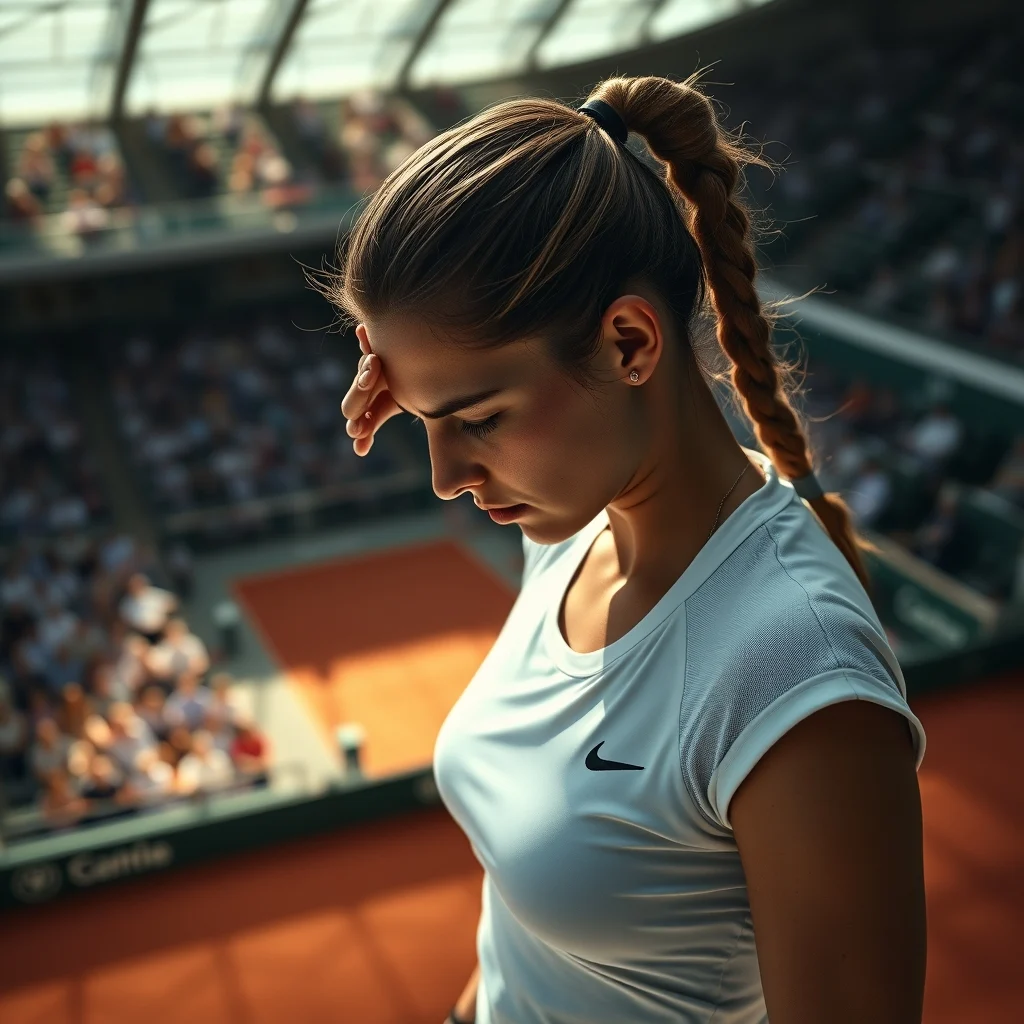
World number one Aryna Sabalenka suffered a stunning 3-6 7-5 6-0 defeat to Russia’s Diana Shnaider in the French Open quarter-finals on Tuesday in Paris, marking another significant Grand Slam opportunity missed.
Dominance Meets Grand Slam Pressure
Sabalenka has established herself as a dominant force in women’s tennis over the past few seasons, amassing 11 WTA titles and maintaining the top ranking for 93 consecutive weeks. Despite this consistent success, her tally of four Grand Slam singles titles, all on hard courts, is increasingly being scrutinized against her clear superiority on tour.
Heading into the French Open quarter-finals, with no other major champions remaining in the draw, Sabalenka was the overwhelming favorite to claim her first Roland Garros title. However, she faltered dramatically, losing a set and a double break advantage against the unseeded Shnaider.
The Mental Game on Clay
Sabalenka herself acknowledged the potential role of pressure, suggesting, “Maybe I’m focusing too much that I’ve never won a Slam [here]. Maybe it makes me overthink and over-emotional.” Clay is not her strongest surface, despite her success on the high-altitude courts of Madrid, which play more like a hard court.
Her build-up to Roland Garros also showed signs of vulnerability. In Madrid, she squandered six match points in a quarter-final loss to Hailey Baptiste. In Rome, she let a set and a break lead slip against veteran Sorana Cirstea. These instances, coupled with her Paris exit, fuel the narrative of missed chances.
A Pattern of Late-Stage Stumbles
While Sabalenka’s record of not losing before a Grand Slam quarter-final since early 2023 is remarkable, her performances in the latter stages of majors have been inconsistent. She has lost four Grand Slam finals and six semi-finals, raising questions about her ability to close out matches under extreme pressure.
Memorable defeats include the 2025 Australian Open final against Madison Keys, where she was the favorite, and a subsequent Melbourne final where she lost a deciding set lead against Elena Rybakina. Last year’s French Open final saw her commit 70 unforced errors in windy conditions, a match she described as her “worst final.”
Against Shnaider, Sabalenka held a commanding 6-3, 4-1 lead before losing 12 of the final 13 games. Her 57 unforced errors far outweighed her 46 winners, highlighting a loss of control in critical moments.
Environmental Factors and Tactical Adjustments
The swirling winds on Court Philippe Chatrier were cited as a significant factor, reminiscent of her loss to Coco Gauff in the same tournament last year. High winds demand sharper footwork and precise court positioning, elements that appeared to challenge Sabalenka.
Her preferred aggressive, first-strike tennis style, aimed at ending rallies quickly from the baseline, proved ill-suited to the conditions. “The one thing you need to do in the wind is increase your margins,” noted former British player Naomi Broady on BBC Radio 5 Sports Extra. “When that is not your game style, and there is a refusal to have a plan B, every now and then it is going to really hurt.”
Broady added that Sabalenka likely felt the title was hers for the taking this year, as she did last year, and that these consecutive losses will be particularly painful.
Looking Ahead to Grass
Sabalenka’s immediate challenge is to recalibrate her mindset and strategy as she shifts focus to the grass-court season, where she has reached the semi-finals in her last three Wimbledon appearances. “I really feel great on clay. I feel great on grass,” Sabalenka stated, but acknowledged the need for introspection. “This is something that I have to step back [from] and try to find a solution, because I just am so tired of losing some matches – not in the best way, [but] because I was overemotional.”
Sabalenka’s unexpected exit means the French Open women’s singles title will be won by either Diana Shnaider, Maja Chwalinska, Mirra Andreeva, or Marta Kostyuk. For Sabalenka, the focus now turns to whether she can overcome these late-stage pressures and environmental challenges on her path to securing more Grand Slam silverware.










Leave a Reply