
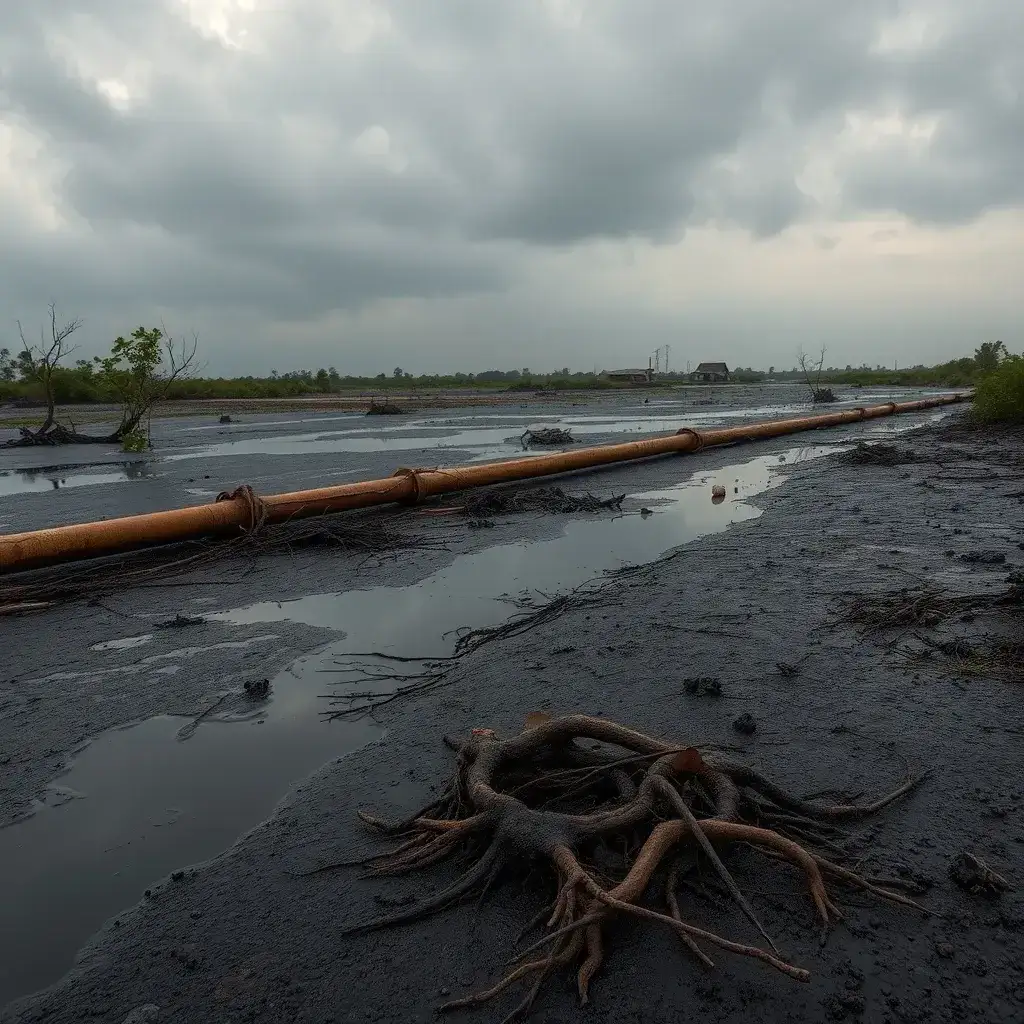
Internal documents obtained by the BBC reveal that British multinational Shell continued operating a major oil pipeline in Nigeria for years, despite evidence of widespread pollution and warnings from its own staff and technical standards. The files suggest a senior Shell executive cautioned as early as 2008 about the risks of pumping millions of barrels of unrefined fuel through the Nembe Creek Trunk Line while it was subjected to extensive oil theft and infrastructure failures.
Decades of Environmental Scarring in the Niger Delta
For decades, the Niger Delta, Africa’s largest oil producer, has suffered from numerous oil spills. These incidents have left the region’s wetlands coated in crude oil and contaminated sediment, severely impacting the environment and the livelihoods of its inhabitants.
The documents came to light as part of legal proceedings in the UK, where communities from the Niger Delta are suing Shell. They allege that over 100 leaks from the Nembe Creek Trunk Line between 2011 and 2013, stemming from oil theft and illegal refining, have caused significant damage to their health, environment, and ability to earn a living.
The Problematic Nembe Creek Trunk Line
The 60-mile (96.5km) Nembe Creek Trunk Line was a critical piece of infrastructure for Shell in Nigeria, capable of transporting up to 150,000 barrels of oil daily from inland fields to a coastal export site. However, it was frequently hit by spills and became a target for illegal oil thieves.
Shell, which sold its remaining onshore assets in Nigeria last year, argues in court that most pollution is due to “large-scale oil theft, sabotage” and illegal refineries. The company states its Nigerian subsidiary invested heavily to mitigate spill risks and improve response times.
Community Impact: From Fishing Grounds to Toxic Zones
Residents in areas like Bille, a community comprising 45 islands near the pipeline, describe a stark environmental degradation. Fishermen like 64-year-old Balafama Augustus Bruce recount how once-thriving fishing grounds, abundant with sardines, catfish, tilapia, and oysters, have become toxic and unusable due to the spills.
“Before 2011, this was a beautiful area. People play here and go into the river,” Bruce told the BBC. “But because of the damage [the spills] have caused, nobody is fishing here again. Because of that, I’ve become poor. I eat from hand to mouth.”
The communities are seeking $1 billion in compensation and cleanup costs through their lawsuit. According to UN data, since Shell began oil shipments from Nigeria in 1958, at least 13 million barrels of crude oil have been spilled in approximately 7,000 incidents.
Historical Context: Activism and Oil Theft
Environmental activism against oil pollution in the Niger Delta has a long history, notably championed by writer Ken Saro-Wiwa, who was executed in 1995. Oil theft, known locally as “bunkering,” involves criminal gangs tapping pipelines to siphon crude oil, which is then either illegally refined or sold.
The region also faced significant security challenges in the mid-2000s due to militant activity, including attacks on installations and kidnappings, demanding greater benefit from oil revenues for the impoverished region.
Internal Warnings: The 2008 Disagreement
An internal Shell email exchange from October 2008 highlights a disagreement among senior executives regarding the continued operation of the Nembe Creek Trunk Line. Markus Droll, then technical vice-president, expressed concern about operating the pipeline outside its usual guidelines.
“If there is another massive explosive attack tomorrow… then we could well find ourselves in the situation of simply having to close the production down,” Droll wrote. He questioned the adequacy of safeguards and flagged potential poor condition in other pipeline sections, stating the approach made him “pretty uncomfortable.”
Ann Pickard, Shell’s regional executive vice-president at the time, criticized Droll for not marking the email as legally privileged. She acknowledged the difficulty of the decision but argued continuing operations posed “the lower risk to both people and environment,” while admitting, “You are right, we may have to deal with it in the future.”
‘Red’ Status and Continued Operations in 2012
A confidential 2012 form revealed that Shell executives were aware the pipeline was not meeting its technical standards. Sections were classified as “red” due to extensive illegal oil-theft connections, a status that, by the company’s definitions, required immediate shutdown or corrective action.
However, executives decided against shutting down the system, fearing it would lead to “a significant number of new illegal connections” elsewhere. Instead, they permitted the Nigerian subsidiary to continue pumping oil.
Shell stated these decisions were based on complex factors including widespread theft and militancy, and that the company worked with Nigerian authorities and local communities on spill response regardless of cause.
Concerns Over Audits and ‘Project Madrid’
In February 2013, executives discussed conducting an audit of oil theft and pipeline integrity management from 2009-2012. Vincent Holtam, then general manager for onshore assets, warned that an audit could “do more harm than good,” potentially exposing the company to government claims over oil losses and community compensation demands.
The following month, a “most confidential” operation, codenamed Project Madrid, was launched to assess spill management. An internal presentation estimated 100 illegal refineries operating near the pipeline, polluting approximately 18,000 hectares of water and land.
The presentation outlined options ranging from temporary shutdowns to halting production for years. The documents do not specify the final decision, but the pipeline resumed operations after temporary repair shutdowns in 2013.
Shell maintains that the documents were presented without critical context and do not reflect the challenges of operating amidst “widespread organised criminality.” The company argues that despite efforts, Nigeria’s poor security environment made preventing gang activity impossible.
Accountability and Lingering Impacts
Law firm Leigh Day, representing the Bille communities, asserts that Shell plc in London made key decisions that led to environmental destruction and that the company should be held responsible.
Residents like Taminoibitein Philip, a periwinkle harvester, report that the sea snails, once abundant, are now scarce, and the pervasive odour of oil and gas affects their health. “We don’t benefit. We are suffering,” Philip stated, expressing hope that the court case will force Shell to clean the waterways.
Looking Ahead
As the legal case progresses, attention will focus on Shell’s defense and the evidence presented regarding its decision-making processes and operational standards in the Niger Delta. The outcome could set precedents for corporate accountability in environmental damage cases involving complex factors like oil theft and security challenges in developing nations.










Leave a Reply