
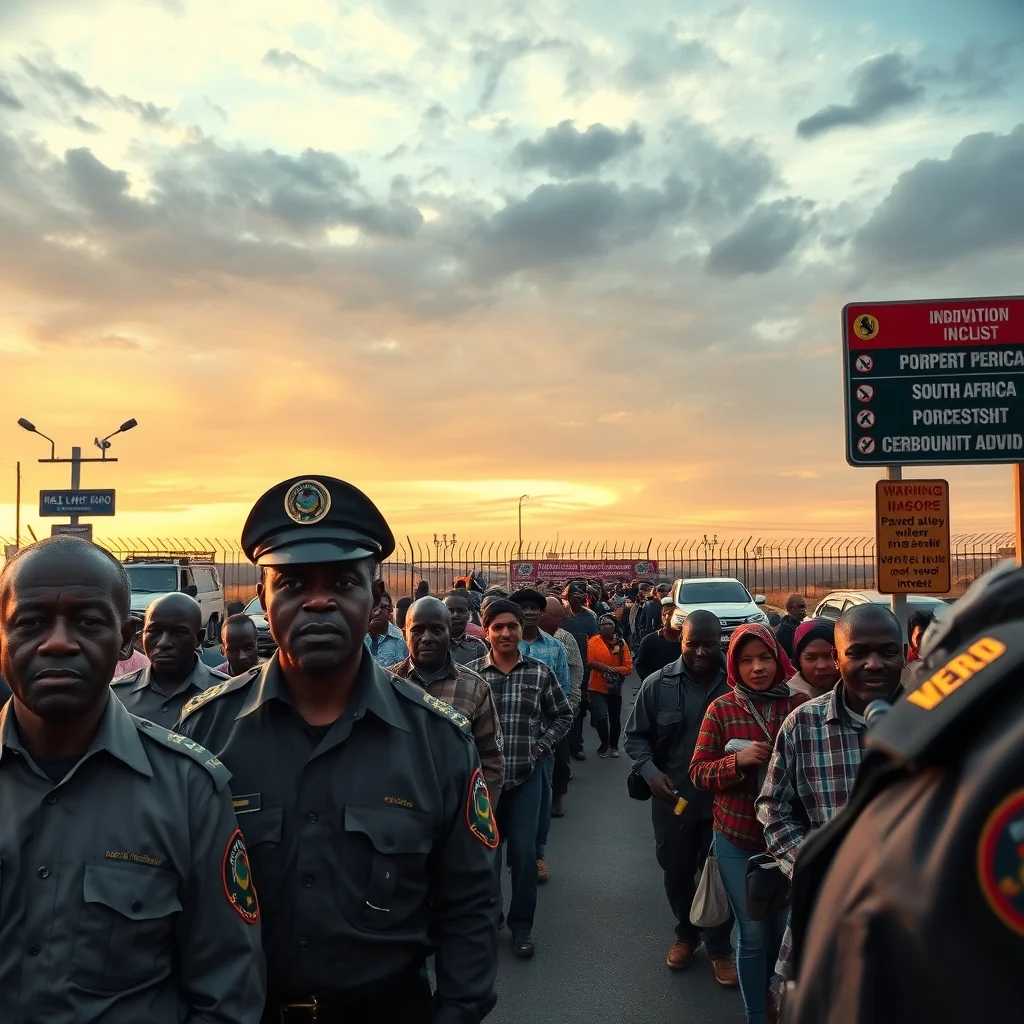
South African President Cyril Ramaphosa announced a comprehensive crackdown on illegal migration in a national address, introducing stringent measures including jail time for employers of undocumented workers, dedicated courts for expedited deportations, and a national biometric ID system. This response comes as anti-foreigner sentiment escalates, fueled by high unemployment and recent incidents of intimidation and violence against migrants, prompting several African nations to organize evacuations of their citizens.
Rising Tensions and Recent Incidents
The announcement follows a period of heightened anti-migrant activity, with groups demanding undocumented foreigners leave the country by June 30. Last weekend saw hundreds of migrants flee their homes in the Western Cape’s Overberg region after reports of door-to-door intimidation and the deaths of two Mozambicans in Mossel Bay. Many sought refuge in community halls, while others opted for repatriation, with approximately 140 individuals departing for Malawi and Mozambique.
In Durban, hundreds of foreign nationals have been camping outside the Department of Home Affairs for weeks, citing fears for their safety. President Ramaphosa acknowledged that illegal migration places an undue burden on South Africa’s public services and stated his government’s commitment to addressing the issue.
President Ramaphosa’s Five-Point Strategy
President Ramaphosa outlined a five-point plan to tackle illegal migration. This strategy focuses on strict enforcement against immigration law violators, bolstering border security, eradicating corruption within the immigration system, closing legal loopholes, and enhancing cooperation with other African nations.
He emphasized that only authorized government officials are permitted to enforce immigration laws, cautioning citizens against vigilantism. “No other person is allowed, for example, to confront someone in the street to demand proof of nationality,” he stated.
Potential Political Motivations
Some analysts suggest that the renewed anti-migrant sentiment could be linked to the upcoming local elections in November. President Ramaphosa warned against groups exploiting legitimate concerns about illegal immigration to destabilize the country by inciting violence.
He asserted that authorities would act against those using these issues for political, personal, or criminal agendas, and cautioned against the spread of misinformation on social media regarding foreign nationals. The president also explicitly rejected xenophobia, racism, sexism, Afrophobia, and all forms of intolerance, highlighting South Africa’s history as a nation built by migration and its contribution to the country’s diversity and vibrancy.
Scale of the Problem and Enforcement Measures
Official figures indicate South Africa hosts over three million foreign nationals, representing about 5% of the population, though undocumented individuals are believed to be significantly more numerous. President Ramaphosa highlighted the overlap between illegal migration routes and organized crime, noting that the Border Management Authority intercepted over 450,000 individuals attempting illegal entry in the past year alone.
To address the exploitation of undocumented workers, the government plans to hire 10,000 inspectors to crack down on businesses employing them. Employers found guilty will face harsher penalties, including potential imprisonment, a significant increase from the current practice of paying mere fines.
Combating Corruption and Identity Theft
The president acknowledged that corruption facilitates illegal migration, with officials sometimes selling documents. In an effort to combat identity theft, which has been enabled by traditional green ID books used by undocumented immigrants and criminal syndicates, these books will be discontinued. The long-term plan involves implementing a digital ID for all residents.
Further changes include relocating refugee reception centers to border posts. The government also intends to address concerns regarding foreign nationals operating informal businesses, such as spaza shops, particularly in townships. Efforts will be made to ensure all informal shops are properly registered with the Small Business Development Department.
Employment Quotas and International Cooperation
In a move likely to address local employment concerns, quotas will be set for the employment of foreign nationals across various economic sectors and occupational categories. South Africa faces one of the world’s highest unemployment rates, currently around 33%, disproportionately affecting young people.
President Ramaphosa announced plans to dispatch envoys to other African countries to communicate these new measures and emphasize the importance of peace and economic growth across the continent for managing migration flows.
Looking Ahead
The president concluded with a message of hope, expressing confidence that these measures would contribute to building a secure, lawful, compassionate, and prosperous South Africa. He drew parallels to the nation’s history of overcoming division, conflict, and injustice, stating, “We will overcome this challenge too.” The effectiveness of these new measures, the response from neighboring countries, and the impact on social cohesion will be key indicators to watch in the coming months.










Leave a Reply