
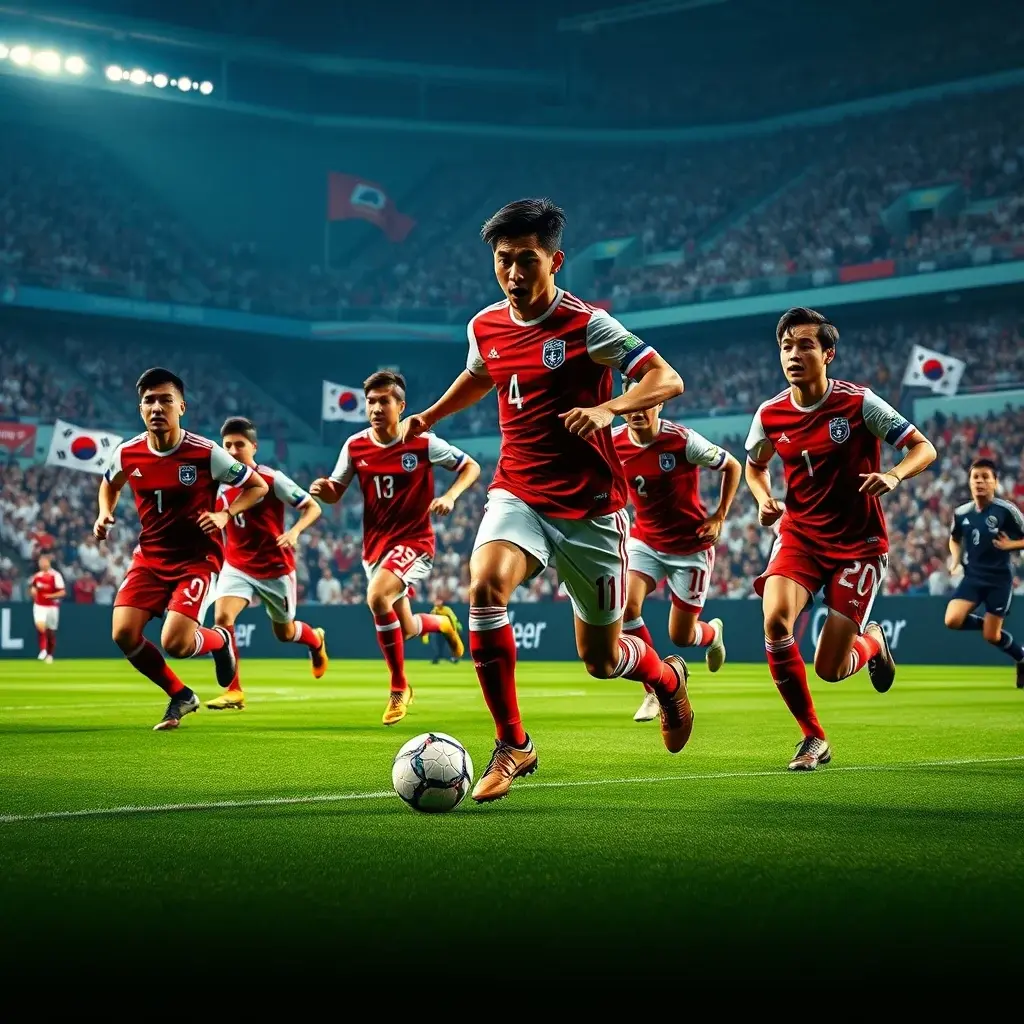
South Korea’s national football team is facing significant challenges as they approach the 2026 World Cup in North America. Head coach Hong Myung-bo’s side has been experimenting with a back-three formation late in their qualification campaign, a tactical shift that has left them with limited preparation time and cohesion. This, coupled with a concerning number of injuries to key players, has cast a shadow over their ambitions to progress beyond the group stage.
Tactical Experimentation Amidst Limited Preparation
The South Korean team predominantly utilized a back-four formation throughout their World Cup qualifiers. A late switch to a back-three system, implemented only after securing their place in the finals, has raised questions about the team’s readiness for this new tactical approach.
A primary concern within the 3-4-3 formation is the perceived scarcity of high-level wing-backs. This has led to considerable attention on Borussia Mönchengladbach’s Jens Castrop, whose versatility to play both centrally and wide could make him a crucial wildcard.
Coach Hong Myung-bo has attempted to allay fears regarding the tactical flexibility. “I think it’s difficult to rely on just one tactical approach and I have experience of that,” Hong stated in a recent interview with KBS. “There’s about a six-day break after the first match so we can assess the strength of our next opponent and adapt our formation to approach the game in different ways.”
Injury Crisis Threatens Team’s Spine
Adding to the team’s anxieties is the precarious fitness of several key players. Stalwarts like Son Heung-min, Kim Min-jae, Lee Kang-in, Lee Jae-sung, and Hwang In-beom are all dealing with a combination of injuries, inconsistent club form, and even benching.
The central midfield area appears particularly vulnerable, with multiple candidates sidelined due to injuries. Hwang In-beom, a vital component of the midfield, has struggled to regain his rhythm this season due to recurring physical setbacks.
Despite these challenges, South Korea enjoyed a strong qualifying campaign, remaining undefeated in all 16 matches and finishing six points ahead of Jordan in the second group stage. Hopes remain high for advancing from a group that includes co-hosts Mexico, South Africa, and Czechia.
“Our first goal is to advance to the round of 32. After that, anything could happen,” Hong commented, setting a pragmatic target for the tournament.
Coaching Legacy and Public Scrutiny
South Korea’s performance at the 2022 Qatar World Cup was lauded for its attacking style, which saw them challenge Uruguay and secure a memorable victory against Portugal to reach the knockout stages. However, the subsequent period has been marked by administrative instability.
The KFA president’s appointment of Jürgen Klinsmann proved to be a failure, with the German coach lasting less than a year. His successor, Hong Myung-bo, inherited a team amidst selection controversies.
While Hong is a revered figure in South Korean football history, he currently operates under a cloud of limited media and public support. His previous World Cup coaching experience in 2014, which ended without a single win, looms large as he prepares for North America. The current outlook for the team’s success remains cautiously pessimistic.
Star Power and Emerging Talent
Son Heung-min remains the nation’s most beloved footballing icon. His career highlights, including winning the Premier League Golden Boot and captaining a Europa League-winning side, underscore his status as a generational talent who has consistently performed for the national team.
Despite his individual brilliance, a major international trophy has eluded both Son and his country. The upcoming tournament presents an opportunity for him to overcome recent struggles at LAFC and find redemption on the world stage.
In terms of emerging talent, Oh Hyeon-gyu is positioned to make a significant impact. Following in the footsteps of Cho Gue-sung from the 2022 tournament, Oh joined Besiktas in January after a potential move to Stuttgart fell through due to injury concerns. He has since maintained strong form in Turkey, emerging as a strong contender for the starting striker position.
The Unsung Hero and Probable Lineup
Lee Jae-sung, despite having over 100 caps, can be considered an unsung hero due to his contributions often being overshadowed by more high-profile teammates. He is a consistent presence on the team sheet, known for his tenacious and intelligent play, blending attacking threat with defensive solidity.
Having recently recovered from a lengthy injury layoff, the 33-year-old veteran is set to play a crucial role alongside his long-time peer, Son Heung-min.
The probable starting XI for South Korea is anticipated to be a 3-4-3 formation: Kim Seung-gyu in goal; a backline of Hanbeom (Yoomin), Kim Min-jae, and Kihyeok; a midfield featuring Youngwoo, Hwang In-beom, Lee Seungho (Jinseop), and Taeseok (Castrop); and an attacking trio of Lee Kang-in, Son Heung-min, and Lee Jae-sung.
Fan Support and Future Outlook
The geographical and emotional distance between South Korea and North America presents a significant hurdle for fan turnout. Despite the widespread popularity of South Korean culture, the arduous journey may deter many fans from attending.
This reluctance is also seen as a reflection of a current disconnect, with neither the KFA nor head coach Hong Myung-bo currently inspiring the level of devotion needed to motivate such a pilgrimage.
What to Watch Next
The coming months will be critical for South Korea to address their tactical cohesion and fitness concerns. The performance of Jens Castrop in the wing-back role, if deployed, will be closely monitored. Furthermore, the recovery and form of key players like Son Heung-min and Kim Min-jae will significantly dictate the team’s success in the tournament. The ability of coach Hong Myung-bo to effectively integrate new tactical approaches and manage player fitness will be paramount as they aim to defy expectations in North America.










Leave a Reply