
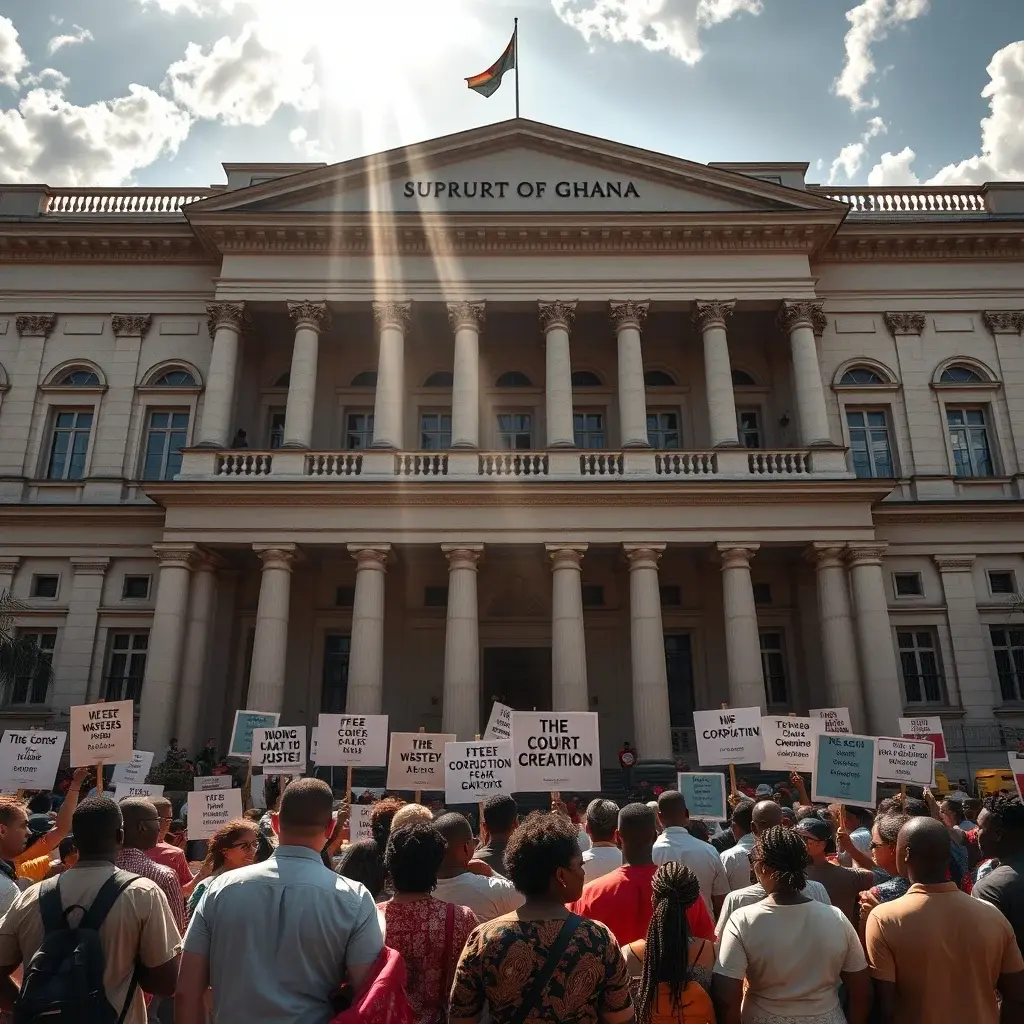
Accra, Ghana – The Supreme Court of Ghana has granted leave to fourteen civil society organizations (CSOs) to be joined as interested parties in a landmark case challenging the constitutionality of the Office of the Special Prosecutor (OSP) Act. This decision, welcomed by legal practitioners, promises to introduce diverse perspectives beyond the initial arguments presented by the applicant and the state, potentially influencing the apex court’s final determination on the validity of a key anti-corruption institution.
Expanding the Legal Arena
Private legal practitioner Justice Abdulai highlighted the significance of the Supreme Court’s decision, stating that the inclusion of CSOs would enrich the proceedings. He noted that these organizations bring insights that extend beyond the immediate legal arguments, offering a broader understanding of the issues at stake.
“It is great news that the Supreme Court has acknowledged this movement and we believe that they will bring different dimensions to this issue, different perspectives that would shift the final decision that the Supreme Court will ultimately make when the matter gets to the point where the decision needs to be made,” Abdulai stated on Joy FM’s Newsnight.
Rationale for Third-Party Inclusion
Abdulai emphasized that constitutional cases of such magnitude should not be confined to the submissions of only the two original parties. With the Attorney General’s Department having already presented its stance, the intervention of a third party is crucial for a comprehensive legal and institutional understanding.
“The whole essence of law is to allow for social re-engineering, and limiting your scope to the parties before you in a matter such as this would have done a disservice to all of us,” he argued.
Addressing Potential Bias
Responding to concerns that some CSOs might have pre-existing positions, potentially reinforcing one side of the debate, Abdulai acknowledged that stakeholders may hold particular views. However, he maintained that their involvement would still introduce new dimensions and critical analyses.
The Supreme Court’s acceptance of their participation signals a recognition that the constitutional questions surrounding the OSP necessitate a wider examination. This includes delving into legal history, public policy considerations, and the broader institutional consequences of the OSP Act.
The Core of the Case
The ongoing case at the Supreme Court centers on the constitutional validity of the OSP Act. The OSP, established as a crucial anti-corruption institution in Ghana, is mandated to investigate and prosecute corruption-related offenses.
The inclusion of CSOs signifies a move towards a more inclusive judicial process, where the societal impact and institutional framework of significant legislation are thoroughly scrutinized. Their participation is expected to provide empirical data, policy analyses, and public interest perspectives that could inform the court’s deliberations.
Implications for Ghana’s Anti-Corruption Framework
The decision to admit the CSOs broadens the scope of the legal challenge, moving it beyond a purely adversarial legal contest. It underscores the importance of public interest litigation and the role of non-state actors in shaping legal and policy outcomes in Ghana.
This development could set a precedent for future constitutional cases, encouraging greater stakeholder engagement in matters with significant public implications. The court’s final ruling, informed by these diverse inputs, will have substantial implications for the future effectiveness and legitimacy of the OSP and Ghana’s broader anti-corruption efforts.
Looking Ahead
As the case progresses, attention will be on the specific arguments presented by the CSOs and how they influence the Supreme Court’s interpretation of the OSP Act. The outcome will be closely watched by anti-corruption advocates, policymakers, and the general public, determining the robustness of a critical governance institution.










Leave a Reply