
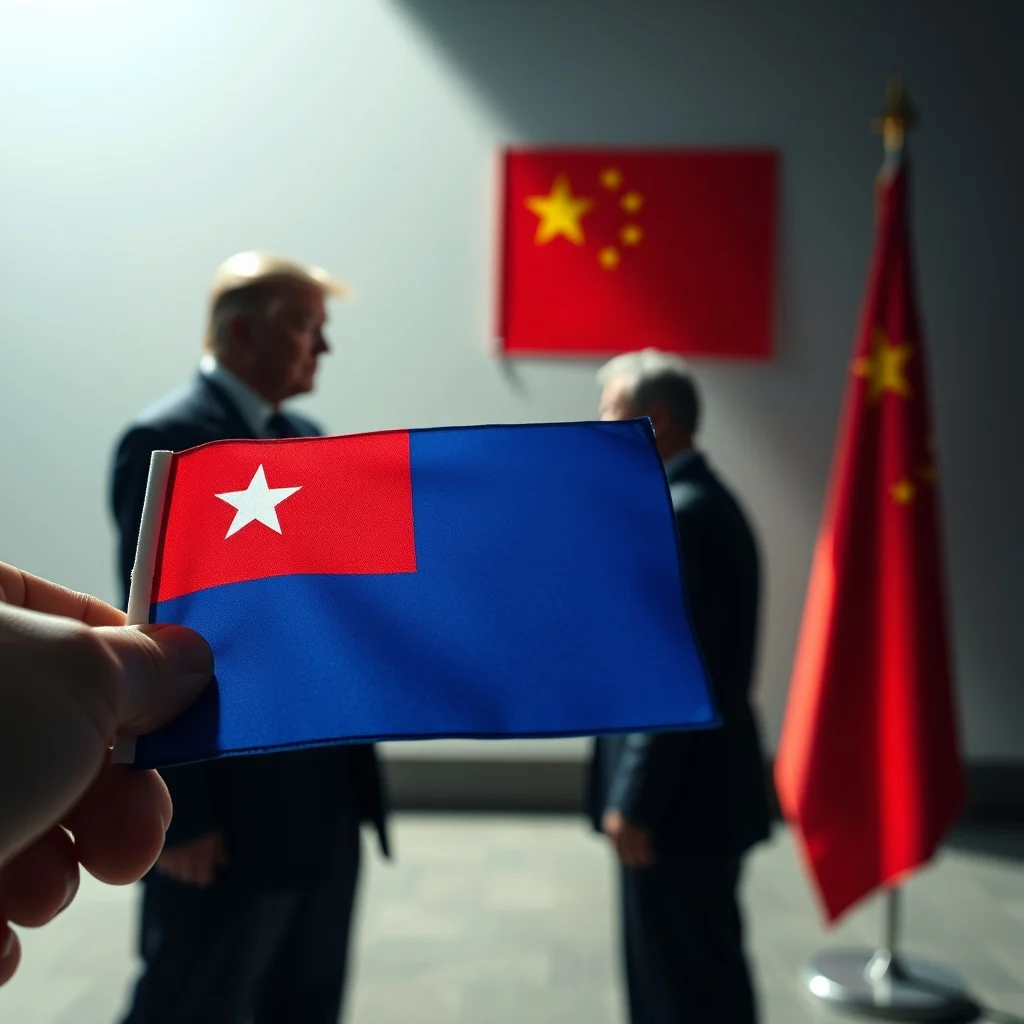
Taiwan has forcefully asserted its status as a sovereign, independent nation following a warning from US President Donald Trump against formal declarations of independence from China. Trump’s remarks, made after a summit in Beijing, indicated he had “made no commitment either way” regarding the self-governing island, which Beijing claims as its territory and has not ruled out reclaiming by force.
Context of US-Taiwan Relations
The US administration is legally obligated to provide Taiwan with the means for self-defense under the Taiwan Relations Act. However, this commitment often requires careful navigation to maintain diplomatic ties with the People’s Republic of China (PRC), which views Taiwan as a renegade province.
Historically, the US has adhered to a “one China” policy, acknowledging Beijing’s claim but not endorsing it, while maintaining robust unofficial relations with Taipei. This delicate balance has been a cornerstone of regional stability for decades.
Taiwan’s Position and Trump’s Ambiguity
Taiwanese President Lai Ching-te has previously articulated that formal independence is unnecessary, as Taiwan already functions as a sovereign state. On Saturday, presidential spokesperson Karen Kuo reiterated this stance, stating it was “self-evident” that Taiwan is “a sovereign, independent democratic country.” Kuo also emphasized Taiwan’s commitment to maintaining the status quo with China, a state of affairs where Taiwan neither declares independence nor seeks unification.
Many in Taiwan identify as a distinct nation, though public opinion largely favors preserving the current ambiguous status. This sentiment reflects a desire to avoid provoking Beijing while solidifying Taiwan’s de facto autonomy.
President Trump, in an interview with Fox News following his meetings with Chinese President Xi Jinping, stated that US policy on Taiwan remained unchanged. He explicitly voiced a desire to avoid conflict, saying, “I’m not looking to have somebody go independent.” He added, “I want them to cool down. I want China to cool down.”
During his return flight to Washington, Trump informed reporters that he and President Xi had “a lot” of discussions about Taiwan but declined to specify whether the US would defend the island. He noted that Xi “feels very strongly” about Taiwan and “doesn’t want to see a movement for independence.”
Implications of Arms Sales and Diplomatic Protocols
The potential sale of an $11 billion arms package to Taiwan is also pending Trump’s decision. The US president indicated he would discuss this with Taiwan’s leadership, acknowledging the unusual nature of direct communication between a US president and Taiwan’s leader, which could significantly strain relations with Beijing.
“Our nation is grateful to President Trump for his continued support for security in the Taiwan Strait since his first term in office,” Taiwan’s presidential spokesman stated. The spokesman added that Taiwan would “continue to deepen co-operation with the US to achieve peace through strength, ensuring that peace and stability across the Taiwan Strait are not threatened or undermined.”
Regional Tensions and Future Outlook
Beijing has consistently expressed strong disapproval of Taiwan’s leadership, labeling President Lai Ching-te a “troublemaker” and a “destroyer of cross-strait peace.” In recent years, China has intensified military activities around Taiwan, increasing regional tensions and testing the established US-led security framework.
The interplay between Trump’s transactional approach to foreign policy, Beijing’s assertive stance, and Taiwan’s determination to maintain its autonomy will be critical in shaping the future of the Taiwan Strait. Observers will be watching closely for Trump’s decision on the arms package and any further signals regarding US commitment to Taiwan’s defense.




Leave a Reply