
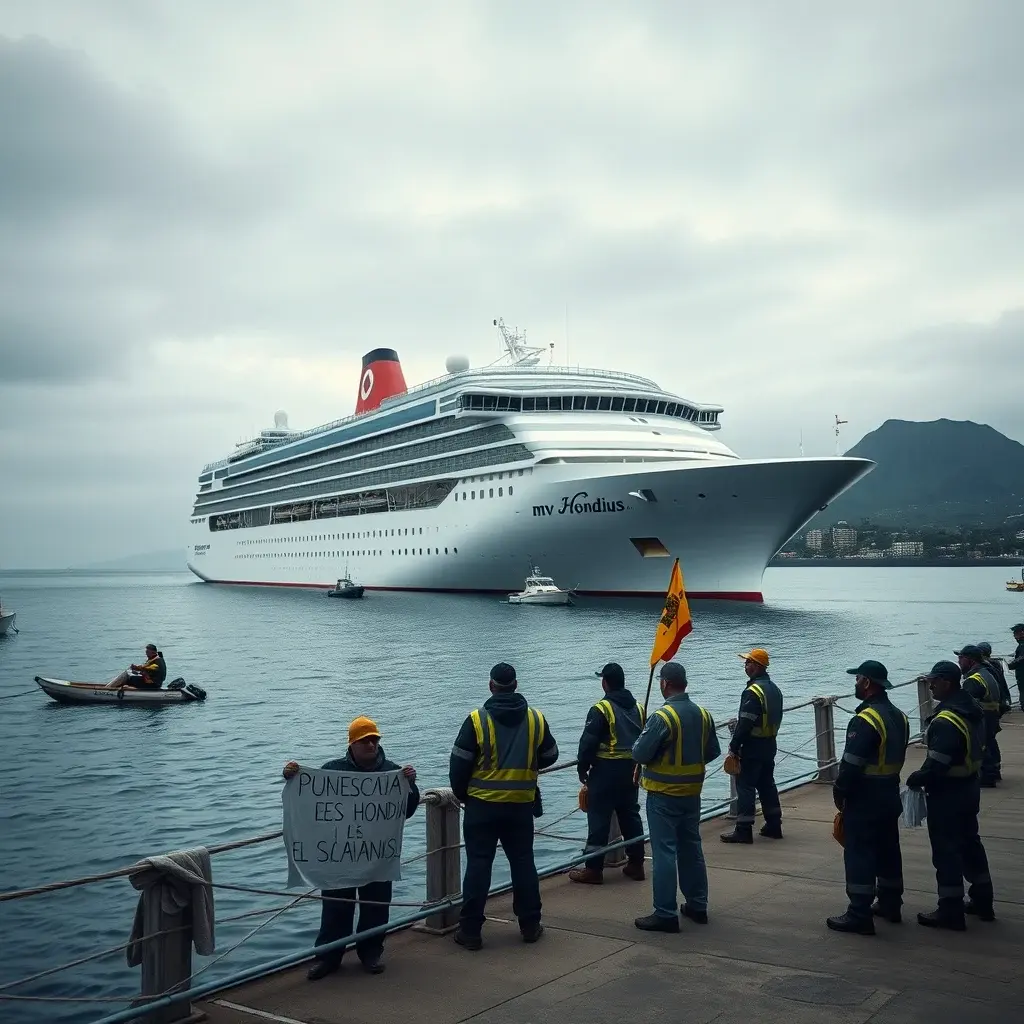
Tenerife is bracing for the arrival of the MV Hondius cruise ship, which is experiencing a hantavirus outbreak, this weekend. The Spanish government, in agreement with the World Health Organization (WHO), has permitted passengers to disembark on the island, a decision met with apprehension and protests from some local residents and port workers concerned about potential health risks.
Dock Workers Voice Health Concerns
On Friday, a group of Tenerife dock workers gathered outside the Canary Islands’ parliament building in Santa Cruz. They expressed their dissatisfaction with the prospect of working in a port without adequate safety measures or information regarding the approaching infected vessel.
“We’re unhappy at the idea of being allowed to work in a port without special safety measures or information when an infected boat is approaching,” stated Joana Batista, a representative of a local port workers’ union. Some workers have even threatened to block the ship’s arrival if their demands for precautions are not met.
“If the boat is going to stop here, then it can do so, but with the necessary measures in place,” Batista added. “Local people need to be told how this will affect them, how the passengers will be transported. We need reassurance above all.”
Broader Islander Resentment Surfaces
The concerns extend beyond immediate health risks, touching upon broader frustrations among some island residents. Nutritionist María de la Luz Sedeño, observing the protest, voiced anger, linking the cruise ship’s arrival to ongoing challenges faced by the Canary Islands.
Her comments appeared to reference the substantial number of undocumented migrants arriving by sea from North and West Africa, a situation that elicits mixed reactions among the island’s population. While some view hosting migrants as a point of pride, others, like Sedeño, perceive it as a burden that makes their territory a focal point of international crises.
NGO Caminando Fronteras reported over 3,000 deaths in 2025 among those attempting to reach the Canary Islands, often in precarious vessels. The impending visit of Pope Leo in June to meet migrants and aid organizations further highlights the region’s role in global humanitarian issues.
Government Reassurance and Modified Disembarkation Plan
The central government, led by the Socialist party, has responded to accusations of high-handedness and a lack of transparency. They detailed the disembarkation plan, emphasizing measures to protect local residents.
The MV Hondius will not dock directly at a passenger terminal. Instead, it will anchor offshore, and passengers will be transported via smaller vessels to the industrial port of Granadilla, located in a less populated area of the island’s southeast. Following their arrival, passengers will be repatriated, while the 14 Spanish nationals aboard will be taken to Madrid for quarantine.
Virginia Barcones, head of Spain’s civil protection agency, assured that there will be no contact between the arriving passengers and the local population, stating that residents “will be absolutely and completely protected.”
Mixed Reactions and Political Exploitation
These assurances have somewhat eased the anxieties of some residents. Marialaina Retina Fernández, a pensioner, expressed a calmer stance, acknowledging the improved information flow. “Now I’m a bit calmer because there’s more information,” she said, adding that while the situation is “not ideal,” she hopes authorities will indeed “do everything possible to make sure nobody gets infected.”
Despite the government’s efforts to manage the situation, the far-right Vox party has attempted to leverage the event, drawing parallels between the cruise ship’s arrival and the challenges posed by irregular migration.
Echoes of Past Crises and Future Vigilance
While the WHO and the Spanish government have downplayed epidemiological comparisons to the COVID-19 pandemic, the arrival of the MV Hondius serves as an unwelcome reminder for many Canary Islanders. The first identified COVID-19 case in Spain was a German tourist on the nearby island of La Gomera, which led to widespread lockdowns and quarantines, including a hotel in Tenerife.
Some islanders, like Retina Fernández, adopt a stoic view, noting Tenerife’s recurring role in international crises. “We’re used to all sorts of problems arriving here,” she remarked, suggesting that the islanders have proven their resilience and capability in managing such situations.
As the MV Hondius approaches, the situation on Tenerife highlights the complex interplay of public health concerns, geopolitical realities, and local anxieties. The coming days will reveal the effectiveness of the implemented safety protocols and the long-term impact on the island’s residents and its reputation as a tourist destination.










Leave a Reply