
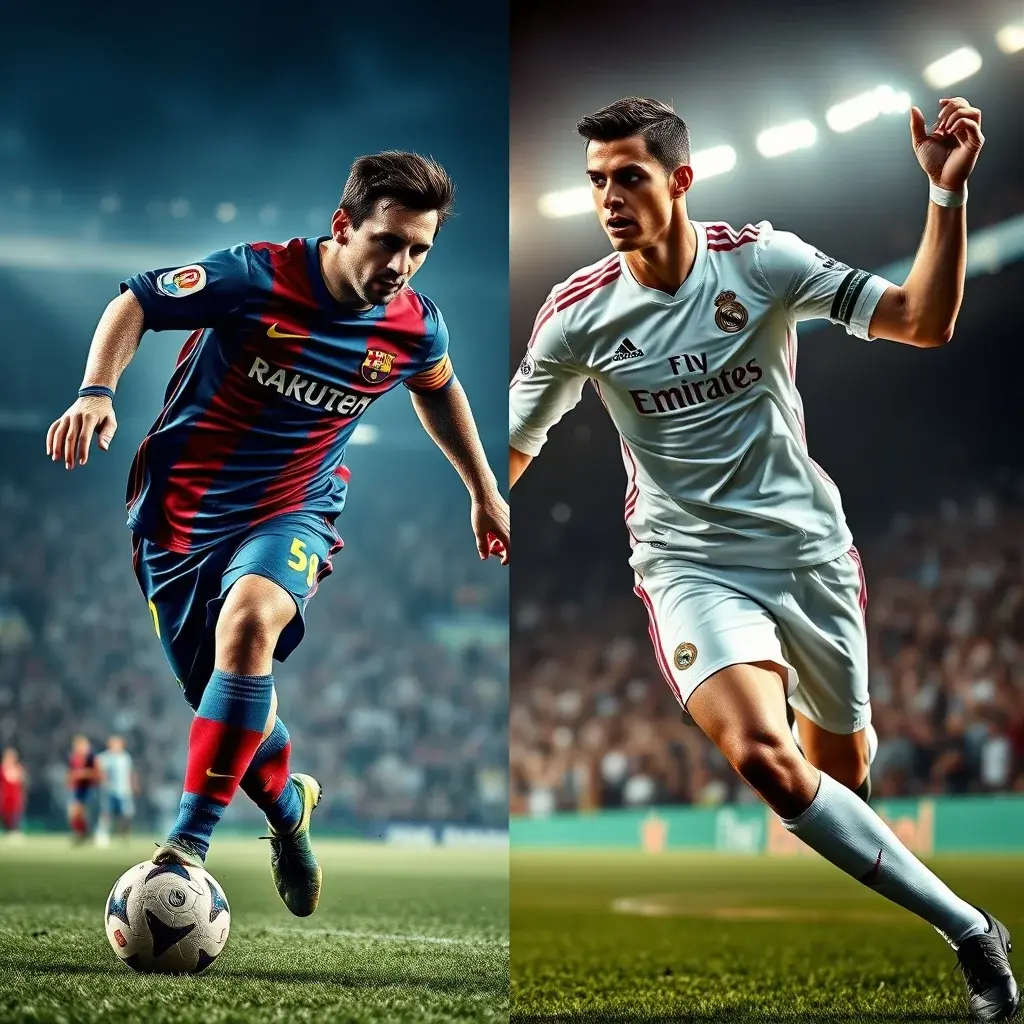
The enduring football rivalry between Lionel Messi and Cristiano Ronaldo, which began to crystallize around 2007, has profoundly shaped the sport for over a decade. This era saw the two global superstars dominate individual awards, with one of them claiming nearly every major accolade, fundamentally altering how football is played, consumed, and debated worldwide.
The Genesis of a Generational Clash
The spark of their historic rivalry can be traced back to an awkward moment at the 2007 FIFA World Player of the Year ceremony. Brazilian legend Pelé mistakenly awarded the second-place trophy to Cristiano Ronaldo, who had finished third behind Lionel Messi. FIFA President Sepp Blatter had to step in, highlighting an early, albeit unintentional, symbolic passing of the torch.
In the subsequent ten years, Messi and Ronaldo became the undisputed kings of football’s individual awards. Their combined dominance is staggering: nearly 2,000 career goals, over 85 trophies for club and country, and countless records and accolades. This unprecedented era has led many, including Argentina’s World Cup winner Angel di Maria, to believe such a sustained, high-level competition between two players may never be seen again.
Pushing Each Other to Greatness
The rivalry was fueled by an insatiable desire for trophies, records, and the unyielding pursuit of being the best. This relentless drive pushed both players to achieve heights previously unimaginable. Their competition transcended the simple ‘greatest of all time’ (GOAT) debate, as they actively inspired each other to evolve and excel.
“They both changed football,” Di Maria stated, underscoring their impact beyond individual statistics. The question of who is the ‘greatest’ remains a fiercely debated topic among fans, pundits, and former teammates. Rio Ferdinand champions Ronaldo, while Xavi insists Messi is the best ever.
Ronaldo himself once famously compared their dynamic: “You cannot compare a Ferrari with a Porsche. It is a different engine.” The numbers offer a complex picture: Ronaldo often leads in goals and Champions League titles, while Messi typically edges ahead in Ballon d’Or awards and total trophies. Ronaldo’s 2016 European Championship win with Portugal is seen by some as a pivotal moment, countered by Messi’s subsequent Copa America and World Cup triumphs with Argentina.
Spanish football expert Guillem Balague offers a nuanced perspective: “For me, Messi is the best player in history and Cristiano is the greatest goalscorer in history.” Deco, who played with both, emphasizes their sustained excellence: “It’s not normal to be on this level all these years.”
Shared Humble Beginnings, Divergent Paths
Despite their contrasting on-field personas—the sublime dribbler versus the physical powerhouse, the shy genius versus the flamboyant ego—their origins share striking similarities. Both Messi and Ronaldo emerged from humble backgrounds, leaving home at a young age to chase their football dreams. Messi departed Rosario for Barcelona at 13, while Ronaldo left Madeira for Lisbon at 12, both grappling with homesickness.
Joshua Robinson, co-author of a book on their rivalry, highlights this shared formative experience: “They both go to a place that says ‘we will take your talent and make you even greater.’ That promise feels appealing but is a huge gamble. That moment of total commitment is when they realize this isn’t kid stuff any more.”
Their unshakeable desire to succeed was a defining commonality. Xavi recalled Messi’s early intensity: “Not only the quality but the intensity with which he did things. There was an aggressiveness in attack that I had never seen before.” Similarly, Ronaldo’s early confidence was evident. Rene Meulensteen, part of Manchester United’s backroom staff, noted Ronaldo’s clear ambition: “The moment he came to Man United it was just a logical step of what he wanted to become – the best player in the world.” Meulensteen recounted developing Ronaldo from a skillful player into a prolific goalscorer through intensive training and video analysis.
The Rivalry Ignites: El Clásico and Beyond
The first direct on-field clash occurred in the 2008 Champions League semi-final between Manchester United and Barcelona. “You could see already Messi was the best in La Liga and Cristiano was the best in the Premier League,” observed Guillem Balague. “To see those two kids on the pitch together was the sign of something to come.” Manchester United’s victory that season, followed by Ronaldo’s first Ballon d’Or, marked the true beginning of their legendary duel.
Ronaldo’s record-breaking £80 million move to Real Madrid in 2009 intensified the rivalry, placing them at the heart of the fiercely contested El Clásico. For nine seasons in Spain, they were direct competitors, each winning five Ballon d’Or awards. During this period, Ronaldo scored 450 goals in 438 games for Real Madrid, while Messi netted 471 in 476 for Barcelona.
The rivalry became intensely personal, amplified by the burgeoning power of social media. “For Cristiano it was Lionel Messi and for Lionel Messi it was Cristiano. ‘I need to beat this guy’,” recalled Txiki Begiristain, then Barcelona’s director of football. The managerial rivalry between Pep Guardiola and José Mourinho mirrored their on-pitch battle, with both players understanding that game-winning moments were their path to supremacy.
Spanish football writer Sid Lowe noted the global consumption of their duel: “We could watch it all on our phones… Everything they did was must-see.” While Barcelona, led by Messi, dominated La Liga, Real Madrid and Ronaldo excelled in the Champions League. Memorable moments, like Messi’s shirt-waving celebration at the Bernabéu in 2017 and Ronaldo’s subsequent mimicry, symbolized the depth of their competitive animosity.
Global Brands and Commercial Empires
When Ronaldo departed for Juventus in 2018, and later Messi moved to Paris Saint-Germain and then Inter Miami, their transfers were driven as much by commercial opportunities as by footballing ambitions. “Brand Beckham opened the door for what was possible and these two have kicked the door off its hinges,” said Rob Pilgrim, head of sport at Meta for Europe, Middle East and Africa.
Their commercial impact is astronomical. Ronaldo’s move to Juventus saw 520,000 shirts sold in 24 hours, while Messi’s transfer to PSG shifted 150,000 shirts in just seven minutes. The players’ vast social media followings—Ronaldo with nearly 700 million Instagram followers and Messi with 500 million—further cement their status as global icons. The most-liked Instagram post in history features Messi lifting the World Cup trophy.
Financially, Ronaldo has consistently topped Forbes’ highest-paid athletes list, while Messi ranks highly. Their rivalry is further amplified by their endorsement deals with competing sportswear giants, Adidas for Messi and Nike for Ronaldo. They have become enormous global brands, capable of commanding attention with minimal public statements.
The iconic 2022 World Cup image of both players engaged in a game of chess for Louis Vuitton became a “commercial masterstroke,” according to Melanie Ropp of the Goat Agency, breaking the internet and becoming globally iconic.
The Lingering Question: Who Defined an Era?
With Messi having achieved the ultimate prize—the World Cup—a feat Ronaldo has not accomplished, the question of who defined this era looms large. “Messi has nothing left to conquer. He has that one thing Ronaldo does not, a World Cup. Now the question is did Messi win this entire era of football?” pondered Robinson.
The narrative of their rivalry is far from over. As both players continue their careers, and with their national teams potentially meeting in future tournaments, the final chapters of this unparalleled sporting saga are yet to be written.










Leave a Reply