
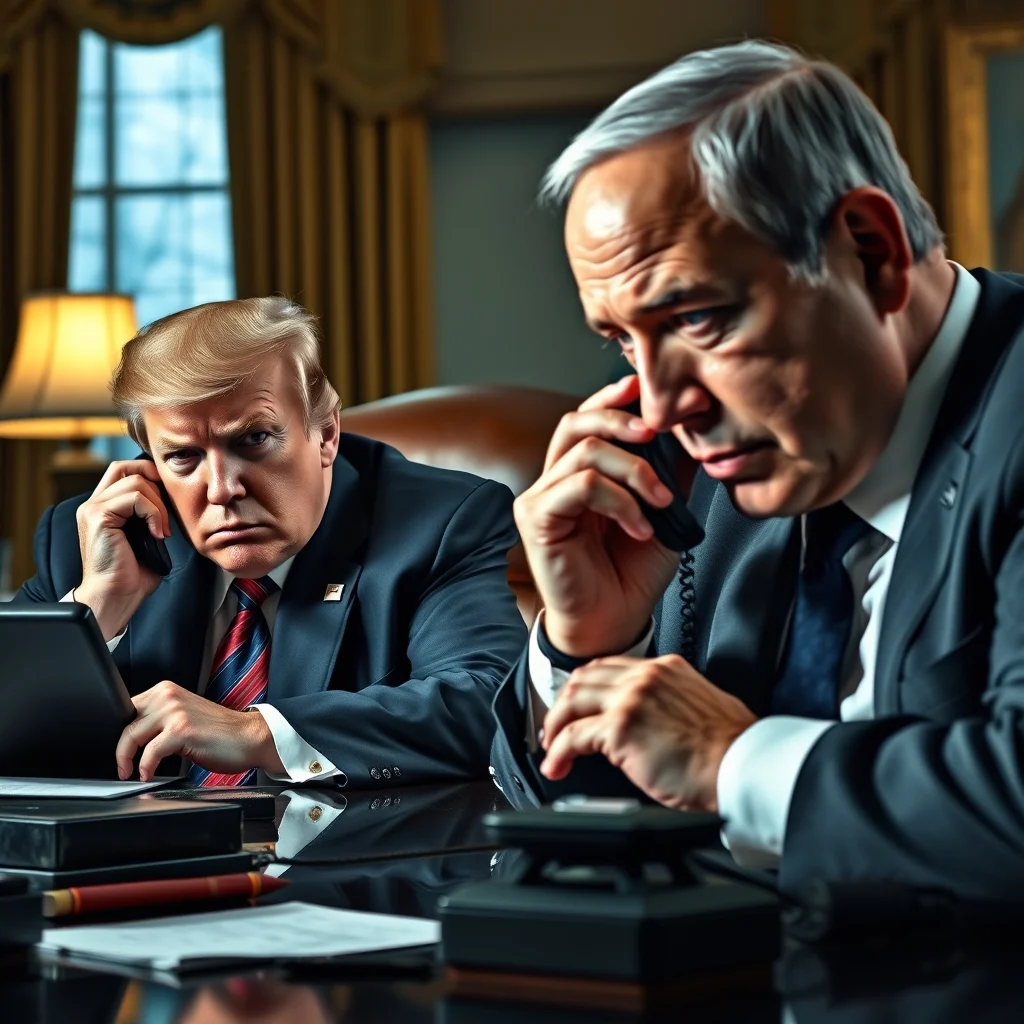
President Donald Trump confirmed he called Israeli Prime Minister Benjamin Netanyahu “effing crazy” and accused him of ingratitude during a phone call on Monday, a dispute that has reportedly thrown Washington’s delicate Iran diplomacy into crisis. Tehran responded to Israel’s strikes on Lebanon by threatening to suspend talks with the US, a potential setback to Trump’s efforts to de-escalate tensions and extricate the US from a protracted conflict with Iran. The conversation, broadcast on the Pod Force One podcast on Wednesday, revealed a rare public acknowledgment of friction between the two leaders.
Context of the Dispute
The reported clash occurred as President Trump is navigating complex negotiations concerning an extended US-Iran ceasefire, which could pave the way for broader discussions on Tehran’s nuclear program. A critical element of these ongoing talks involves the reopening of the Strait of Hormuz, a vital global shipping lane. Israel’s military actions in Lebanon, targeting Iran-backed Hezbollah, have complicated these diplomatic efforts, as Iran insists that any ceasefire must encompass Lebanon.
This is not the first time a US president has experienced friction with Prime Minister Netanyahu. The Israeli leader has a documented history of challenging White House directives and testing the patience of American administrations. However, he has consistently navigated these challenges, often emerging politically unscathed.
Divergent Military and Political Goals
While both Trump and Netanyahu broadly agree on the objective of preventing Iran from acquiring nuclear weapons, their strategic priorities diverge on other fronts. Israel’s commitment to confronting Hezbollah, even amidst ongoing US-Iran negotiations, creates a complex geopolitical landscape. Experts suggest this divergence has led to frustration within the White House.
Brett Bruen, former diplomat and president of the Global Situation Room, noted that Netanyahu has a history of pursuing his own agenda regardless of Washington’s stance. “Trump… decided to take the plunge with him, and is now learning a really hard lesson about what happens when you get into war with a pretty mercurial leader that has an agenda which doesn’t always align with your own priorities,” Bruen told the BBC.
Shifting Public Opinion and Political Pressures
The reported disagreement also surfaces amid a notable shift in American public opinion regarding support for Israel. A Pew Research Poll released in April indicated that 60% of Americans now hold a negative view of Israel, a significant increase from 42% before the 2023 conflict with Hamas. This evolving sentiment adds a layer of political complexity for President Trump.
Furthermore, some conservative figures have publicly voiced concerns, suggesting that Israeli influence may have pushed the US into the conflict with Iran. Joe Kent, former head of the National Counterterrorism Center, resigned in March citing this belief, though the pro-Israel lobbying group AIPAC has refuted such claims, labeling them as antisemitic tropes.
In this environment, some analysts believe Trump has an incentive to create distance from Netanyahu to appease domestic critics. “I think there is a political necessity now to create daylight between Israel and the US,” Bruen stated, adding that Netanyahu’s actions, whether in Lebanon or Gaza, can be politically problematic for the Trump administration.
Historical Precedents and Netanyahu’s Negotiation Style
Netanyahu’s tenure has seen him clash with multiple US presidents. His relationship with President Bill Clinton was strained over the Oslo accords, and his dealings with President Barack Obama were particularly difficult, notably after a unilateral speech to Congress regarding Iran policy. More recently, his administration’s accusations of the US withholding weapons drew sharp criticism from the Biden White House.
Natan Sachs, an expert on US-Israeli relations at the Middle East Institute, described Netanyahu as a “very difficult negotiator, not just in terms of being tough, but in terms of being very suspicious.” Despite these historical tensions, Trump and Netanyahu have often maintained a strong personal and political rapport, with Netanyahu frequently praising Trump as “the greatest friend to Israel” in US history. This dynamic allowed Netanyahu to find a US president willing to “break the mould” in Middle East affairs.
Future Implications
The long-term impact of this latest public disagreement on the Trump-Netanyahu relationship remains uncertain. While Netanyahu downplayed the incident as a “tactical disagreement,” experts suggest it could be a significant indicator of underlying friction. “It’s potentially significant. We don’t know if it was a one-time event or a harbinger of broader things,” Sachs commented, acknowledging that Trump has changed his mind about individuals in the past. The coming weeks will reveal whether this spat was an isolated incident or a sign of deeper challenges ahead for US-Israeli relations and the broader Iran diplomacy efforts.










Leave a Reply