
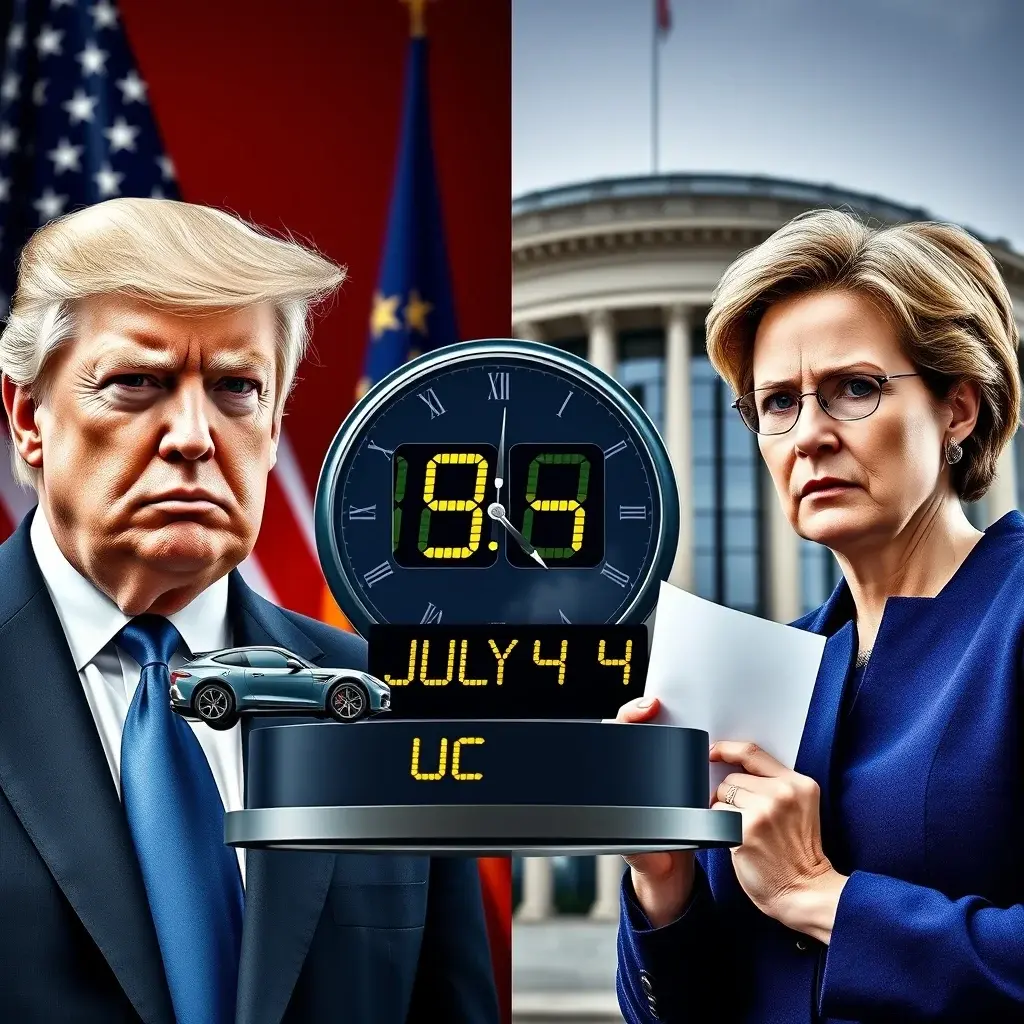
President Donald Trump has issued an ultimatum to the European Union, demanding the bloc eliminate its tariffs on U.S. goods by July 4 or face significantly higher American tariffs. This threat follows a phone call with European Commission President Ursula von der Leyen, who stated that progress is being made on tariff reduction.
Trade Deal Stalemate and New Threats
The ultimatum comes amid ongoing negotiations for a trade deal that was initially agreed upon last July. Progress stalled this week after European lawmakers and governments failed to reach a consensus. Trump expressed his dissatisfaction via social media, accusing the EU of non-compliance with the existing agreement.
Trump stated that if the EU does not meet his demand for zero tariffs by the United States’ 250th birthday, American tariffs will escalate to “much higher levels.” This follows previous threats of 30% tariffs on European goods and a specific threat last week to increase tariffs on trucks and cars to 25%.
European Parliament’s Conditional Approval
The European Parliament granted conditional approval to the trade deal in March. Lawmakers supported legislation to implement the agreement but included safeguards to ensure U.S. adherence. A key condition was the exclusion of European steel and aluminum products from Trump’s global 50% tariff on these metals.
However, the deal requires endorsement from all 27 EU member states, a step that has proven challenging. Despite the parliamentary vote, the full ratification process remains incomplete.
Negotiations Continue Amidst Uncertainty
Despite the heightened rhetoric, both sides express commitment to the deal’s implementation. Ursula von der Leyen affirmed on X that the bloc is making “good progress towards tariff reduction.” The chief negotiator for the European Parliament, Bernd Lange, also indicated positive movement but acknowledged that “there is still some way to go.”
Negotiators are scheduled to reconvene for another round of talks on May 19 in Strasbourg. Lange emphasized the parliament’s dedication to advancing its mandate and securing guarantees for citizens and companies on both sides of the Atlantic.
Legal Challenges to Trump’s Tariffs
Adding another layer of complexity, a U.S. trade court ruled on Thursday that Trump’s recent 10% global tariffs were not justified under U.S. trade law. This ruling, though currently applying to tariffs for two specific companies, could pave the way for further legal challenges against his broader tariff decisions.
The tariffs in question were imposed on February 24, invoking Section 122 of the 1974 Trade Act, which permits temporary duties to address balance of payments deficits. The court found that the cited deficits did not warrant the use of this specific legal provision.
Implications and Future Outlook
The latest developments underscore the volatile nature of U.S.-EU trade relations. Trump’s aggressive stance and the EU’s conditional approach create uncertainty for businesses reliant on transatlantic trade. The legal challenges to U.S. tariffs introduce further unpredictability.
The upcoming negotiations in Strasbourg will be crucial in determining whether the two sides can bridge their differences before the July deadline. Market participants and industry leaders will be closely monitoring these discussions for any signs of a breakthrough or further escalation of trade tensions.










Leave a Reply