
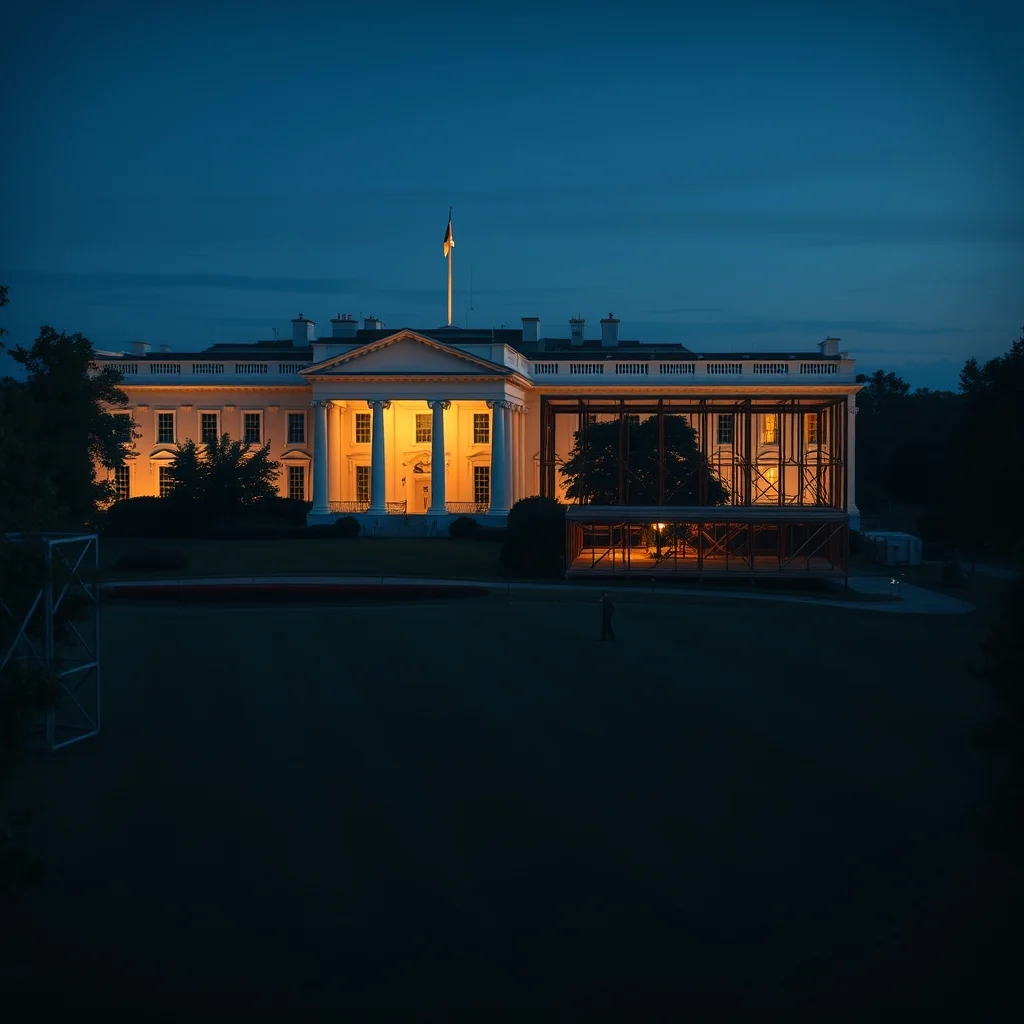
WASHINGTON D.C. – The U.S. Justice Department renewed its plea to a federal judge on Sunday to lift an injunction halting construction on President Donald Trump’s White House ballroom project, arguing that a shooting incident outside the White House on Saturday highlights an urgent need for enhanced security measures.
In a five-page court filing, the Justice Department asserted that the recent shooting underscores the critical necessity for “top-level, state-of-the-art security at the White House, including the ballroom,” deeming it vital to national security. The department also requested the dismissal of the lawsuit challenging the project.
Background of the Dispute
The legal challenge originated from the National Trust for Historic Preservation, a congressionally chartered nonprofit organization. The Trust filed a lawsuit arguing that Trump lacked the legal authority to construct the ballroom without explicit congressional approval.
U.S. District Judge Richard Leon, appointed by former President George W. Bush, initially ruled in April that the President did indeed lack the necessary authority. He subsequently issued an injunction to halt “above-ground construction of the planned ballroom.” However, this order was quickly placed on hold by an appeals court, allowing construction to continue.
Previous Legal Maneuvers and a Renewed Urgency
This is not the first time the Justice Department has sought to dissolve the injunction. Following a foiled attack attempt at the White House Correspondents’ Association dinner in April, the department urged Judge Leon to dismiss the lawsuit and lift the construction halt. Judge Leon has yet to rule on that prior request.
The National Trust for Historic Preservation indicated after the April incident that they would not withdraw their lawsuit, despite the Justice Department’s previous appeal.
The Saturday Incident
The impetus for the Justice Department’s latest filing was a shooting incident that occurred on Saturday. A gunman fired at a White House checkpoint and was subsequently shot by officers. The individual later died from their injuries after being transported to a hospital, according to the Secret Service.
Implications for National Security and Historic Preservation
The Justice Department’s argument centers on the idea that the ballroom, as part of an upgraded security infrastructure, is essential for protecting the White House and its occupants. The recent shooting is being presented as empirical evidence of the vulnerabilities that require immediate attention and investment in security enhancements.
Conversely, the National Trust for Historic Preservation’s concerns revolve around the preservation of historical integrity and adherence to legal processes. Their lawsuit aims to ensure that significant federal projects undergo proper review and authorization, particularly when they involve historic landmarks.
The ongoing legal battle pits national security concerns, as articulated by the executive branch, against the principles of historic preservation and the requirement for legislative oversight in major federal construction projects. The outcome could set a precedent for future developments within protected historical sites and influence the balance between presidential authority and congressional power.
Looking ahead, the key development to watch will be Judge Leon’s response to the Justice Department’s renewed motion, particularly in light of the most recent security incident. His decision could either expedite the ballroom’s construction under the guise of national security or uphold the legal challenge, potentially leading to further appeals and a prolonged legal battle that could impact future executive actions on federal properties.








Leave a Reply