
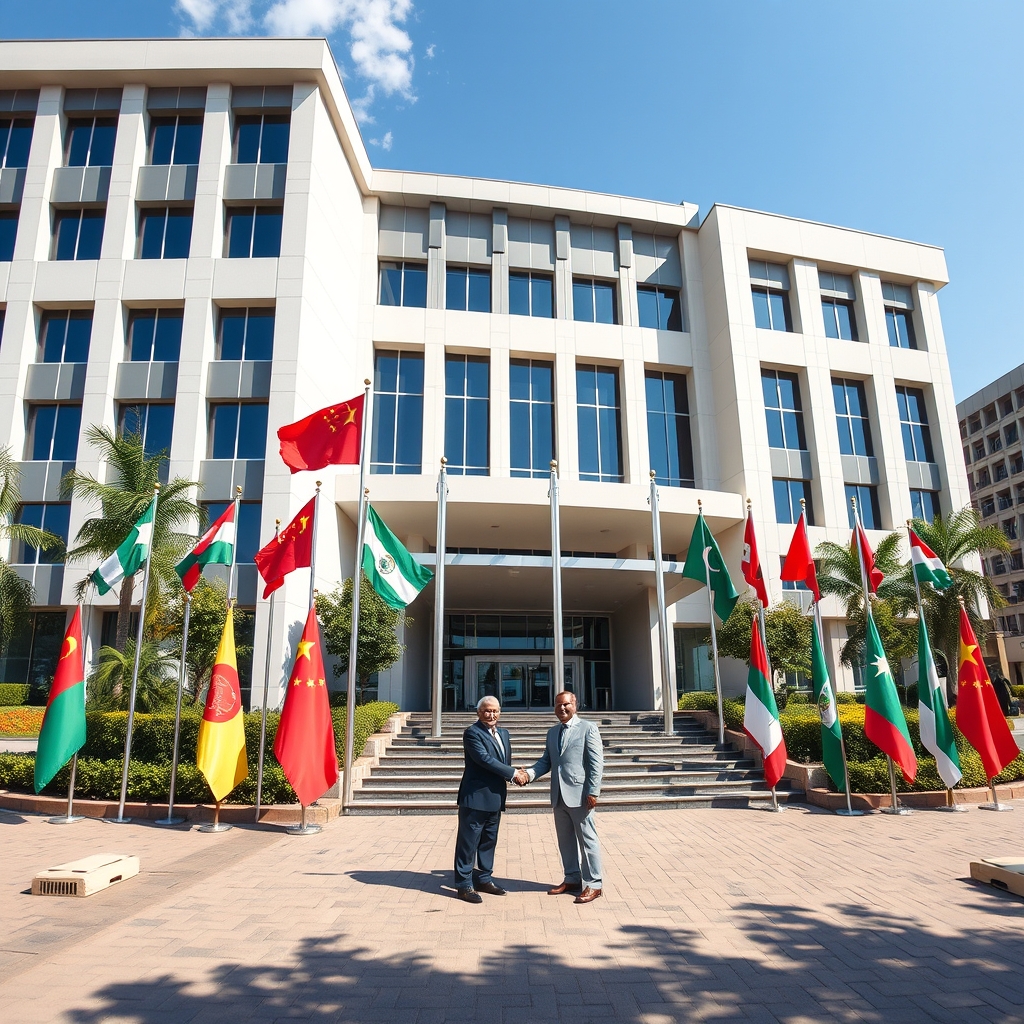
China has officially handed over a newly constructed $56.5 million headquarters complex to the Economic Community of West African States (ECOWAS) in Abuja, Nigeria. This significant handover, completed in under two years, represents one of Beijing’s most prominent institutional projects in West Africa and underscores deepening diplomatic and economic ties.
Context of China-Africa Cooperation
The project is situated within the broader landscape of China’s increasing engagement with African nations, particularly in infrastructure development and institutional support. Beijing has consistently framed these initiatives as mutually beneficial partnerships driven by African demand and aimed at fostering sustainable development and amplifying the continent’s global voice.
This latest contribution follows a pattern of Chinese investment in critical infrastructure across Africa, including public buildings, energy projects, and transportation networks. Analysts often interpret these developments as strategic moves by China to expand its economic and political influence, although Chinese officials maintain a stance of non-interference and support for African-led development models.
The New ECOWAS Headquarters
The state-of-the-art facility, fully funded by the People’s Republic of China, is set to become the primary administrative hub for the 15-member ECOWAS bloc. During the handover ceremony, China’s Ambassador to Nigeria, Yu Dunhai, highlighted the complex as a flagship aid project designed to enhance ECOWAS’s institutional capacity.
Ambassador Yu stated that the building provides “a robust foundation” for achieving regional development goals. He reiterated China’s commitment to cooperation with African partners, emphasizing its principles of “non-interference” and the absence of “political strings attached.” This approach, he explained, supports African countries in pursuing development paths tailored to their specific contexts.
Omar Touray, President of the ECOWAS Commission, formally accepted the complex, commending the rapid construction timeline and the effective collaboration between ECOWAS and Chinese teams. He noted that engineers and technical staff worked tirelessly to bring the regional landmark to fruition, with joint coordination proving crucial for meeting deadlines.
The inauguration of the new headquarters is anticipated later this year. Sierra Leone’s President Julius Maada Bio, the current ECOWAS Chair, is expected to attend, alongside Nigerian President Bola Ahmed Tinubu and other regional leaders.
Expanding Bilateral Relations and Regional Impact
Nigeria’s Minister of State for Foreign Affairs, Bianca Odumegwu-Ojukwu, described the project as a testament to the growing relationship between China and West Africa. She characterized the development as illustrative of “fruitful and progressive relations” and indicative of continued cooperation in infrastructure and institutional support.
For ECOWAS, the new headquarters promises to centralize operations in Abuja and improve coordination among its member states. This enhanced capacity comes at a critical juncture for the bloc, which is currently navigating significant regional challenges, including political instability in several member nations and ongoing efforts to deepen economic integration.
Future Implications and Watchpoints
The handover of the ECOWAS headquarters signifies more than just a new administrative building; it represents a tangible symbol of China’s sustained commitment to institutional development in West Africa. As ECOWAS grapples with complex security and economic issues, the enhanced operational capacity afforded by the new facility could prove vital.
The project is likely to be closely watched as an indicator of China’s long-term strategy in Africa and the evolving dynamics of international partnerships within the continent. Observers will be keen to see how this strengthened institutional base within ECOWAS influences regional stability, economic cooperation, and the bloc’s engagement with global partners.








Leave a Reply