
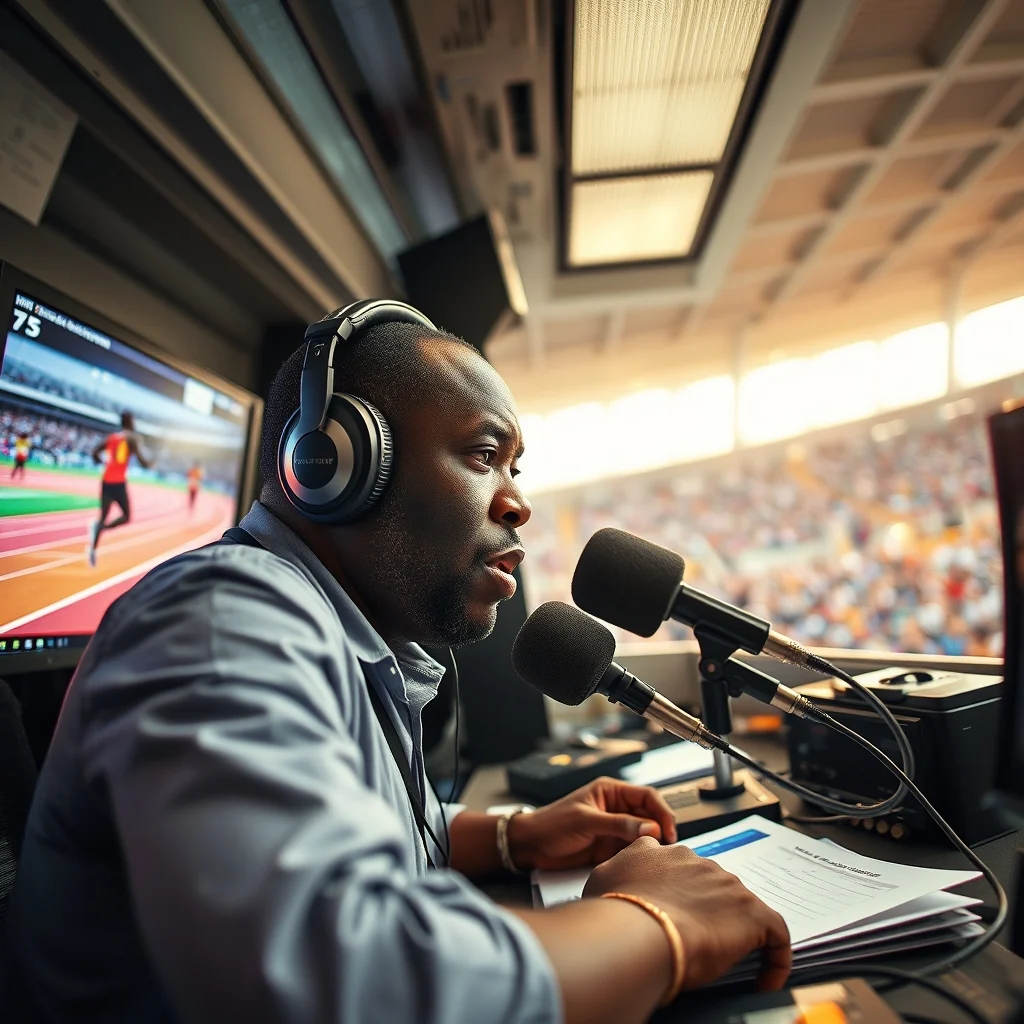
Accra, Ghana – On Tuesday, May 12th, a sudden and urgent phone call thrust Muftawu Nabila, a media professional, into the unexpected role of lead commentator for the 24th African Athletics Championships. The broadcast, scheduled to begin that morning at the University of Ghana Sports Stadium, was missing a vital element: a voice to narrate the events, leading to a last-minute scramble for a commentator.
The situation unfolded rapidly. At 8:28 AM GMT, just as Nabila was concluding his morning television duties and attending office meetings, he received a call from Veronica Commey, a veteran sports journalist and Deputy Director General of the National Sports Authority. Commey informed him of the urgent need for commentary, with the broadcast set to go live at 9:00 AM GMT.
Faced with an immediate need and no prior briefing or preparation, Nabila agreed to help. The distance to the stadium, approximately 20 minutes away, posed a significant challenge given the looming deadline and potential traffic in Accra. Recognizing that a car might not be fast enough, Nabila quickly arranged for a motorbike taxi to transport him to the stadium.
The motorbike ride was a race against time, weaving through traffic to ensure his arrival before the 8:50 AM deadline. Upon reaching the University of Ghana Sports Stadium, Nabila was immediately handed the program lineup by the Executive Producer. Without any rehearsal or time to prepare, he was escorted to the commentary booth.
With an earpiece on and microphone in hand, Nabila began his commentary at 9:00 AM GMT, describing the opening moments of the championships to an audience across Africa. Despite battling a cold that affected his voice, he delivered the introduction, acknowledging the continental audience and setting the stage for the event.
What followed was an unexpected journey into a new facet of his career. Nabila, who had never formally commentated before, found himself narrating various athletic events, from the decathlon to sprints and relays. This experience highlighted his latent versatility, a trait he had previously downplayed.
The organization of the championships presented significant challenges in the initial days, including shifting schedules, incomplete athlete lists, and technical issues. These chaotic conditions tested the production team and commentators alike. Nabila adapted by using athlete’s national colors as a guide when official information was lacking, finding beauty and narrative within the confusion.
He described moments of intense athletic performance, such as Julius Yego’s javelin throw, Badamasi’s hurdle victory, and Joseph Rogail’s consecutive gold medal in the 400m hurdles. The commentary spanned various disciplines, including relays, steeplechase, long-distance races, and sprints, revealing the poetry of athletics to him.
The experience required personal sacrifice. Nabila’s small business, which supports his livelihood, remained closed for six days, impacting his routine income. He also faced personal challenges, including seeking medical attention for his cold and experiencing a moment where he had to walk to and from the stadium after losing his wallet.
Despite the difficulties, the feedback from listeners across the globe, including the United States, United Kingdom, Zimbabwe, and Kenya, was overwhelming. While acknowledging the imperfections and mistakes inherent in a live, unprepared broadcast, Nabila found validation in the moments where his commentary felt instinctive and cinematic.
He credited colleagues Benjamin Yamoah and Nii Akwei for their support, providing steady guidance, statistics, and context that enriched the broadcast. The championships concluded with Zimbabwe’s victory in the men’s 4x400m relay, marking the end of an unforgettable week.
The 2026 African Athletics Championships in Accra not only celebrated athletic talent on the track but also revealed a commentator in Muftawu Nabila, who discovered his voice and capability under pressure, fulfilling a role he never anticipated.


Leave a Reply