
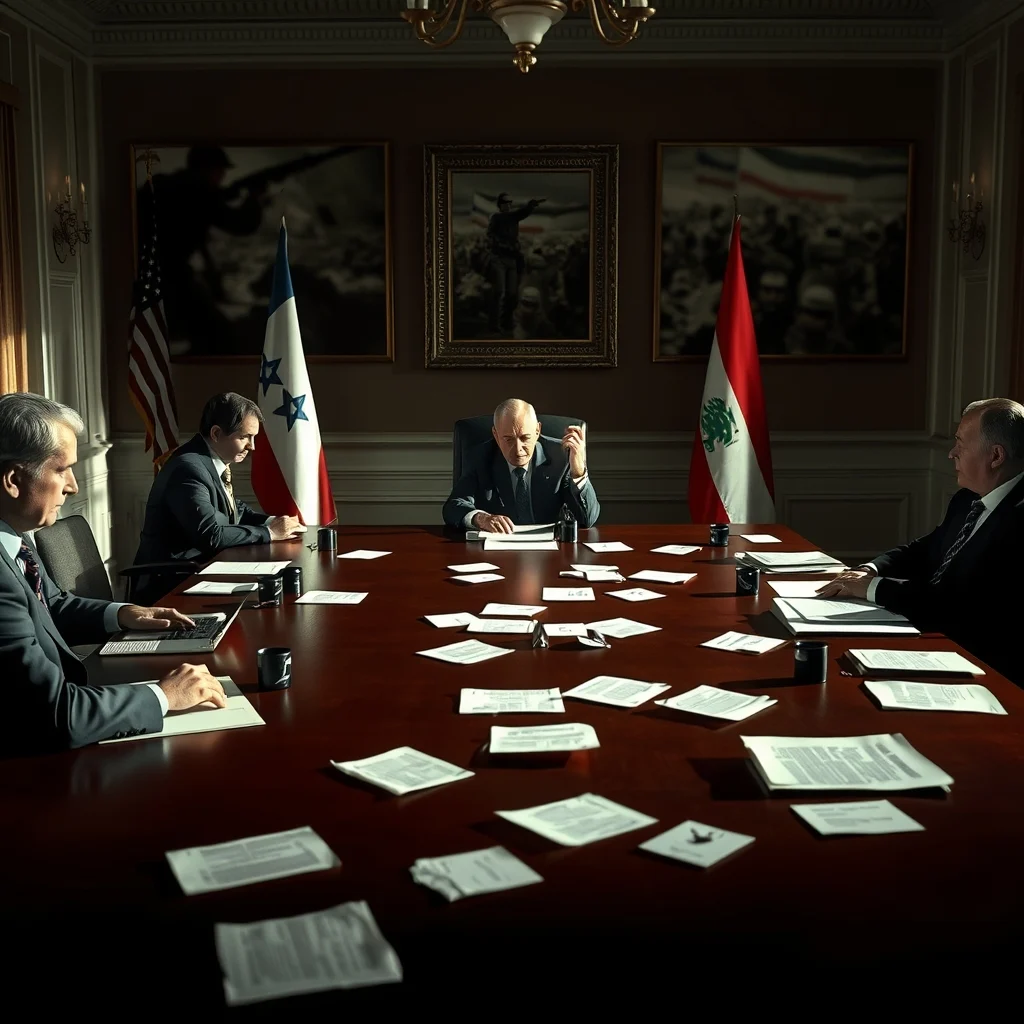
Hezbollah has emphatically rejected a renewed US-backed ceasefire agreement with Israel, which aimed to establish “pilot” security zones within Lebanon excluding the militant group. The announcement came on Thursday, following a joint statement by the US State Department on Wednesday outlining the terms of the fragile truce, which stipulated a complete cessation of fire by Hezbollah. The group’s leader, Naim Qassem, deemed negotiations “futile” and “humiliating” for Lebanon, stating the proposed ceasefire, interpreted as Hezbollah halting fire and withdrawing fighters, amounted to surrender and would serve Israeli objectives.
The US-brokered deal, reached after a fourth round of talks in Washington, was contingent on the evacuation of all Hezbollah operatives from an area between the Israeli border and the Litani river, approximately 30km north. This zone is currently occupied by Israeli ground forces. The agreement proposed that the US would assist in establishing “pilot zones” where the Lebanese Armed Forces would have exclusive control, barring all non-state actors.
However, Hezbollah, which was not directly involved in the negotiations, has categorically dismissed the terms. The group’s leadership views the proposed ceasefire as a capitulation that fulfills Israel’s aims rather than a genuine peace accord. This sentiment was echoed on the streets of Beirut’s southern suburbs, a Hezbollah stronghold known as Dahieh, where residents expressed skepticism about a one-sided ceasefire.
Storekeeper Sami, a 25-year resident of Dahieh, told the BBC, “You cannot have a ceasefire from one side, it’s going to be an all side or no ceasefire.” He pointed to ongoing strikes in Lebanon on Thursday as evidence that the truce was not being universally observed. His neighbor, Hadi, whose family has run a store for 35 years, expressed a deep-seated lack of hope, stating, “My generation, my dad’s generation, my grandpa’s generation, they didn’t see anything of hope from these people – not necessarily the Israeli people. You can say the Israeli government.”
The agreement followed a partial ceasefire announced on Monday. Under that earlier arrangement, Lebanon stated Israel would refrain from bombing Beirut in exchange for Hezbollah not attacking Israel. Representatives from both countries are scheduled to meet again on June 22 for further discussions aimed at a comprehensive agreement.
Hezbollah, a powerful Shia Muslim militia, political party, and social movement supported by Iran, possesses an armed force considered more formidable than the Lebanese army. The group has engaged in numerous conflicts with Israel and is designated as a terrorist organization by Israel and several other nations, including the United States and the United Kingdom.
Lebanese President Joseph Aoun indicated that the ceasefire could be implemented within 24 hours of final approval from all parties involved. Conversely, Israeli Defense Minister Israel Katz stated that the Israeli military would continue its operations “for the time being” to “dismantle terrorist infrastructure in the area.”
Reports from Lebanese media on Thursday detailed multiple Israeli strikes across southern Lebanon. The state-run National News Agency (NNA) reported five fatalities in air strikes on Sohmor in the Bekaa Valley and another death when a motorcycle was targeted in Maaroub, near Tyre. The United Nations peacekeeping force in Lebanon (Unifil) confirmed that one of its peacekeepers died from wounds sustained when mortar shells hit his position near Marjayoun on Wednesday night.
The Israeli military accused Hezbollah of firing the mortars that struck the UN position, killing the Serbian peacekeeper, Senior Sergeant Milovan Jovanovic. Hezbollah has not yet commented on this specific incident. The Israeli military also reported identifying impacts from “suspicious aerial targets” in southern Lebanon where troops were operating, though no injuries were reported.
Hezbollah had earlier claimed responsibility for targeting Israeli troops and military vehicles with drones and rockets in Qantara and near Beaufort Castle on Thursday.
Lebanon became involved in the conflict between the US, Israel, and Iran on March 2, following Hezbollah rocket launches into Israel in retaliation for an Israeli strike that killed Iran’s supreme leader. Israel responded with extensive air campaigns and a ground invasion in the south. A prior US-brokered ceasefire on April 16 failed to halt hostilities, leading Prime Minister Benjamin Netanyahu to order intensified strikes and deeper incursions into Lebanon last week in response to ongoing attacks on northern Israeli communities.
The conflict has resulted in at least 3,526 deaths in Lebanon, according to the country’s health ministry, a figure that does not differentiate between combatants and civilians. The UN reports that over a million people have been displaced in Lebanon, with Israeli evacuation orders affecting more than an eighth of the country. Israel reports 26 soldiers and four civilians killed on its side of the border.
The rejection of the ceasefire by Hezbollah casts significant doubt on the efficacy of US-led diplomatic efforts and raises concerns about the future trajectory of the conflict. The lack of consensus between the primary belligerents suggests that the fragile situation in southern Lebanon is likely to persist, with continued military operations and potential escalation. The international community will be watching closely to see if further diplomatic avenues can be explored or if the conflict will intensify. The status of the planned June 22 talks remains uncertain in light of Hezbollah’s firm stance.








Leave a Reply