
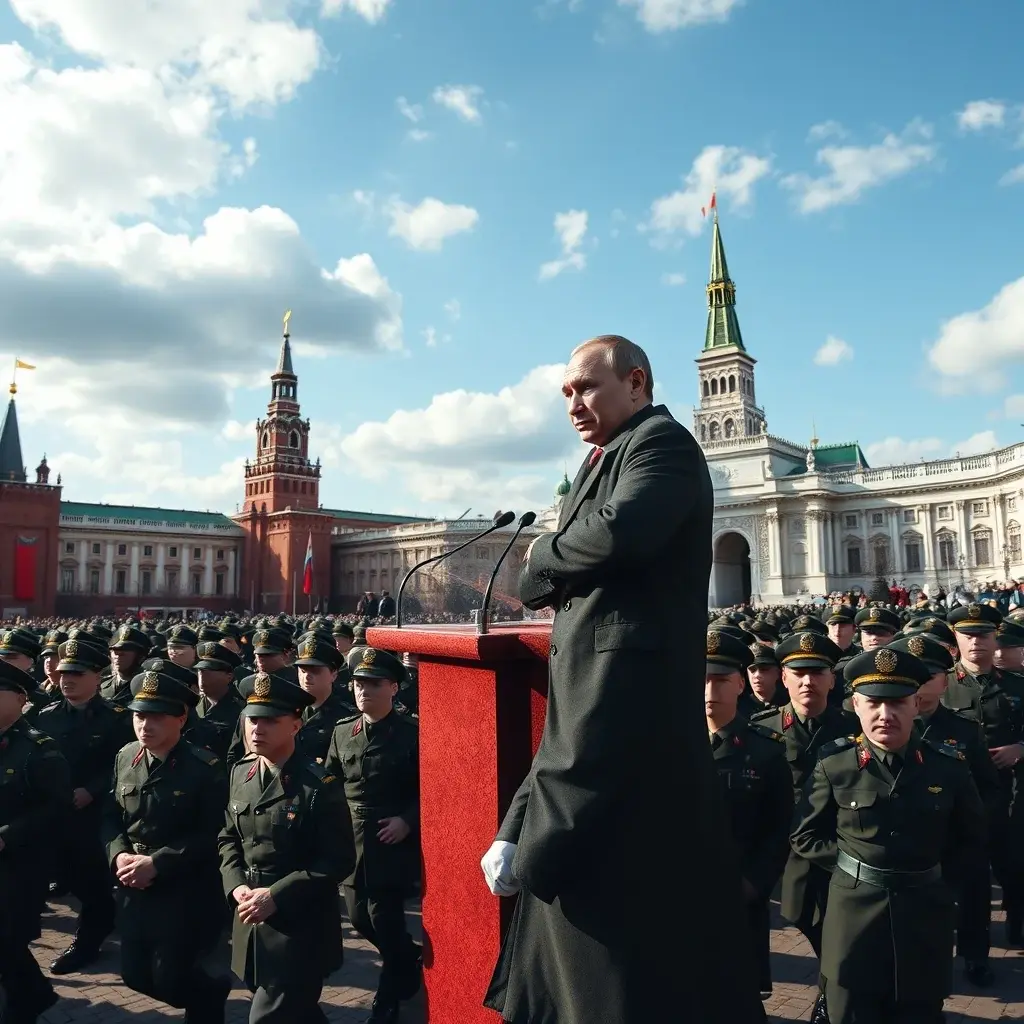
MOSCOW, Russia – President Vladimir Putin used his annual Victory Day address in Red Square on Monday to frame Russia’s ongoing conflict in Ukraine as a “just” war and to condemn NATO, which he accused of arming and supporting Ukraine as an “aggressive force.” The remarks came amidst a noticeably scaled-back military parade, curtailed for security reasons, and muted national celebrations across Russia commemorating the Soviet Union’s victory over Nazi Germany in World War II.
Context of Victory Day and Current Tensions
Victory Day, celebrated annually on May 9th, is Russia’s most significant national holiday. It honors the immense sacrifices made by the Soviet Union during World War II, a conflict that devastated the region and claimed millions of lives. In recent years, under President Putin, the parade has increasingly been used as a powerful propaganda tool to showcase Russia’s military strength and national pride.
However, this year’s commemoration occurs against the backdrop of Russia’s prolonged military operation in Ukraine, which began in February 2022. The war has resulted in widespread international condemnation, severe economic sanctions against Russia, and a significant death toll on both sides. The altered nature of the parade and heightened security measures reflect the ongoing security concerns and the sensitive geopolitical climate.
Scaled-Back Parade and Putin’s Address
For the first time in many years, Moscow’s Victory Day parade conspicuously lacked armored vehicles and ballistic missiles. Instead, the focus was on a large contingent of marching military personnel. President Putin began his speech by invoking the historical sacrifices of Soviet soldiers from World War II.
“The great feat of the generation of victors inspires the soldiers carrying out the goals of the special military operation today,” Putin stated, directly referencing the conflict in Ukraine. He continued by asserting that Russian forces were confronting “an aggressive force armed and supported by the whole bloc of Nato.” He praised the troops, stating, “And despite this, our heroes move forward.”
Putin also lauded the contributions of Russian citizens to the war effort, acknowledging scientists, inventors, military correspondents, doctors, and teachers. “No matter how military tactics change, the future of the country is being provided for by the people,” he remarked.
Following the speech, cannons fired, and a military brass band played. Notable foreign guests in attendance included Belarusian leader Alexander Lukashenko, Malaysia’s King Sultan Ibrahim, and Uzbekistan’s President Shavkat Mirziyoyev. Slovak Prime Minister Robert Fico, the sole EU representative, also met with Putin at the Kremlin before the parade.
Reduced International Presence and Security Concerns
The number of foreign leaders attending this year’s parade was markedly lower compared to the 80th-anniversary commemoration the previous year, which saw leaders such as China’s Xi Jinping and Brazil’s Luiz Inácio Lula da Silva present. This reduced international turnout underscores the current diplomatic isolation Russia faces due to the war in Ukraine.
The parade was preceded by an announcement brokered by U.S. President Donald Trump regarding a three-day ceasefire between Russia and Ukraine. However, shortly after the Moscow ceremony, Russia’s defense ministry accused Ukraine of violating this ceasefire, though no specific details were provided. Ukraine had not immediately commented on the accusation at the time of reporting.
Nationwide Celebrations and Disruptions
Victory Day celebrations were observed in other cities across Russia, though generally on a smaller scale than in previous years. Events such as parades and “Immortal Regiment” marches, honoring war veterans, took place in cities like Vladivostok, Krasnoyarsk, and St. Petersburg, according to state media reports.
However, numerous other parades were canceled entirely. Some planned virtual events were scheduled to compensate, but potential internet outages posed a risk of disruption.
Implications and Future Outlook
President Putin’s use of Victory Day to reinforce his narrative on Ukraine and criticize NATO signals a continued commitment to his government’s stance on the conflict. The reduced scale of the parade and the focus on historical parallels suggest an effort to rally domestic support by drawing parallels between past struggles and the current military operation.
The accusations of ceasefire violations, if substantiated or leading to further escalation, could complicate any nascent diplomatic efforts. The international community will be closely watching for any signs of de-escalation or further military actions following these events. The effectiveness of Russia’s domestic propaganda, particularly in light of the war’s ongoing toll and international isolation, remains a key factor to monitor.
The muted celebrations and security-driven modifications to the traditional parade may indicate evolving challenges for Russia, both domestically and internationally. Future Victory Day commemorations will likely continue to be scrutinized for shifts in rhetoric, military posturing, and the overall geopolitical messaging conveyed by the Kremlin.










Leave a Reply